

Kirjailija
Ivo H. Daalder
Kirjat ja teokset yhdessä paikassa: 9 kirjaa, julkaisuja vuosilta 2000–2022, suosituimpiin kuuluu America Unbound. Vertaile teosten hintoja ja tarkista saatavuus suomalaisista kirjakaupoista.
Nimi esiintyy myös muodoissa: Ivo H Daalder
9 kirjaa
Kirjojen julkaisuvuodet: 2000–2022.
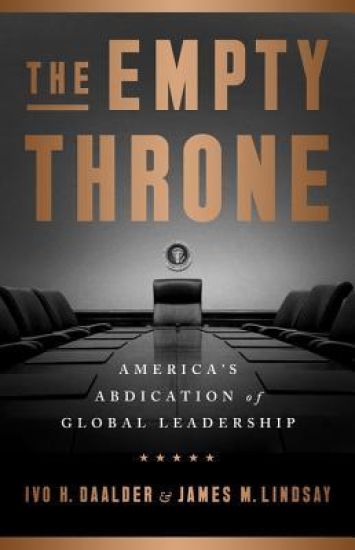
American foreign policy is adrift. For seventy years, the world order that the United States fashioned out of the ruins of World War II produced unprecedented global stability, prosperity, and democratic consensus. Critics argue that Donald Trump's America First policy threatens this world order. What Trump's staunchest critics fail to realize, though, is this order has been fraying for years. Ivo Daalder, former ambassador to NATO and the president of the Chicago Council on Global Affairs, and James Lindsay, a senior vice president at the Council of Foreign Relations, give us a chilling account of why things are worse than they seem. At its core the U. S.-led world order has been a victim of its own success, well before Trump even campaigned for office. The unprecedented period of peace at the end of the 20th century produced record economic growth. Once poor countries like China, India, and Brazil prospered, and as they grew richer, they increasingly contested both the rules and America's privileged position within the order. At the same time, as the costs grew, many Americans soured on the benefits of global leadership, especially as their own prospects for a better life dimmed. Now that Trump sits in the Oval Office, optimists hope that his advisers will curb Trump's taste for foreign policy disruption. But even if this does occur, neither Trump nor his advisers have a strategy for addressing the fundamental challenge for American foreign policy: how to revitalize the world order on which America's security and prosperity rests. Daalder and Lindsay are sure Trump will damage that order; he may well finish it off for good.
A splendidly illuminating book.--The New York TimesLike it or not, George W. Bush has launched a revolution in American foreign policy. He has redefined how America engages the world, shedding the constraints that friends, allies, and international institutions once imposed on its freedom of action. In America Unbound, Ivo Daalder and James Lindsay caution that the Bush revolution comes with serious risks-and, at some point, we may find that America's friends and allies will refuse to follow his lead, leaving the U. S. unable to achieve its goals. This edition has been extensively revised and updated to include major policy changes and developments since the book's original publication.
A senior fellow in Foreign Policy Studies at the Brookings Institution traces the evolution of George Bush's world view, and the subsequent revolution in foreign policy it sparked in the wake of 9/11--a complete re-alignment of old treaties and alliances that is nevertheless in line with the president's long-standing beliefs on the subject. Reprint.
"George W. Bush has launched a revolution in American foreign policy. He has redefined how America engages the world, shedding the constraints that friends, allies, and international institutions impose on its freedom of action. He has insisted that an America unbound is a more secure America. How did a man once mocked for knowing little about the world come to be a foreign policy revolutionary? In America Unbound, Ivo H. Daalder and James M. Lindsay dismiss claims that neoconservatives have captured the heart and mind of the president. They show that George W. Bush has been no one's puppet. He has been a strong and decisive leader with a coherent worldview that was evident even during the 2000 presidential campaign. Daalder and Lindsay caution that the Bush revolution comes with significant risks. Raw power alone is not enough to preserve and extend America's security and prosperity in the modern world. The United States often needs the help of others to meet the challenges it faces overseas. But Bush's revolutionary impulse has stirred great resentment abroad. At some point, Daalder and Lindsay warn, Bush could find that America's friends and allies refuse to follow his lead. America will then stand alone—a great power unable to achieve its most important goals."
Protecting the American Homeland
Michael E. O'Hanlon; Peter R. Orszag; Ivo H. Daalder
Brookings Institution
2003
nidottu
"A good deal has been done to improve the safety of Americans on their own soil since the attacks of September 11, 2001. Yet there have been numerous setbacks. The Bush administration and Congress wasted at least six months in 2002 due to partisan disagreement over a new budget for homeland security, and as one consequence, resources were slow to reach first responders across the country. Most improvements in homeland security have focused on ""refighting the last war""—improving defenses against attacks similar to those the country has already suffered. Not enough has been done to anticipate possible new kinds of terrorist actions. Policymakers have also focused too much attention on the creation of a department of homeland security—rather than identifying and addressing the kinds of threats to which the country remains vulnerable. While the creation of a cabinet-level agency focusing on homeland security may have merit, the authors of this study argue that the department will not, in and of itself, make Americans safer. To the contrary, the complexity of merging so many disparate agencies threatens to distract Congress and the administration from other, more urgent security efforts. This second edition of Protecting the American Homeland urges policymakers to focus on filling key gaps that remain in the current homeland security effort: identifying better protection for private infrastructure; using information technology to share intelligence and more effectively ""connect the dots"" that could hold hints to possible terrorist tactics; expanding the capacities of the Coast Guard and Customs Service, as well as airline transportation security; dealing with the possible threat of surface-to-air missiles to airliners; and encouraging better coordination among intelligence agencies. While acknowledging the impossibility of preventing every possible type of terrorist violence, the authors recommend a more systematic approach to homeland security that focuses on preventing attacks that can cause large numbers of casualties, massive economic or societal disruption, or severe political harm to the nation."

"After eleven weeks of bombing in the spring of 1999, the United States and NATO ultimately won the war in Kosovo. Serbian troops were forced to withdraw, enabling an international military and political presence to take charge in the region. But was this war inevitable or was it the product of failed western diplomacy prior to the conflict? And once it became necessary to use force, did NATO adopt a sound strategy to achieve its aims of stabilizing Kosovo? In this first in-depth study of the Kosovo crisis, Ivo Daalder and Michael O'Hanlon answer these and other questions about the causes, conduct, and consequences of the war. Based on interviews with many of the key participants, they conclude that notwithstanding important diplomatic mistakes before the conflict, it would have been difficult to avoid the Kosovo war. That being the case, U. S. and NATO conduct of the war left much to be desired. For more than four weeks, the Serbs succeeded where NATO failed, forcefully changing Kosovo's ethnic balance by forcing 1.5 million Albanians from their home and more than 800,000 from the country. Had they chosen to massacre more of their victims, NATO would have been powerless to stop them. In the end, NATO won the war by increasing the scope and intensity of bombing, making serious plans for a ground invasion, and moving diplomacy into full gear in order to convince Belgrade that this was a war Serbia would never win. The Kosovo crisis is a cautionary tale for those who believe force can be used easily and in limited increments to stop genocide, mass killing, and the forceful expulsion of entire populations. Daalder and O'Hanlon conclude that the crisis holds important diplomatic and military lessons that must be learned so that others in the future might avoid the mistakes that were made in this case."
"For over four years, Washington responded to war in Bosnia by handing the problem to the Europeans to resolve and substituting high-minded rhetoric for concerted action. Then, in the summer of 1995, the Clinton administration suddenly shifted course, deciding to assert the leadership that would prove necessary to end the war in Bosnia. This book—based on numerous interviews with key participants in the decisionmaking process and written by a former National Security Council aide—examines how the policy to end the war took shape. Getting to Dayton is a powerful case study of how determined individuals can exploit their positions to change U. S. government policy on crucial issues. In so doing, Daalder not only explains how Washington launched the diplomacy that culminated at Dayton, but also why the subsequent peace proved to be difficult to establish. Ivo H. Daalder is a senior fellow at the Brookings Institution. From 1995 to 1996 he served on the National Security Council staff as Director for European Affairs, where he was responsible for coordinating U. S. policy for Bosnia. His most recent publications include The United States and Europe in the Global Arena (1998) and Bosnia After SFOR: Options for Continued U. S. Engagement (1997). He is co-author of Winning Ugly: NATO's War to Save Kosovo, which will be published in 2000."