Kirjailija
J. D. Beresford
Kirjat ja teokset yhdessä paikassa: 56 kirjaa, julkaisuja vuosilta 1999–2026, suosituimpiin kuuluu H.G. Wells. Vertaile teosten hintoja ja tarkista saatavuus suomalaisista kirjakaupoista.
Nimi esiintyy myös muodoissa: J D Beresford, J.D. Beresford
56 kirjaa
Kirjojen julkaisuvuodet: 1999–2026.
An imperfect mother. By: J. D. Beresford. / NOVEL /
J. D. Beresford
Createspace Independent Publishing Platform
2018
nidottu
John Davys Beresford (17 March 1873 - 1 February 1947) was an English writer, now remembered for his early science fiction and some short stories in the horror story and ghost story genres. Beresford was a great admirer of H. G. Wells, and wrote the first critical study of Wells in 1915. His Wellsian novel The Hampdenshire Wonder was a major influence on Olaf Stapledon. His other science-fiction novels include The Riddle of the Tower, about a dystopian, hive-like society. His father was a clergyman in Castor, now in Cambridgeshire near Peterborough. J. D. Beresford was affected by infantile paralysis, which left him partially disabled. He was educated at Oundle. After training to become an architect, he became a professional writer, first as a dramatist, and journalist. In early adulthood he broke away from his father's views and became a "determined but defensive" agnostic. He combined a prominent place in Edwardian literary London with time spent in the provinces, in particular Cornwall where D. H. Lawrence had an extended stay in his Porthcothan cottage. Later in life Beresford abandoned his earlier agnosticism and described himself as a Theosophist and a pacifist. Beresford was also interested in psychology, and attended several meetings organised by A. R. Orage to discuss psychological issues. Other attendees at these meetings included Havelock Ellis, Clifford Sharp, David Eder and Maurice Nicoll. Beresford also contributed to numerous publications; in addition to being a book reviewer for The Manchester Guardian, he also wrote for the New Statesman, The Spectator, Westminster Gazette, and the Theosophist magazine The Aryan Path. At one point, Beresford was offered the editorship of the pacifist magazine Peace News but declined because he felt he "would be a bad editor". Beresford's interest in the spiritual and philosophical may be best illustrated by the publisher notes to his novel, On A Huge Hill:

Nineteen impressions. By: J. D. Beresford. / STORIES /
J. D. Beresford
Createspace Independent Publishing Platform
2018
nidottu
John Davys Beresford (17 March 1873 - 1 February 1947) was an English writer, now remembered for his early science fiction and some short stories in the horror story and ghost story genres. Beresford was a great admirer of H. G. Wells, and wrote the first critical study of Wells in 1915. His Wellsian novel The Hampdenshire Wonder was a major influence on Olaf Stapledon. His other science-fiction novels include The Riddle of the Tower, about a dystopian, hive-like society. His father was a clergyman in Castor, now in Cambridgeshire near Peterborough. J. D. Beresford was affected by infantile paralysis, which left him partially disabled. He was educated at Oundle. After training to become an architect, he became a professional writer, first as a dramatist, and journalist. In early adulthood he broke away from his father's views and became a "determined but defensive" agnostic. He combined a prominent place in Edwardian literary London with time spent in the provinces, in particular Cornwall where D. H. Lawrence had an extended stay in his Porthcothan cottage. Later in life Beresford abandoned his earlier agnosticism and described himself as a Theosophist and a pacifist. Beresford was also interested in psychology, and attended several meetings organised by A. R. Orage to discuss psychological issues. Other attendees at these meetings included Havelock Ellis, Clifford Sharp, David Eder and Maurice Nicoll. Beresford also contributed to numerous publications; in addition to being a book reviewer for The Manchester Guardian, he also wrote for the New Statesman, The Spectator, Westminster Gazette, and the Theosophist magazine The Aryan Path. At one point, Beresford was offered the editorship of the pacifist magazine Peace News but declined because he felt he "would be a bad editor". Beresford's interest in the spiritual and philosophical may be best illustrated by the publisher notes to his novel, On A Huge Hill: "Mr Beresford's readers have long known that that for him there are more things in heaven or earth than are dreamt of in official medical philosophy. He has used his novelist's skill to convince the sensitive reader that the age of miracles is not over, and that, in certain circumstances, the spirit may exercise what seem to us miraculous powers over the substance of the body. This he did in 'The Camberwell Miracle' and 'Peckover'; and in this absorbing novel, he returns to the theme, with the study of a man fitting himself to become a great healer."

Goslings. By: J. D. Beresford. / NOVEL /
J. D. Beresford
Createspace Independent Publishing Platform
2018
nidottu
John Davys Beresford (17 March 1873 - 1 February 1947) was an English writer, now remembered for his early science fiction and some short stories in the horror story and ghost story genres. Beresford was a great admirer of H. G. Wells, and wrote the first critical study of Wells in 1915. His Wellsian novel The Hampdenshire Wonder was a major influence on Olaf Stapledon. His other science-fiction novels include The Riddle of the Tower, about a dystopian, hive-like society. His father was a clergyman in Castor, now in Cambridgeshire near Peterborough. J. D. Beresford was affected by infantile paralysis, which left him partially disabled. He was educated at Oundle. After training to become an architect, he became a professional writer, first as a dramatist, and journalist. In early adulthood he broke away from his father's views and became a "determined but defensive" agnostic. He combined a prominent place in Edwardian literary London with time spent in the provinces, in particular Cornwall where D. H. Lawrence had an extended stay in his Porthcothan cottage. Later in life Beresford abandoned his earlier agnosticism and described himself as a Theosophist and a pacifist. Beresford was also interested in psychology, and attended several meetings organised by A. R. Orage to discuss psychological issues. Other attendees at these meetings included Havelock Ellis, Clifford Sharp, David Eder and Maurice Nicoll. Beresford also contributed to numerous publications; in addition to being a book reviewer for The Manchester Guardian, he also wrote for the New Statesman, The Spectator, Westminster Gazette, and the Theosophist magazine The Aryan Path. At one point, Beresford was offered the editorship of the pacifist magazine Peace News but declined because he felt he "would be a bad editor."

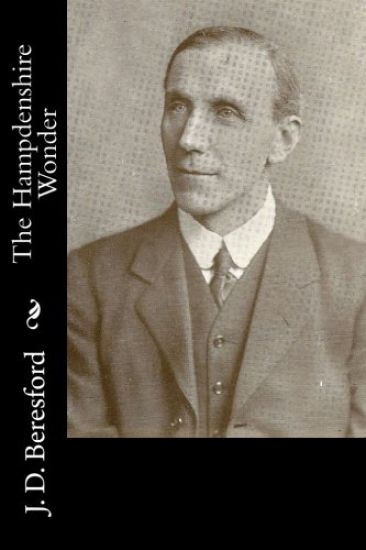
The Hampdenshire wonder. By: J.D. Beresford. / science fiction NOVEL /
J. D. Beresford
Createspace Independent Publishing Platform
2018
nidottu
The Hampdenshire Wonder is a 1911 science fiction novel by J. D. Beresford. It is one of the first novels to involve a wunderkind. The child in it, Victor Stott, is the son of a famous cricket player. This origin is perhaps a reference to H. G. Wells's father Joseph Wells. The novel concerns his progress from infant to almost preternaturally brilliant child. Victor Stott is subtly deformed to allow for his powerful brain. One prominent, and unpleasant, character is the local minister. As J. D. Beresford's father was a minister, and Beresford was himself partially disabled, some see autobiographical aspects to the story. However this is unproven. What is more concrete is that the story of Christian Friedrich Heinecken was an inspiration for the story. Whether the biography of that child prodigy was accurate or not, "the Lubeck prodigy" is mentioned in the work. Also, in the original version, the ideas of Henri Bergson on evolution are also significant.
The early history of Jacob Stahl. By: J. D. Beresford. / the first of a trilogy of novels with A Candidate for Truth and The Invisible Event /
J. D. Beresford
Createspace Independent Publishing Platform
2018
nidottu
John Davys Beresford (17 March 1873 - 1 February 1947) was an English writer, now remembered for his early science fiction and some short stories in the horror story and ghost story genres. Beresford was a great admirer of H. G. Wells, and wrote the first critical study of Wells in 1915. His Wellsian novel The Hampdenshire Wonder was a major influence on Olaf Stapledon. His other science-fiction novels include The Riddle of the Tower, about a dystopian, hive-like society. His father was a clergyman in Castor, now in Cambridgeshire near Peterborough. J. D. Beresford was affected by infantile paralysis, which left him partially disabled. He was educated at Oundle. After training to become an architect, he became a professional writer, first as a dramatist, and journalist. In early adulthood he broke away from his father's views and became a "determined but defensive" agnostic. He combined a prominent place in Edwardian literary London with time spent in the provinces, in particular Cornwall where D. H. Lawrence had an extended stay in his Porthcothan cottage. Later in life Beresford abandoned his earlier agnosticism and described himself as a Theosophist and a pacifist. Beresford was also interested in psychology, and attended several meetings organised by A. R. Orage to discuss psychological issues. Other attendees at these meetings included Havelock Ellis, Clifford Sharp, David Eder and Maurice Nicoll. Beresford also contributed to numerous publications; in addition to being a book reviewer for The Manchester Guardian, he also wrote for the New Statesman, The Spectator, Westminster Gazette, and the Theosophist magazine The Aryan Path. At one point, Beresford was offered the editorship of the pacifist magazine Peace News but declined because he felt he "would be a bad editor".

God's counterpoint. By: J. D. Beresford. / NOVEL /
J. D. Beresford
Createspace Independent Publishing Platform
2018
nidottu
John Davys Beresford (17 March 1873 - 1 February 1947) was an English writer, now remembered for his early science fiction and some short stories in the horror story and ghost story genres. Beresford was a great admirer of H. G. Wells, and wrote the first critical study of Wells in 1915. His Wellsian novel The Hampdenshire Wonder was a major influence on Olaf Stapledon. His other science-fiction novels include The Riddle of the Tower, about a dystopian, hive-like society. His father was a clergyman in Castor, now in Cambridgeshire near Peterborough. J. D. Beresford was affected by infantile paralysis, which left him partially disabled. He was educated at Oundle. After training to become an architect, he became a professional writer, first as a dramatist, and journalist. In early adulthood he broke away from his father's views and became a "determined but defensive" agnostic. He combined a prominent place in Edwardian literary London with time spent in the provinces, in particular Cornwall where D. H. Lawrence had an extended stay in his Porthcothan cottage. Later in life Beresford abandoned his earlier agnosticism and described himself as a Theosophist and a pacifist. Beresford was also interested in psychology, and attended several meetings organised by A. R. Orage to discuss psychological issues. Other attendees at these meetings included Havelock Ellis, Clifford Sharp, David Eder and Maurice Nicoll. Beresford also contributed to numerous publications; in addition to being a book reviewer for The Manchester Guardian, he also wrote for the New Statesman, The Spectator, Westminster Gazette, and the Theosophist magazine The Aryan Path. At one point, Beresford was offered the editorship of the pacifist magazine Peace News but declined because he felt he "would be a bad editor." Beresford's interest in the spiritual and philosophical may be best illustrated by the publisher notes to his novel, On A Huge Hill:

The house in Demetrius Road. / NOVEL / By: J. D. Beresford
J. D. Beresford
Createspace Independent Publishing Platform
2018
nidottu
John Davys Beresford (17 March 1873 - 1 February 1947) was an English writer, now remembered for his early science fiction and some short stories in the horror story and ghost story genres. Beresford was a great admirer of H. G. Wells, and wrote the first critical study of Wells in 1915. His Wellsian novel The Hampdenshire Wonder was a major influence on Olaf Stapledon. His other science-fiction novels include The Riddle of the Tower, about a dystopian, hive-like society. His father was a clergyman in Castor, now in Cambridgeshire near Peterborough. J. D. Beresford was affected by infantile paralysis, which left him partially disabled. He was educated at Oundle. After training to become an architect, he became a professional writer, first as a dramatist, and journalist. In early adulthood he broke away from his father's views and became a "determined but defensive" agnostic. He combined a prominent place in Edwardian literary London with time spent in the provinces, in particular Cornwall where D. H. Lawrence had an extended stay in his Porthcothan cottage. Later in life Beresford abandoned his earlier agnosticism and described himself as a Theosophist and a pacifist. Beresford was also interested in psychology, and attended several meetings organised by A. R. Orage to discuss psychological issues. Other attendees at these meetings included Havelock Ellis, Clifford Sharp, David Eder and Maurice Nicoll. Beresford also contributed to numerous publications; in addition to being a book reviewer for The Manchester Guardian, he also wrote for the New Statesman, 8] The Spectator, Westminster Gazette, and the Theosophist magazine The Aryan Path. At one point, Beresford was offered the editorship of the pacifist magazine Peace News but declined because he felt he "would be a bad editor". Beresford's interest in the spiritual and philosophical may be best illustrated by the publisher notes to his novel, On A Huge Hill: "Mr Beresford's readers have long known that that for him there are more things in heaven or earth than are dreamt of in official medical philosophy. He has used his novelist's skill to convince the sensitive reader that the age of miracles is not over, and that, in certain circumstances, the spirit may exercise what seem to us miraculous powers over the substance of the body. This he did in 'The Camberwell Miracle' and 'Peckover'; and in this absorbing novel, he returns to the theme, with the study of a man fitting himself to become a great healer."
The invisible event. By: J. D. Beresford. / NOVEL /
J. D. Beresford
Createspace Independent Publishing Platform
2018
nidottu
John Davys Beresford (17 March 1873 - 1 February 1947) was an English writer, now remembered for his early science fiction and some short stories in the horror story and ghost story genres. Beresford was a great admirer of H. G. Wells, and wrote the first critical study of Wells in 1915. His Wellsian novel The Hampdenshire Wonder was a major influence on Olaf Stapledon. His other science-fiction novels include The Riddle of the Tower, about a dystopian, hive-like society. His father was a clergyman in Castor, now in Cambridgeshire near Peterborough. J. D. Beresford was affected by infantile paralysis, which left him partially disabled. He was educated at Oundle. After training to become an architect, he became a professional writer, first as a dramatist, and journalist. In early adulthood he broke away from his father's views and became a "determined but defensive" agnostic. He combined a prominent place in Edwardian literary London with time spent in the provinces, in particular Cornwall where D. H. Lawrence had an extended stay in his Porthcothan cottage. Later in life Beresford abandoned his earlier agnosticism and described himself as a Theosophist and a pacifist. Beresford was also interested in psychology, and attended several meetings organised by A. R. Orage to discuss psychological issues. Other attendees at these meetings included Havelock Ellis, Clifford Sharp, David Eder and Maurice Nicoll. Beresford also contributed to numerous publications; in addition to being a book reviewer for The Manchester Guardian, he also wrote for the New Statesman, The Spectator, Westminster Gazette, and the Theosophist magazine The Aryan Path. At one point, Beresford was offered the editorship of the pacifist magazine Peace News but declined because he felt he "would be a bad editor". Beresford's interest in the spiritual and philosophical may be best illustrated by the publisher notes to his novel, On A Huge Hill:
I COULD not say at which station the woman and her baby entered the train. Since we had left London I had been engrossed in Henri Bergson's Time and Free Will, as it is called in the English translation. I had been conscious of various stoppages and changes of passengers, but my attention had been held by Bergson's argument. I agreed with his conclusion in advance, but I wished to master his reasoning. I looked up when the woman entered my compartment, though I did not notice the name of the station. I caught sight of the baby she was carrying, and turned back to my book. I thought the child was a freak, an abnormality; and such things disgust me. I returned to the study of my Bergson and read: "It is at the great and solemn crisis, decisive of our reputation with others, that we choose in defiance of what is conventionally called a motive, and this absence of any tangible reason is the more striking the deeper our freedom goes." I kept my eyes on the book-the train had started again-but the next passage conveyed no meaning to my mind, and as I attempted to re-read it an impression was interposed between me and the work I was studying. I saw projected on the page before me an image which I mistook at first for the likeness of Richard Owen. It was the conformation of the head that gave rise to the mistake, a head domed and massive, white and smooth-it was a head that had always interested me. But as I looked, my mind already searching for the reason of this hallucination, I saw that the lower part of the face was that of an infant. My eyes wandered from the book, and my gaze fluttered along the four persons seated opposite to me, till they rested on the reality of my vision. Even as these acts were being performed, I found myself foolishly saying, "I don't call this freedom."
Notice: This Book is published by Historical Books Limited (www.publicdomain.org.uk) as a Public Domain Book, if you have any inquiries, requests or need any help you can just send an email to [email protected] This book is found as a public domain and free book based on various online catalogs, if you think there are any problems regard copyright issues please contact us immediately via [email protected]
Excerpt: ... I was disappointed. I wanted to fight him. I knew now that since the scene I had witnessed in the wood the primitive savage in me had been longing for some excuse to break out in its own primitive, savage way. And once again I was frustrated. I was just too civilised to leap at him without further excuse. He gave me none.