Kirjojen hintavertailu – 12 859 828 kirjaa ja 27 kauppaa

Kirjailija

J. David Richardson

Kirjat ja teokset yhdessä paikassa: 3 kirjaa, julkaisuja vuosilta 1995–2001, suosituimpiin kuuluu Global Competition Policy. Vertaile teosten hintoja ja tarkista saatavuus suomalaisista kirjakaupoista.

3 kirjaa

Kirjojen julkaisuvuodet: 1995–2001.

Why Global Commitment Really Matters!

Why Global Commitment Really Matters!

Howard Lewis Iii; J. David Richardson

The Peterson Institute for International Economics
2001
nidottu
In this study Howard Lewis III and J. David Richardson explore the gains that workers, companies, and communities achieve from choosing to engage with the global economy. Why Global Commitment Really Matters! follows two earlier Institute publications that explored the benefits of exporting. This study summarizes new research on American importing, international investment, and technology transfers that shows similar benefits. All types of global commitment seem to generate greater productivity, higher pay, stronger growth, and better survival rates. These in turn rejuvenate entire industries and their workforces and communities as they allow better firms and jobs to supplant those with less desirable traits. Exports, imports, investment, and technology transfer form a family of global commitments that spawns a family of economic rewards. The study shows that exactly the same patterns are being discovered in similar new research abroad. Little of this new research has made its way into the mainstream of public debate over trade and economic policies. The authors supplement their research survey with profiles of real American exporters, importers, multinational companies, foreign affiliates, and technology partners. They also weigh criticisms and alternative interpretations of the research, and examine the problems of those left on the margins of the global economy.

Global Competition Policy

Global Competition Policy

Edward Graham; J. David Richardson

The Peterson Institute for International Economics
1997
nidottu
There is growing consensus among international trade negotiators and policymakers that a prime area for future multilateral discussion is competition policy. Competition policy includes antitrust policy (including merger regulation and control) but is often extended to include international trade measures and other policies that affect the structure, conduct, and performance of individual industries. This study includes country studies of competition policy in Western Europe, North America, and the Far East (with a focus on Japan) in the light of increasingly globalized activities of business firms. Areas where there are major differences in philosophy, policy, or practice are identified, with emphasis on those differences that could lead to economic costs and international friction. Alternatives for eliminating these costs and frictions are discussed, including unilateral policy changes, bilateral or multilateral harmonization of policies, and creation of new international regimes to supplement or replace national or regional regimes.
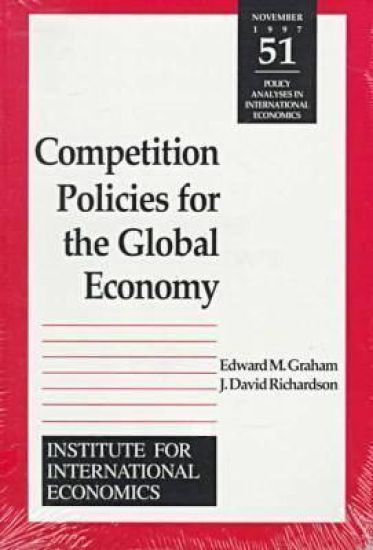
Competition Policies for the Global Economy

Competition Policies for the Global Economy

Edward Graham; J. David Richardson

The Peterson Institute for International Economics
1995
nidottu
As border barriers have declined, private barriers to competition have grown more significant. More and more international trade disputes involve private business practices that allegedly block the market access of rival firms. Such disputes include high profile conflicts between Japan and the United States over semiconductors, auto parts, and photographic film, between the European Union and the United States over aerospace and defense mergers, and between Asian nations and others over access to telecommunications networks. More such disputes are inevitable, especially in sectors that have been traditionally state-controlled but that are now subject to privatization. The regulation of private business practices that restrict competition is called competition (or antitrust) policy. In this book, the authors survey national competition policies and the issues they raise for international trade and investment. The book includes detailed recommendations for international agreement on minimum standards in those competition-policy measures that affect the ability of foreign firms to contest markets. These standards could be negotiated and implemented bilaterally, regionally, and globally at the World Trade Organization. At the international level, governments might agree on certain initial steps to accomplish greater contestability: "national treatment" for foreign-controlled firms, abolition of most international cartels (including those that are now sanctioned), and establishment of mandatory consultation procedures when one government believes that private business practices in another nation foreclose exports or direct investment. There should also be premerger notification requirements for transborder or other mergers having cross-border effects. Further steps might be implemented at a future time.