

Kirjailija
J. G. Fichte
Kirjat ja teokset yhdessä paikassa: 24 kirjaa, julkaisuja vuosilta 1916–2025, suosituimpiin kuuluu The Science of Knowledge. Vertaile teosten hintoja ja tarkista saatavuus suomalaisista kirjakaupoista.
Nimi esiintyy myös muodoissa: J G Fichte, J.G Fichte, J.G. Fichte
24 kirjaa
Kirjojen julkaisuvuodet: 1916–2025.

Reprint of the original, first published in 1868.
Reprint of the original, first published in 1868.
Contribution to the Correction of the Public's Judgments on the French Revolution
J. G. Fichte
State University of New York Press
2021
pokkari
Halvin toimitettuna 46,80 €
First translation into English of Fichte's major work on the French Revolution. The reception history of the French Revolution in France and England is well documented among Anglophone scholars; however, the debate over the Revolution in Germany is much less well known. Fichte's Contribution played an important role in this debate. Presented here for the first time in English, Fichte's work provides a distinctive synthesis of Locke's "possessive individualism," Rousseau's general will, and Kant's moral philosophy. This eclectic blend results in an unusual rights theory that at times veers close to a form of anarchism. Written in 1792–93, just before Fichte moved to Jena to develop his philosophical system in a series of works-above all the Wissenschaftslehre of 1794-the Contribution provides invaluable insight into Fichte's early development. In addition, Fichte's work predates much of Kant's political philosophy, and can shed light on the rich dialogue in German political thought in the 1790s.
Contribution to the Correction of the Public's Judgments on the French Revolution
J. G. Fichte
State University of New York Press
2021
sidottu
First translation into English of Fichte's major work on the French Revolution. The reception history of the French Revolution in France and England is well documented among Anglophone scholars; however, the debate over the Revolution in Germany is much less well known. Fichte's Contribution played an important role in this debate. Presented here for the first time in English, Fichte's work provides a distinctive synthesis of Locke's "possessive individualism," Rousseau's general will, and Kant's moral philosophy. This eclectic blend results in an unusual rights theory that at times veers close to a form of anarchism. Written in 1792–93, just before Fichte moved to Jena to develop his philosophical system in a series of works-above all the Wissenschaftslehre of 1794-the Contribution provides invaluable insight into Fichte's early development. In addition, Fichte's work predates much of Kant's political philosophy, and can shed light on the rich dialogue in German political thought in the 1790s.

This book has been considered by academicians and scholars of great significance and value to literature. This forms a part of the knowledge base for future generations. So that the book is never forgotten we have represented this book in a print format as the same form as it was originally first published. Hence any marks or annotations seen are left intentionally to preserve its true nature.

This book has been considered by academicians and scholars of great significance and value to literature. This forms a part of the knowledge base for future generations. So that the book is never forgotten we have represented this book in a print format as the same form as it was originally first published. Hence any marks or annotations seen are left intentionally to preserve its true nature.

This book is not intended for philosophers by profession, who will find nothing in it that has not been already set forth in other writings of the same author. It ought to be intelligible to all readers who are able generally to understand a book at all. To those who only wish to repeat, in somewhat varied order, certain phrases which they have already learned by rote, and who mistake this business of the memory for understanding, it will probably be found unintelligible. It ought to attract and animate the reader, and to elevate him above the world of sense, to a transcendental region; -- at least the author is conscious that he has not entered upon his task without such inspiration. Often, indeed, the fire with which we commence an undertaking disappears during the toil of execution; and thus, at the conclusion of a work, we are in danger of doing ourselves injustice upon this point. In short, whether the author has succeeded in attaining his object or not, can only be determined by the effect which the work shall produce on the readers to whom it is addressed, -- and in this the author has no voice.
The Vocation of the Scholar & The Vocation of Man
J G Fichte; William Smith
Pertinent Press
2018
sidottu
Lectures on the Theory of Ethics (1812)
J. G. Fichte
State University of New York Press
2016
pokkari
Lectures from the late period of Fichte's career, never before available in English. Translated here for the first time into English, this text furnishes a new window into the final phase of Fichte's career. Delivered in the summer of 1812 at the newly founded University of Berlin, Fichte's lectures on ethics explore some of the key concepts and issues in his evolving system of radical idealism. Addressing moral theory, the theory of education, the philosophy of history, and the philosophy of religion, Fichte engages both directly and indirectly with some of his most important contemporaries and philosophical rivals, including Kant, Schelling, and Hegel. Benjamin D. Crowe's translation includes extensive annotations and a German-English glossary. His introduction situates the text systematically, historically, and institutionally within an era of cultural ferment and intellectual experimentation, and includes a bibliography of recent scholarship on Fichte's moral theory and on the final period of his career.
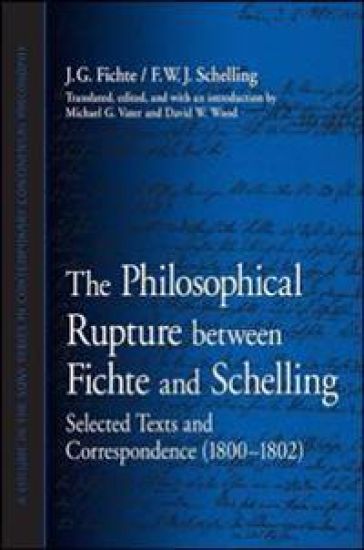
The Philosophical Rupture between Fichte and Schelling
J. G. Fichte; F. W. J. Schelling
State University of New York Press
2013
pokkari
Correspondence and texts by Fichte and Schelling illuminate their thought and the trajectory of their philosophical falling out. The disputes of philosophers provide a place to view their positions and arguments in a tightly focused way, and also in a manner that is infused with human temperaments and passions. Fichte and Schelling had been perceived as "partners" in the cause of Criticism or transcendental idealism since 1794, but upon Fichte's departure from Jena in 1799, each began to perceive a drift in their fundamental interests and allegiances. Schelling's philosophy of nature seemed to move him toward a realistic philosophy, while Fichte's interests in the origin of personal consciousness, intersubjectivity, and the ultimate determination of the agent's moral will moved him to explore what he called "faith" in one popular text, or a theory of an intelligible world. This volume brings together the letters the two philosophers exchanged between 1800 and 1802 and the texts that each penned with the other in mind.
Jugement de M. de Schelling Sur La Philosophie de M. Cousin
Friedrich Wilhelm Joseph Schelling; J. Willm; J. G. Fichte
KESSINGER PUBLISHING, LLC
2010
pokkari
New Exposition Of The Science Of Knowledge (1869)
J. G. Fichte
KESSINGER PUBLISHING, LLC
2008
sidottu

New Exposition Of The Science Of Knowledge
J. G. Fichte; A. E. (TRN) Kroeger
Kessinger Pub
2007
pokkari
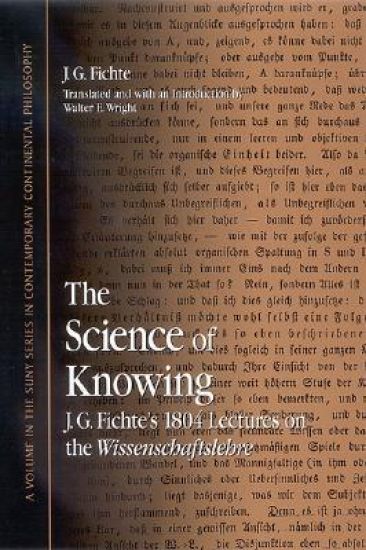
The first English translation of Fichte's second set of 1804 lectures on the Wissenschaftslehre. Considered by some to be his most important text, this series of lectures given by Johann Gottlieb Fichte (1762–1814) at his home in Berlin in 1804 is widely regarded as the most perspicuous presentation of his fundamental philosophy. Now available in English, this translation provides in striking and original language Fichte's exploration of the transcendental foundations of experience and knowing in ways that go beyond Kant and Reinhold and charts a promising, novel pathway for German Idealism. Through a close examination of this work one can see that Fichte's thought is much more than a way station between Kant and Hegel, thus making the case for Fichte's independent philosophical importance. The text is divided into two parts: a doctrine of truth or reason, and a doctrine of appearance. A central feature of the text is its performative dimension. Philosophy, for Fichte, is something we enact rather than any discursively expressible object of awareness; a philosophical truth is not expressible as a set of propositions but is a spontaneous inwardly occurring realization. Therefore, he always regards the expression of philosophy in words as strategic, aiming to ignite philosophy's essentially inward process and to arouse the event of philosophical insight. The new translation contains a German-English glossary and an extensive introduction and notes by the translator.
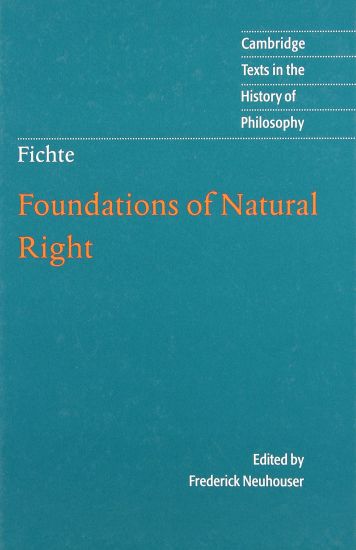
Foundations of Natural Right
J. G. Fichte
Cambridge University Press
2000
pokkari
Halvin toimitettuna 56,10 €
In the history of philosophy, Fichte’s thought marks a crucial transitional stage between Kant and post-Kantian philosophy. Fichte radicalized Kant’s thought by arguing that human freedom, not external reality, must be the starting point of all systematic philosophy, and in Foundations of Natural Right, thought by many to be his most important work of political philosophy, he applies his ideas to fundamental issues in political and legal philosophy, covering such topics as civic freedom, rights, private property, contracts, family relations, and the foundations of modern political organization. This volume offers the first complete translation of the work into English, by Michael Baur, together with an introduction by Frederick Neuhouser that sets it in its philosophical and historical context.
In the history of philosophy, Fichte's thought marks a crucial transitional stage between Kant and post-Kantian philosophy. Fichte radicalized Kant's thought by arguing that human freedom, not external reality, must be the starting point of all systematic philosophy, and in Foundations of Natural Right, thought by many to be his most important work of political philosophy, he applies his ideas to fundamental issues in political and legal philosophy, covering such topics as civic freedom, rights, private property, contracts, family relations, and the foundations of modern political organization. This volume offers a complete translation of the work into English, by Michael Baur, together with an introduction by Frederick Neuhouser that sets it in its philosophical and historical context.