Kirjojen hintavertailu – 12 903 725 kirjaa ja 27 kauppaa

Kirjailija

J. Hillis Miller

Kirjat ja teokset yhdessä paikassa: 37 kirjaa, julkaisuja vuosilta 1990–2022, suosituimpiin kuuluu Medium is the Maker. Vertaile teosten hintoja ja tarkista saatavuus suomalaisista kirjakaupoista.

Nimi esiintyy myös muodoissa: J Hillis Miller

37 kirjaa

Kirjojen julkaisuvuodet: 1990–2022.

The Conflagration of Community

The Conflagration of Community

J. Hillis Miller

University of Chicago Press
2011
sidottu
"After Auschwitz to write even a single poem is barbaric." "The Conflagration of Community" challenges Theodor Adorno's famous statement about aesthetic production after "The Holocaust", arguing for the possibility of literature to bear witness to extreme collective and personal experiences. J. Hillis Miller considers how novels about the Holocaust relate to fictions written before and after it, and uses theories of community from Jean-Luc Nancy and Derrida to explore the dissolution of community bonds in its wake. Miller juxtaposes readings of books about "the Holocaust" - Keneally's Schindler's "List", McEwan's "Black Dogs", Spiegelman's "Maus", and Kertesz's "Fatelessness" - with Kafka's novels and Morrison's "Beloved", asking what it means to think of texts as acts of testimony. Throughout, Miller questions the resonance between the difficulty of imagining, understanding, or remembering Auschwitz - a difficulty so often a theme in records of the Holocaust - and the exasperating resistance to clear, conclusive interpretation of these novels. "The Conflagration of Community" is an eloquent study of literature's value to fathoming the unfathomable.
For Derrida

For Derrida

J. Hillis Miller

Fordham University Press
2009
pokkari
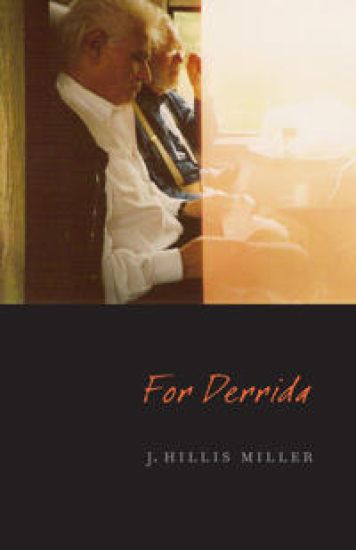
This book—the culmination of forty years of friendship between J. Hillis Miller and Jacques Derrida, during which Miller also closely followed all Derrida's writings and seminars—is "for Derrida" in two senses. It is "for him," dedicated to his memory. The chapters also speak, in acts of reading, as advocates for Derrida's work. They focus especially on Derrida's late work, including passages from the last, as yet unpublished, seminars. The chapters are "partial to Derrida," on his side, taking his part, gratefully submitting themselves to the demand made by Derrida's writings to be read—slowly, carefully, faithfully, with close attention to semantic detail. The chapters do not progress forward to tell a sequential story. They are, rather, a series of perspectives on the heterogeneity of Derrida's work, or forays into that heterogeneity. The chief goal has been, to borrow a phrase from Wallace Stevens, "plainly to propound" what Derrida says. The book aims, above all, to render Derrida's writings justice. It should be remembered, however, that, according to Derrida himself, every rendering of justice is also a transformative interpretation. A book like this one is not a substitute for reading Derrida for oneself. It is to be hoped that it will encourage readers to do just that.
For Derrida

For Derrida

J. Hillis Miller

Fordham University Press
2009
sidottu
This book—the culmination of forty years of friendship between J. Hillis Miller and Jacques Derrida, during which Miller also closely followed all Derrida's writings and seminars—is "for Derrida" in two senses. It is "for him," dedicated to his memory. The chapters also speak, in acts of reading, as advocates for Derrida's work. They focus especially on Derrida's late work, including passages from the last, as yet unpublished, seminars. The chapters are "partial to Derrida," on his side, taking his part, gratefully submitting themselves to the demand made by Derrida's writings to be read—slowly, carefully, faithfully, with close attention to semantic detail. The chapters do not progress forward to tell a sequential story. They are, rather, a series of perspectives on the heterogeneity of Derrida's work, or forays into that heterogeneity. The chief goal has been, to borrow a phrase from Wallace Stevens, "plainly to propound" what Derrida says. The book aims, above all, to render Derrida's writings justice. It should be remembered, however, that, according to Derrida himself, every rendering of justice is also a transformative interpretation. A book like this one is not a substitute for reading Derrida for oneself. It is to be hoped that it will encourage readers to do just that.
Medium is the Maker

Medium is the Maker

J. Hillis Miller

LIVERPOOL UNIVERSITY PRESS
2009
nidottu
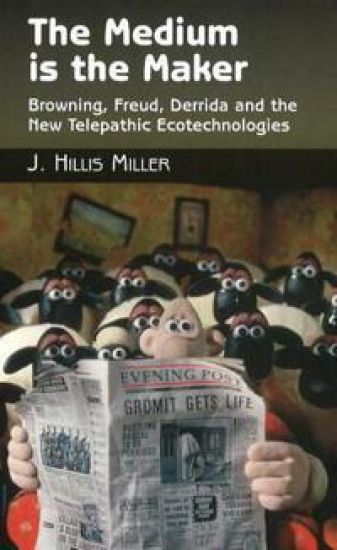
This book sets out to provide a new understanding of the nexus between the literary world and contemporary communication (iPhone et al.) in all its facets -- not Marshall McLuhan's "The medium is the message", but a new formula: "The medium is the maker". In this exploration of the medium -- traditional, modern, post-modern -- Miller engages with Browning, Freud, and Derrida to provide a platform of personal discovery and literary enlightenment (at times solemn, ironic, comic, and occasionally devastating).
Literature As Conduct

Literature As Conduct

J. Hillis Miller

Fordham University Press
2005
sidottu
The work of a master critic writing at the peak of his powers, this magisterial book draws on speech act theory, as it originated with J. L. Austin and was further developed by Paul de Man and Jacques Derrida, to investigate the many dimensions of doing things with words in James's fiction. Three modes of speech act occur in James's novels. First, James's writing of his fictions is performative. He puts on paper words that have the power to raise in the reader the phantoms of imaginary persons. Second, James's writing does things with words that do other things in their turn, including conferring on the reader responsibility for further judgment and action: for example, teaching James's novels or writing about them. Finally, the narrators and characters in James's fictions utter speech acts that are forms of doing things with words— promises, declarations, excuses, denials, acts of bearing witness, lies, decisions publicly attested, and the like. The action of each work by James, he shows, is brought about by its own idiosyncratic repertoire of speech acts. In careful readings of six major examples, "The Aspern Papers," The Portrait of a Lady, The Awkward Age, The Wings of the Dove, The Golden Bowl, and The Sense of the Past, Miller demonstrates the value of speech act theory for reading literature.
Literature As Conduct

Literature As Conduct

J. Hillis Miller

Fordham University Press
2005
pokkari
The work of a master critic writing at the peak of his powers, this magisterial book draws on speech act theory, as it originated with J. L. Austin and was further developed by Paul de Man and Jacques Derrida, to investigate the many dimensions of doing things with words in James's fiction. Three modes of speech act occur in James's novels. First, James's writing of his fictions is performative. He puts on paper words that have the power to raise in the reader the phantoms of imaginary persons. Second, James's writing does things with words that do other things in their turn, including conferring on the reader responsibility for further judgment and action: for example, teaching James's novels or writing about them. Finally, the narrators and characters in James's fictions utter speech acts that are forms of doing things with words— promises, declarations, excuses, denials, acts of bearing witness, lies, decisions publicly attested, and the like. The action of each work by James, he shows, is brought about by its own idiosyncratic repertoire of speech acts. In careful readings of six major examples, "The Aspern Papers," The Portrait of a Lady, The Awkward Age, The Wings of the Dove, The Golden Bowl, and The Sense of the Past, Miller demonstrates the value of speech act theory for reading literature.
Speech Acts in Literature

Speech Acts in Literature

J. Hillis Miller

Stanford University Press
2002
sidottu
This book demonstrates the presence of literature within speech act theory and the utility of speech act theory in reading literary works. Though the founding text of speech act theory, J. L. Austin's How to Do Things with Words, repeatedly expels literature from the domain of felicitous speech acts, literature is an indispensable presence within Austin's book. It contains many literary references but also uses as essential tools literary devices of its own: imaginary stories that serve as examples and imaginary dialogues that forestall potential objections. How to Do Things with Words is not the triumphant establishment of a fully elaborated theory of speech acts, but the story of a failure to do that, the story of what Austin calls a "bogging down." After an introductory chapter that explores Austin's book in detail, the two following chapters show how Jacques Derrida and Paul de Man in different ways challenge Austin's speech act theory generally and his expulsion of literature specifically. Derrida shows that literature cannot be expelled from speech acts—rather that what he calls "iterability" means that any speech act may be literature. De Man asserts that speech act theory involves a radical dissociation between the cognitive and positing dimensions of language, what Austin calls language's "constative" and "performative" aspects. Both Derrida and de Man elaborate new speech act theories that form the basis of new notions of responsible and effective politico-ethical decision and action. The fourth chapter explores the role of strong emotion in effective speech acts through a discussion of passages in Derrida, Wittgenstein, and Austin. The final chapter demonstrates, through close readings of three passages in Proust, the way speech act theory can be employed in an illuminating way in the accurate reading of literary works.
On Literature

On Literature

J. Hillis Miller

Routledge
2002
nidottu
Debates rage over what kind of literature we should read, what is good and bad literature, and whether in the global, digital age, literature even has a future. But what exactly is literature? Why should we read literature? How do we read literature? These are some of the important questions J. Hillis Miller answers in this beautifully written and passionate book. He begins by asking what literature is, arguing that the answer lies in literature's ability to create an imaginary world simply with words. On Literature also asks the crucial question of why literature has such authority over us. Returning to Plato, Aristotle and the Bible, Miller argues we should continue to read literature because it is part of our basic human need to create imaginary worlds and to have stories. Above all, On Literature is a plea that we continue to read and care about literature.
On Literature

On Literature

J. Hillis Miller

Routledge
2002
sidottu
Debates rage over what kind of literature we should read, what is good and bad literature, and whether in the global, digital age, literature even has a future. But what exactly is literature? Why should we read literature? How do we read literature? These are some of the important questions J. Hillis Miller answers in this beautifully written and passionate book. He begins by asking what literature is, arguing that the answer lies in literature's ability to create an imaginary world simply with words. On Literature also asks the crucial question of why literature has such authority over us. Returning to Plato, Aristotle and the Bible, Miller argues we should continue to read literature because it is part of our basic human need to create imaginary worlds and to have stories. Above all, On Literature is a plea that we continue to read and care about literature.
The Disappearance of God

The Disappearance of God

J. Hillis Miller

University of Illinois Press
2000
nidottu
A landmark work of literary criticism by one of the foremost interpreters of nineteenth-century England, The Disappearance of God confronts the consciousness of an absent (though perhaps still existent) God in the writings of Thomas De Quincey, Robert Browning, Emily Brontë, Matthew Arnold, and Gerard Manley Hopkins. J. Hillis Miller surveys the intellectual and material developments that conspired to cut man off from God--among other factors the city, developments within Christianity, subjectivism, and the emergence of the modern historical sense--and shows how each writer's body of work reflects a sustained response to the experience of God's disappearance.
Black Holes / J. Hillis Miller; or, Boustrophedonic Reading

Black Holes / J. Hillis Miller; or, Boustrophedonic Reading

J. Hillis Miller; Manuel Asensi

Stanford University Press
1999
sidottu
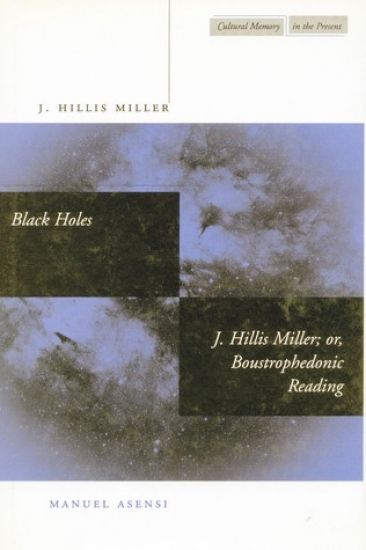
This innovative work sets two texts by two different authors on facing pages, designed so that they read in tandem—Miller's text on the right, Asensi's on the left. It makes a long trajectory, moving back and forth as an ox plows a field, boustrophedonically, to borrow the figure in Manuel Asensi's title. Black Holes, by J. Hillis Miller, analyzes changes in the contemporary research university in the West. The mission of the research university has been profoundly influenced by the end of the Cold War and by globalization, advances in communication technologies, and shifts in funding from the federal government to transnational corporations. Miller aims to discover what the function of the humanities might be in this new kind of university. Echoing Bill Readings, he calls for a university of dissensus that would be made up of adjacent or overlapping communities, each fundamentally other to the others, each inhabited by its own otherness. Each of those opacities is a kind of black hole in the luminosity or enlightenment to which the university has traditionally been dedicated. Miller concludes with sections on Trollope and Proust that attempt to show how otherness is exemplified in the work of two fundamentally dissimilar authors. Manuel Asensi's J. Hillis Miller: or, Boustrophedonic Reading is the first comprehensive interpretation of Miller's work, one that foregrounds its difference not only from the work of his associates—such as Paul de Man, Jacques Derrida, and Georges Poulet—but from European literary methodologies such as semiotics, Slavic formalism, Glosematics, narratology, structuralism, and reception theory. Bypassing or challenging conventional accounts of Miller's work, Asensi brings a fresh view to his readings of Miller's criticism. He finds there a complex and partially contradictory "matrix" that persists, throughout the apparent methodological changes, from Miller's earliest work to the most recent. According to Asensi, that matrix organizes itself around a fascination with the strangeness or otherness of literary works.
Ariadne's Thread

Ariadne's Thread

J. Hillis Miller

Yale University Press
1995
pokkari
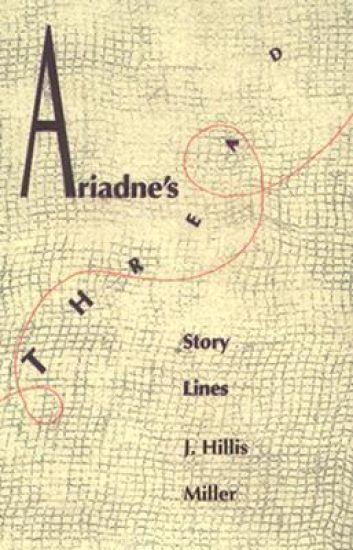
"What line should the critic follow in explicating, unfolding, or unknotting . . . passages? How should the critic thread her or his way into the labyrinthine problems of narrative form?—from chapter I In this brilliant and engaging book, one of America's leading literary critics explores the intricacies of narrative theory. Using the image of Ariadne's thread, which was given to Theseus to carry into the labyrinth so that he could find his way out, J. Hillis Miller traces out the "line" so often associated with narrative and writing in general. In the process he illuminates the nature of literature as well as the nature of narrative. Considering a wide range of texts from Western literature over the last two centuries—in particular Meredith's The Egoist, Goethe's Elective Affinities, and Borges's "Death and the Compass"—Miller explores the way rhetorical devices and figurative language interrupt, break into, delay, and expand storytelling. He also illustrates these rhetorical disruptions of narrative logic in his own work. In its four chapters—about the role of line, character, interpersonal relationships, and figurative language in narrative—Miller's study encounters in its own language the problems it discusses, as concepts and words are scrutinized for their diverse meanings and resonances. Demonstrating that every narrative, including this one about the nature of narrative, has divergent lines and multiple motives and uses, Ariadne's Thread tells its story and enacts its subject at the same time.
Illustration Pb

Illustration Pb

J. Hillis Miller

Reaktion Books
1992
nidottu
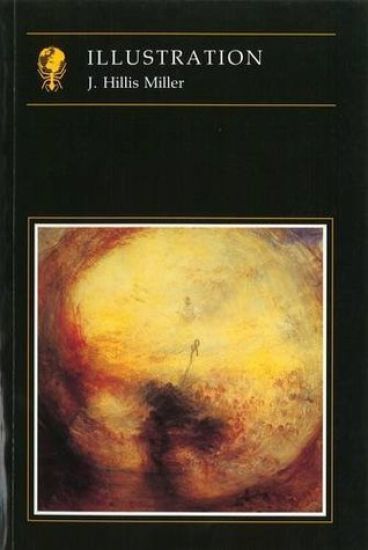
In this rich and illuminating book, the celebrated literary critic J. Hillis Miller turns to a crucial topic in visual culture: that of the relationship between word and image in paintings, prints, illustrated novels and other forms of art and literature. Mark Twain, John Ruskin, Henry James and Walter Benjamin are among the writers and thinkers whose challenging comments the author engages for his own examination of text and image, which includes Hans Holbein's woodcuts, Phiz's illustrations to Dickens' novels and Turner's exploration of the sight and power of the sun in his sublime later paintings. According to J. Millis Miller, forms of art and literature in which words and pictures are combined contain a power that necessarily alters the world we perceive, rather than merely supplying reflections of it. This conviction is embedded in a larger argument that concerns the direction cultural studies must take if they are to avoid reinforcing the social and political hegemonies they seek to challenge.
Tropes, Parables, and Performatives

Tropes, Parables, and Performatives

J. Hillis Miller

Duke University Press
1991
sidottu
Tropes, Parables, Performatives collects J. Hillis Miller’s essays on seven major twentieth-century authors: Lawrence, Kafka, Stevens, Williams, Woolf, Hardy, and Conrad. For all their evident differences, these essays from early to late explore a single intuition about literature, which may be framed by three words: “trope,” “parable,” and “performative.” Throughout these essays Miller is fascinated with the tropological dimension of literary language, with the way figures of speech turn aside the telling of a story or the presentation of a literary theme. The exploration of this turning leads to the recognition that all works of literature are parabolic, “thrown beside” their real meaning. They tell one story but call forth something else. Miller further agrees that all parables are fundamentally performative. They do not merely name something or give knowledge, but rather use words to make something happen, to get the reader from here to there. Each essay here attempts to formulate what, in a given case, the reader perfomatively enters by way of parabolic trope.
Theory Now and Then

Theory Now and Then

J. Hillis Miller

Duke University Press
1991
sidottu
Theory Now and Then contains the more overtly theoretical essays by J. Hillis Miller published between 1966 and 1989. These essays trace the trajectory of theory over the last thirty years in the United States: from the “Continental Shift” announced in the Yale Colloquium of 1965, through Miller’s assimilation of the work of the Geneva Critics, to the shift to that “deconstruction in America” in which Miller played a conspicuous role. Included here are review essays on other theorists’ work: the Geneva Circle including Georges Poulet; Joseph Riddel, Edward Said, Meyer Abrams; and the critics of the “Yale School,” such as Jacques Derrida and others, Paul De Man, Geoffrey Hartman, and Harold Bloom, with whom Miller was associated. Exemplary readings of the theorists themselves, and of texts by Milton, Shelley, Wordsworth, Emerson, George Eliot, Nietzsche, Wallace Stevens, and William Carlos Williams punctuate these essays.
Victorian Subjects

Victorian Subjects

J. Hillis Miller

Duke University Press
1990
sidottu
Written over a thirty-five year period, these essays reflect the changes in J. Hillis Miller’s thinking on Victorian topics, from an early concern with questions of consciousness, form, and intellectual history, to a more recent focus on parable and the development of a deconstructive ethics of reading. Miller defines the term “Victorian subjects” in more than one sense. The phrase identifies an historical time but also names a concern throughout with subjectivity, consciousness, and selfhood in Victorian literature. The essays show various Victorian subjectivities seeking to ground themselves in their own underlying substance or in some self beneath or beyond the self. But “Victorian subjects” also discusses those who were subject to Queen Victoria, to the reigning ideologies of the time, to historical, social, and material conditions, including the conditions under which literature was written, published, distributed, and consumed. These essays, taken together, sketch the outlines of ideological assumptions within the period about the self, interpersonal relations, nature, literary form, the social function of literature, and other Victorian subjects.