
Kirjojen hintavertailu – 12 903 724 kirjaa ja 27 kauppaa

Kirjailija

J. Jack Lee

Kirjat ja teokset yhdessä paikassa: 3 kirjaa, julkaisuja vuosilta 2010–2024, suosituimpiin kuuluu Bayesian Adaptive Methods for Clinical Trials. Vertaile teosten hintoja ja tarkista saatavuus suomalaisista kirjakaupoista.

3 kirjaa

Kirjojen julkaisuvuodet: 2010–2024.

Bayesian Adaptive Methods for Clinical Trials

Bayesian Adaptive Methods for Clinical Trials

Scott M. Berry; Bradley P. Carlin; J. Jack Lee; Peter Muller

TAYLOR FRANCIS LTD
2024
nidottu
Already popular in the analysis of medical device trials, adaptive Bayesian designs are increasingly being used in drug development for a wide variety of diseases and conditions, from Alzheimer’s disease and multiple sclerosis to obesity, diabetes, hepatitis C, and HIV. Written by leading pioneers of Bayesian clinical trial designs, Bayesian Adaptive Methods for Clinical Trials explores the growing role of Bayesian thinking in the rapidly changing world of clinical trial analysis. The book first summarizes the current state of clinical trial design and analysis and introduces the main ideas and potential benefits of a Bayesian alternative. It then gives an overview of basic Bayesian methodological and computational tools needed for Bayesian clinical trials. With a focus on Bayesian designs that achieve good power and Type I error, the next chapters present Bayesian tools useful in early (Phase I) and middle (Phase II) clinical trials as well as two recent Bayesian adaptive Phase II studies: the BATTLE and ISPY-2 trials. In the following chapter on late (Phase III) studies, the authors emphasize modern adaptive methods and seamless Phase II–III trials for maximizing information usage and minimizing trial duration. They also describe a case study of a recently approved medical device to treat atrial fibrillation. The concluding chapter covers key special topics, such as the proper use of historical data, equivalence studies, and subgroup analysis. For readers involved in clinical trials research, this book significantly updates and expands their statistical toolkits. The authors provide many detailed examples drawing on real data sets. The R and WinBUGS codes used throughout are available on supporting websites. Scott Berry talks about the book on the CRC Press YouTube Channel.
Bayesian Adaptive Methods for Clinical Trials

Bayesian Adaptive Methods for Clinical Trials

Scott M. Berry; Bradley P. Carlin; J. Jack Lee; Peter Muller

CRC Press Inc
2010
sidottu
Already popular in the analysis of medical device trials, adaptive Bayesian designs are increasingly being used in drug development for a wide variety of diseases and conditions, from Alzheimer’s disease and multiple sclerosis to obesity, diabetes, hepatitis C, and HIV. Written by leading pioneers of Bayesian clinical trial designs, Bayesian Adaptive Methods for Clinical Trials explores the growing role of Bayesian thinking in the rapidly changing world of clinical trial analysis. The book first summarizes the current state of clinical trial design and analysis and introduces the main ideas and potential benefits of a Bayesian alternative. It then gives an overview of basic Bayesian methodological and computational tools needed for Bayesian clinical trials. With a focus on Bayesian designs that achieve good power and Type I error, the next chapters present Bayesian tools useful in early (Phase I) and middle (Phase II) clinical trials as well as two recent Bayesian adaptive Phase II studies: the BATTLE and ISPY-2 trials. In the following chapter on late (Phase III) studies, the authors emphasize modern adaptive methods and seamless Phase II–III trials for maximizing information usage and minimizing trial duration. They also describe a case study of a recently approved medical device to treat atrial fibrillation. The concluding chapter covers key special topics, such as the proper use of historical data, equivalence studies, and subgroup analysis. For readers involved in clinical trials research, this book significantly updates and expands their statistical toolkits. The authors provide many detailed examples drawing on real data sets. The R and WinBUGS codes used throughout are available on supporting websites. Scott Berry talks about the book on the CRC Press YouTube Channel.
Model-Assisted Bayesian Designs for Dose Finding and Optimization

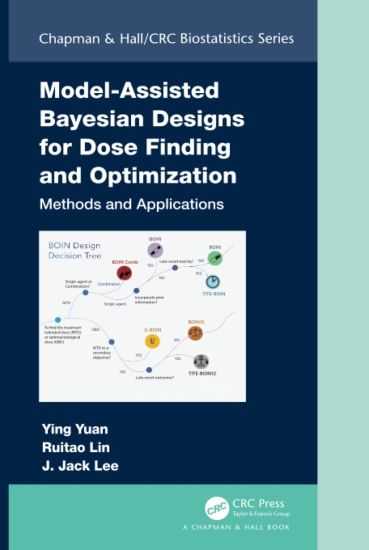
Model-Assisted Bayesian Designs for Dose Finding and Optimization

Ying Yuan; Ruitao Lin; J. Jack Lee

TAYLOR FRANCIS LTD
2022
sidottu
Bayesian adaptive designs provide a critical approach to improve the efficiency and success of drug development that has been embraced by the US Food and Drug Administration (FDA). This is particularly important for early phase trials as they form the basis for the development and success of subsequent phase II and III trials. The objective of this book is to describe the state-of-the-art model-assisted designs to facilitate and accelerate the use of novel adaptive designs for early phase clinical trials. Model-assisted designs possess avant-garde features where superiority meets simplicity. Model-assisted designs enjoy exceptional performance comparable to more complicated model-based adaptive designs, yet their decision rules often can be pre-tabulated and included in the protocol—making implementation as simple as conventional algorithm-based designs. An example is the Bayesian optimal interval (BOIN) design, the first dose-finding design to receive the fit-for-purpose designation from the FDA. This designation underscores the regulatory agency's support of the use of the novel adaptive design to improve drug development. FeaturesRepresents the first book to provide comprehensive coverage of model-assisted designs for various types of dose-finding and optimization clinical trialsDescribes the up-to-date theory and practice for model-assisted designsPresents many practical challenges, issues, and solutions arising from early-phase clinical trialsIllustrates with many real trial applicationsOffers numerous tips and guidance on designing dose finding and optimization trialsProvides step-by-step illustrations of using software to design trialsDevelops a companion website (www.trialdesign.org) to provide freely available, easy-to-use software to assist learning and implementing model-assisted designsWritten by internationally recognized research leaders who pioneered model-assisted designs from the University of Texas MD Anderson Cancer Center, this book shows how model-assisted designs can greatly improve the efficiency and simplify the design, conduct, and optimization of early-phase dose-finding trials. It should therefore be a very useful practical reference for biostatisticians, clinicians working in clinical trials, and drug regulatory professionals, as well as graduate students of biostatistics. Novel model-assisted designs showcase the new KISS principle: Keep it simple and smart!