Kirjojen hintavertailu – 12 903 725 kirjaa ja 27 kauppaa

Kirjailija

J. M. Bernstein

Kirjat ja teokset yhdessä paikassa: 8 kirjaa, julkaisuja vuosilta 1993–2020, suosituimpiin kuuluu Against Voluptuous Bodies. Vertaile teosten hintoja ja tarkista saatavuus suomalaisista kirjakaupoista.

8 kirjaa

Kirjojen julkaisuvuodet: 1993–2020.

Torture and Dignity

Torture and Dignity

J. M. Bernstein

University of Chicago Press
2020
nidottu
In this unflinching look at the experience of suffering and one of its greatest manifestations—torture—J. M. Bernstein critiques the repressions of traditional moral theory, showing that our morals are not immutable ideals but fragile constructions that depend on our experience of suffering itself. Morals, Bernstein argues, not only guide our conduct but also express the depth of mutual dependence that we share as vulnerable and injurable individuals. Beginning with the attempts to abolish torture in the eighteenth century, and then sensitively examining what is suffered in torture and related transgressions, such as rape, Bernstein elaborates a powerful new conception of moral injury. Crucially, he shows, moral injury always involves an injury to the status of an individual as a person—it is a violent assault against his or her dignity. Elaborating on this critical element of moral injury, he demonstrates that the mutual recognitions of trust form the invisible substance of our moral lives, that dignity is a fragile social possession, and that the perspective of ourselves as potential victims is an ineliminable feature of everyday moral experience.

Torture and Dignity

Torture and Dignity

J. M. Bernstein

University of Chicago Press
2015
sidottu
In this unflinching look at the experience of suffering and one of its greatest manifestations-torture-J. M. Bernstein critiques the repressions of traditional moral theory, showing that our morals are not immutable ideals but fragile constructions that depend on our experience of suffering itself. Morals, Bernstein argues, not only guide our conduct but also express the depth of mutual dependence that we share as vulnerable and injurable individuals. Beginning with the attempts to abolish torture in the eighteenth century, and then sensitively examining what is suffered in torture and related transgressions, such as rape, Bernstein elaborates a powerful new conception of moral injury. Crucially, he shows, moral injury always involves an injury to the status of an individual as a person-it is a violent assault against his or her dignity. Elaborating on this critical element of moral injury, he demonstrates that the mutual recognitions of trust form the invisible substance of our moral lives, that dignity is a fragile social possession, and that the perspective of ourselves as potential victims is an ineliminable feature of everyday moral experience.
Art and Aesthetics After Adorno

Art and Aesthetics After Adorno

J. M. Bernstein; Claudia Brodsky; Anthony J. Cascardi; Thierry de Duve; Ales Erjavec; Robert Kaufman; Fred Rush

Fordham University Press
2013
pokkari
Theodor Adorno's Aesthetic Theory (1970) offers one of the most powerful and comprehensive critiques of art and of the discipline of aesthetics ever written. The work offers a deeply critical engagement with the history and philosophy of aesthetics and with the traditions of European art through the middle of the 20th century. It is coupled with ambitious claims about what aesthetic theory ought to be. But the cultural horizon of Adorno's Aesthetic Theory was the world of high modernism, and much has happened since then both in theory and in practice. Adorno's powerful vision of aesthetics calls for reconsideration in this light. Must his work be defended, updated, resisted, or simply left behind? This volume gathers new essays by leading philosophers, critics, and theorists writing in the wake of Adorno in order to address these questions. They hold in common a deep respect for the power of Adorno's aesthetic critique and a concern for the future of aesthetic theory in response to recent developments in aesthetics and its contexts.
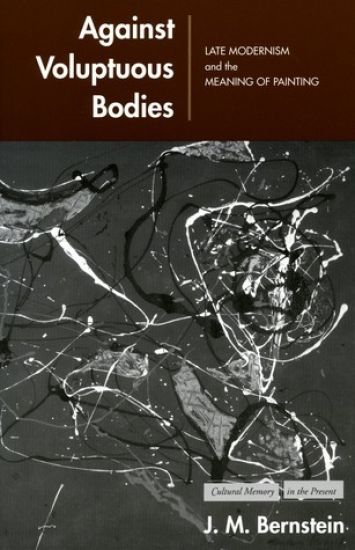
Against Voluptuous Bodies

Against Voluptuous Bodies

J. M. Bernstein

Stanford University Press
2006
sidottu
The aim of this book is to provide an account of modernist painting that follows on from the aesthetic theory of Theodor W. Adorno. It offers a materialist account of modernism with detailed discussions of modern aesthetics from Kant to Arthur Danto, Stanley Cavell, and Adorno. It discusses in detail competing accounts of modernism: Clement Greenberg, Michael Fried, Yve-Alain Bois, and Thierry de Duve; and it discusses several painters and artists in detail: Pieter de Hooch, Jackson Pollock, Robert Ryman, Cindy Sherman, and Chaim Soutine. Its central thesis is that modernist painting exemplifies a form of rationality that is an alternative to the instrumental rationality of enlightened modernity. Modernist paintings exemplify how nature and the sociality of meaning can be reconciled.
Against Voluptuous Bodies

Against Voluptuous Bodies

J. M. Bernstein

Stanford University Press
2006
pokkari
The aim of this book is to provide an account of modernist painting that follows on from the aesthetic theory of Theodor W. Adorno. It offers a materialist account of modernism with detailed discussions of modern aesthetics from Kant to Arthur Danto, Stanley Cavell, and Adorno. It discusses in detail competing accounts of modernism: Clement Greenberg, Michael Fried, Yve-Alain Bois, and Thierry de Duve; and it discusses several painters and artists in detail: Pieter de Hooch, Jackson Pollock, Robert Ryman, Cindy Sherman, and Chaim Soutine. Its central thesis is that modernist painting exemplifies a form of rationality that is an alternative to the instrumental rationality of enlightened modernity. Modernist paintings exemplify how nature and the sociality of meaning can be reconciled.
Adorno

Adorno

J. M. Bernstein

Cambridge University Press
2001
sidottu
Theodor W. Adorno is best known for his contributions to aesthetics and social theory. Critics have always complained about the lack of a practical, political or ethical dimension to Adorno's philosophy. In this highly original contribution to the literature on Adorno, J. M. Bernstein offers the first attempt in any language to provide an account of the ethical theory latent in Adorno's writings. Bernstein relates Adorno's ethics to major trends in contemporary moral philosophy. He analyses the full range of Adorno's major works, with a special focus on Dialectic of Enlightenment, Minima Moralia and Negative Dialectics. In developing his account Bernstein lays particular stress on Adorno's contention that the event of Auschwitz demands a new categorical imperative. This book will be widely acknowledged as the standard work on Adorno's ethics and as such will interest professionals and students of philosophy, political theory, sociology, history of ideas, art history and music.
Adorno

Adorno

J. M. Bernstein

Cambridge University Press
2001
pokkari
Theodor W. Adorno is best known for his contributions to aesthetics and social theory. Critics have always complained about the lack of a practical, political or ethical dimension to Adorno’s philosophy. In this highly original contribution to the literature on Adorno, J. M. Bernstein offers the first attempt in any language to provide an account of the ethical theory latent in Adorno’s writings. Bernstein relates Adorno’s ethics to major trends in contemporary moral philosophy. He analyses the full range of Adorno’s major works, with a special focus on Dialectic of Enlightenment, Minima Moralia and Negative Dialectics. In developing his account Bernstein lays particular stress on Adorno’s contention that the event of Auschwitz demands a new categorical imperative. This book will be widely acknowledged as the standard work on Adorno’s ethics and as such will interest professionals and students of philosophy, political theory, sociology, history of ideas, art history and music.
The Fate of Art

The Fate of Art

J. M. Bernstein

Polity Press
1993
nidottu
This original and wide-ranging book, now available in paperback, is a major contribution to contemporary philosophy. Bernstein focuses on the work of four key thinkers - Kant, Heidegger, Derrida and Adorno - and provides a powerful new interpretation of their writings on art, aesthetics and politics. Bernstein argues that our experience of art today is conditioned by the loss of the truth-function of art: with the growth of modern science and technological reason, art is relegated to a separate and autonomous domain of the aesthetic. This condition of 'aesthetic alienation' - the raging discord between art and truth - is one of the most perspicuous signs of the fragmentation of modernity. Aesthetic alienation is challenged in differing ways by modern Continental philosophers like Heidegger, Derrida and Adorno. Bernstein shows how each of these philosophers uses the experience of art and the discourse of aesthetics to criticize the fragmentation of modernity. He examines in detail their responses to aesthetic alienation and raises a range of fundamental questions concerning the relations between art, philosophy and politics in modern societies.