Kirjojen hintavertailu – 12 859 818 kirjaa ja 27 kauppaa

Kirjailija

J Moufawad-Paul

Kirjat ja teokset yhdessä paikassa: 6 kirjaa, julkaisuja vuosilta 2016–2020, suosituimpiin kuuluu Critique of Maoist Reason. Vertaile teosten hintoja ja tarkista saatavuus suomalaisista kirjakaupoista.

Nimi esiintyy myös muodoissa: J. Moufawad-Paul, J. Moufawad–paul

6 kirjaa

Kirjojen julkaisuvuodet: 2016–2020.

The Communist Necessity

The Communist Necessity

J Moufawad-Paul

Kersplebedeb
2020
pokkari
"There was a time when we proclaimed that we were part of a beautiful and fragmented chaos of affinity groups, conflicted organizations, disorganized rebels, all of whom were somehow part of the same social movement that was greater than the sum of its parts. We were more accurately a disorganized mob of enraged plebeians shaking our fists at a disciplined imperial army. Years ago we spoke of social movementism but now it only makes sense to drop the 'social' since this phase of confusion was incapable of understanding the social terrain. Disparate, unfocused, and divided movements lack a unified intentionality; they have proved themselves incapable of pursuing the necessity of communism." Five years ago The Communist Necessity was written to demarcate a revolutionary politics grounded in necessity from social movementism, and revolutionary science from contemporary intellectual fads. Now J. Moufawad-Paul's notorious polemic is back, still relevant and prescient. This second edition of Moufawad-Paul's first book includes a preface by Dao-yuan Chou and a reflective afterword by the author. New readers can discover why the recognition of communism's necessity "requires a new return to the revolutionary communist theories and experiences won from history." The Communist Necessity is a polemical interrogation of the practice of "social movementism" that has enjoyed a normative status at the centres of capitalism. Despite the fact that the name "communism" has been reclaimed by a variety of important intellectuals, J. Moufawad-Paul argues that, due to a failure to grapple with the concrete questions connected to historical moments of actually making revolution, movementist praxis remains hegemonic. More of a philosophical intervention than a historiography or political economy, The Communist Necessity engages in a quick and pointed manner with a variety of authors and tendencies including Alain Badiou, Jodi Dean, the Invisible Committee, Tiqqun, Th orie Communiste, and others. Moufawad-Paul argues that a refusal to recognize contemporary revolutionary movements from the 1980s to the present results in the reification of a capitalist "end of history" discourse within this movementist conceptualization of theory and practice. Originally written as a small essay on the left-wing blog MLM Mayhem, The Communist Necessity was expanded into a pocket-sized treatise in 2015, sketching out the boundaries of the movementist terrain, as well as its contemporary ideologues, so as to raise questions that may be uncomfortable for those still devoted to movementist praxis, particularly if they define themselves as marxist. Aware of his past affinity with social movementism, and with some apprehension of the problem of communist orthodoxy, Moufawad-Paul argues that the recognition of communism's necessity "requires a new return to the revolutionary communist theories and experiences won from history." J. Moufawad-Paul lives in Toronto and works as casualized contract faculty at York University where he received his PhD in philosophy. He is the author of Austerity Apparatus, Continuity and Rupture, and Demarcation and Demystification. Dao-yuan Chou is an organizer and author of Silage Choppers and Snake Spirits.

Demarcation and Demystification

Demarcation and Demystification

J. Moufawad-Paul

John Hunt Publishing
2019
nidottu
Marx once declared that philosophers have only interpreted the world, but the point is to change it. Demarcation and Demystification examines the ways in which a radical practice of philosophy is possible under the aegis of Marx's 11th thesis, arguing that philosophy's radicality is discovered by understanding that it can only ever interpret the world; that social transformation lies beyond the sphere of its operations. 'Demarcation and Demystification is a major statement on the gulf between what philosophers actually do, and what they think they do.' Matthew R. McLennan, author of Philosophy and Vulnerability
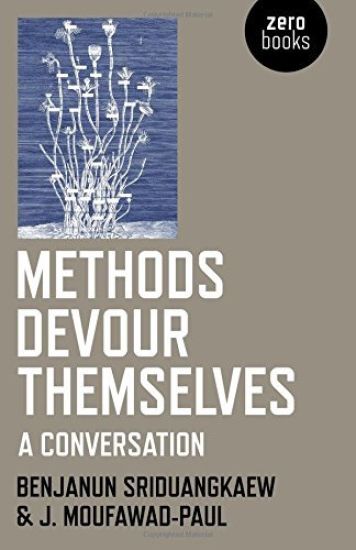
Methods Devour Themselves

Methods Devour Themselves

Benjanun Sriduangkaew; J. Moufawad-Paul

John Hunt Publishing
2018
nidottu
Methods Devour Themselves is a dialogue between fiction and non-fiction. Inspired by Quentin Meillassoux's Science Fiction and Extro-Science Fiction that was paired with an Isaac Asimov short story, this book examines the ways in which stories can provoke philosophical interventions and philosophical essays can provoke stories. Alternating between Benjanun Sriduangkaew's fiction and J. Moufawad-Paul's non-fiction, Methods Devour Themselves is an interstitial project that brings fiction and essay into a unique, avant-garde whole.
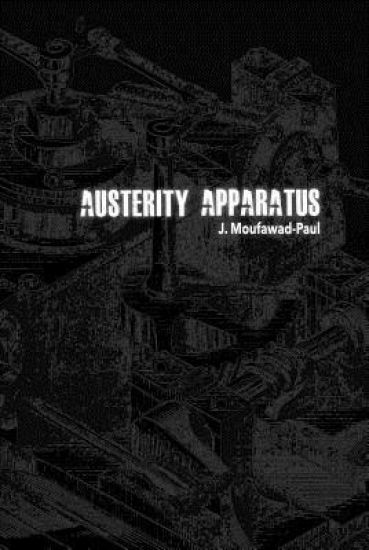
Austerity Apparatus

Austerity Apparatus

J Moufawad-Paul

Kersplebedeb
2017
pokkari
"By 2009, every anti-worker ideologue and their devotees had a popularized concept under which to mobilize their arguments about how and why workers should absorb the excesses of those capitalists who wanted to maintain their wealthy lifestyles: austerity. In this sense, the austerity apparatus is simply that which functions to police the everyday operations of crisis capitalism. In another sense this apparatus is the mobilization of operations that are a normative part of capitalism even without a crisis But this is simply due to the fact that economic crises are also part of capitalism's day-to-day functioning: capitalism is crisis, implicitly or explicitly." An excavation of the ideology of austerity and its relationship to the mechanisms of capitalism, Austerity Apparatus is a philosophical excursion through a variety of concepts surrounding capitalist crisis and class struggle. Written as a series of interconnected meditations on the problematic of austerity, Austerity Apparatus is a creative intervention rather than a polemic or rigorous analysis; it is designed to force reflection on the ways in which contemporary capitalism conditions its subjects to accept its limits. In examining the problematic of austerity, Moufawad-Paul also discusses the relationship between neoliberalism and fascism and the ways in which the latter is immanent to capitalism. This aspect of Austerity Apparatus should be of particular interest to readers exploring the meaning of the contemporary re-emergence of fascist politics.