Kirjojen hintavertailu – 12 903 725 kirjaa ja 27 kauppaa

Kirjailija

J. N. Findlay

Kirjat ja teokset yhdessä paikassa: 12 kirjaa, julkaisuja vuosilta 1970–2018, suosituimpiin kuuluu Wittgenstein. Vertaile teosten hintoja ja tarkista saatavuus suomalaisista kirjakaupoista.

Nimi esiintyy myös muodoissa: J N Findlay, J.N. Findlay

12 kirjaa

Kirjojen julkaisuvuodet: 1970–2018.

Language, Mind and Value

Language, Mind and Value

J N Findlay

Routledge
2018
nidottu
Philosophical themes as diverse as language, value, mind and God are among the topics discussed in this book, originally published in 1963. Considerably influential, there are contributions on Time, Camrbidge Philosophy, Doedelian Sentences, Morality by Convention and the Non-Existence of God. They reflect a gradual move from a position where the influence of Wittgenstein is paramount, to a position where there is considerable criticism of linguistic philosophy and a growing interest in the approaches of Hegel and the phenomenologists.
Values and Intentions

Values and Intentions

J. N. Findlay

Routledge
2016
nidottu
Professor Findlay in this book, originally published in 1961, set out to justify, and to some extent carry out, a ‘material value-ethic’, ie. A systematic setting forth of the ends of rational action. The book is in the tradition of Moore, Rashfall, Ross, Scheler and Hartmann though it avoids altogether dogmatic intuitive methods. It argues that an organised framework of ends of action follows from the attitude underlying our moral pronouncements, and that this framework, while allowing personal elaboration, is not a matter for individual decision. The relations connecting our fundamental value-judgements with one another, and the frames of mind behind them, are not rigorously deductive but are sufficiently compelling to be called logical. Something of a ‘transcendental deduction’ of a well-ordered family for our basic heads of valuation is both possible and necessary. The work is further critical of the notion of obligation which has been extended far beyond legal contracts and understandings. The book also contains a chapter on religion.
Language, Mind and Value

Language, Mind and Value

J N Findlay

Routledge
2016
sidottu
Philosophical themes as diverse as language, value, mind and God are among the topics discussed in this book, originally published in 1963. Considerably influential, there are contributions on Time, Camrbidge Philosophy, Doedelian Sentences, Morality by Convention and the Non-Existence of God. They reflect a gradual move from a position where the influence of Wittgenstein is paramount, to a position where there is considerable criticism of linguistic philosophy and a growing interest in the approaches of Hegel and the phenomenologists.
Hegel

Hegel

J N Findlay

Routledge
2015
nidottu
First published in 2002. Written in 1958, this book offers a re-examination of Hegel's work, and is the volume I of a series of seven volumes on his work. Starting with a biography and the key ideas, the author offers his own explanations of ideas that are central in Hegel: being the notion of spirit, the dialectical method, the phenomenology of spirit, the doctrines of being, essence and notion; the philosophy of nature, absolute knowledge and subjective/objective spirit.
Values and Intentions

Values and Intentions

J. N. Findlay

Routledge
2014
sidottu
Professor Findlay in this book, originally published in 1961, set out to justify, and to some extent carry out, a ‘material value-ethic’, ie. A systematic setting forth of the ends of rational action. The book is in the tradition of Moore, Rashfall, Ross, Scheler and Hartmann though it avoids altogether dogmatic intuitive methods. It argues that an organised framework of ends of action follows from the attitude underlying our moral pronouncements, and that this framework, while allowing personal elaboration, is not a matter for individual decision. The relations connecting our fundamental value-judgements with one another, and the frames of mind behind them, are not rigorously deductive but are sufficiently compelling to be called logical. Something of a ‘transcendental deduction’ of a well-ordered family for our basic heads of valuation is both possible and necessary. The work is further critical of the notion of obligation which has been extended far beyond legal contracts and understandings. The book also contains a chapter on religion.
Wittgenstein

Wittgenstein

J.N. Findlay

Routledge
2010
nidottu
This is Volume V of eight in a series on Wittgenstein. Originally published in 1984, the aim of this book is to offer a comprehensive critique of the thought of Wittgenstein from a standpoint which recognizes him to be, both in his earlier and his later thinking, a systematic philosophical thinker of immense consequence and originality.
Wittgenstein

Wittgenstein

J.N. Findlay

Routledge
2005
sidottu
This is Volume V of eight in a series on Wittgenstein. Originally published in 1984, the aim of this book is to offer a comprehensive critique of the thought of Wittgenstein from a standpoint which recognizes him to be, both in his earlier and his later thinking, a systematic philosophical thinker of immense consequence and originality.
Hegel

Hegel

J N Findlay

Routledge
2002
sidottu
First published in 2002. Written in 1958, this book offers a re-examination of Hegel's work, and is the volume I of a series of seven volumes on his work. Starting with a biography and the key ideas, the author offers his own explanations of ideas that are central in Hegel: being the notion of spirit, the dialectical method, the phenomenology of spirit, the doctrines of being, essence and notion; the philosophy of nature, absolute knowledge and subjective/objective spirit.
Kant and the Transcendental Object

Kant and the Transcendental Object

J. N. Findlay

Oxford University Press
1981
sidottu
This book is an attempt to conduct a comprehensive examination of Kant's metaphysic of Transcendental Idealism, which is everywhere presupposed by his critical theory of knowledge, his theory of the moral and the aesthetic judgement, and his rational approach to religion. It will attempt to show that this metaphysic is profoundly coherent, despite frequent inconsistencies of expression, and that it throws an indispensable light on his critical enquiries. Kant conceives of knowledge in especially narrow terms, and there is nothing absurd in the view that thinkables must, in his sense, extend far more widely than knowables. Kant also goes further than most who have thought in his fashion in holding that, not only the qualities of the senses, but also the space and time in which we place them, have non-sensuous, non-spatial, and non-temporal foundations in relations among thinkables that transcend empirical knowledge. This contention also reposes on important arguments, and can be given a sense that will render it interesting and consistent. The book explores this sense, and connects it with the thought of Kant's immediate predecessors in the great German scholastic movement that began with Leibniz: this scholasticism, it will be held, is throughout preserved as the unspoken background of Kant's critical developments, whose great innovation really consisted in pushing it out of the region of the knowable, into the region of what is permissively or, in some cases, obligatorily, thinkable.

Phenomenology of Spirit

Phenomenology of Spirit

G. W. F. Hegel; J. N. Findlay

Oxford University Press Inc
1979
nidottu

Halvin toimitettuna 23,40 €

This brilliant study of the stages in the mind's necessary progress from immediate sense-consciousness to the position of a scientific philosophy includes an introductory essay and a paragraph-by-paragraph analysis of the text to help the reader understand this most difficult and most influential of Hegel's works.
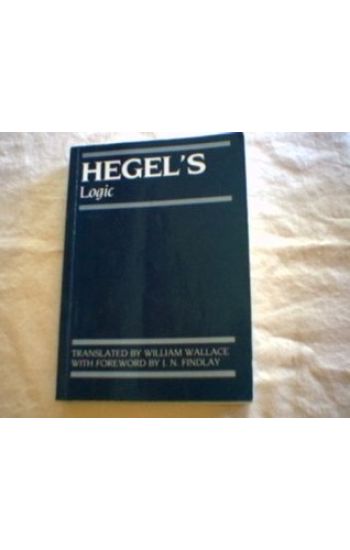
Hegel's Logic

Hegel's Logic

G. W. F. Hegel; J. N. Findlay

Clarendon Press
1975
nidottu
What I think remains sustainable and valid in Hegel's thought is the attempt to regard the ongoing crisis of reason as itself constitutive of self-consciousness. |s Revue Internationale de Philosophie |d 01/10/1996
Hegel's Philosophy of Mind

Hegel's Philosophy of Mind

G. W. F. Hegel; J. N. Findlay

Clarendon Press
1970
nidottu
The present reissue of Wallace's translation of Hegel's Philosophy of Mind includes the Zusatze or lecture-notes which, in the collected works, accompany the first section entitled "Subjective Mind" and which Wallace omitted from his translation. Professor J. N. Findlay has written a Foreword and this replaces Wallace's introductory essays.