Kirjojen hintavertailu – 12 875 077 kirjaa ja 26 kauppaa

Kirjailija

J. N. Reddy

Kirjat ja teokset yhdessä paikassa: 25 kirjaa, julkaisuja vuosilta 1982–2025, suosituimpiin kuuluu Mechanics of Solids and Structures. Vertaile teosten hintoja ja tarkista saatavuus suomalaisista kirjakaupoista.

Nimi esiintyy myös muodoissa: J.N. Reddy, J N Reddy

25 kirjaa

Kirjojen julkaisuvuodet: 1982–2025.

Mechanics of Solids and Structures

Mechanics of Solids and Structures

Roger T. Fenner; J.N. Reddy; Arun R. Srinivasa

TAYLOR FRANCIS LTD
2025
nidottu
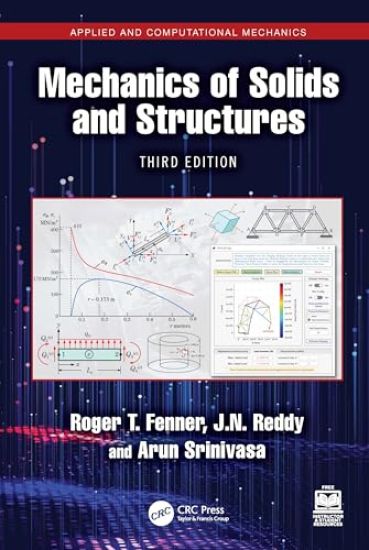
The third edition of Mechanics of Solids and Structures makes use of computational methods such as the finite element method that has revolutionized the field to solve problems while retaining all the basic principles and foundational information needed for mastering advanced engineering mechanics principles and acquiring problem-solving skills. The authors have updated the text to include the integration of numerical approaches and MATLAB® computer programs into the body of the text for carrying out analysis of truss, beam, and frame structures. The third edition also offers an update to Chapters 1 through 4 as follows. All material related to determinate trusses and cables is moved to Chapter 1, as most students most likely were introduced to these topics in a course on statics. Thus, Chapter 1 of the current edition is a review of statics. The concepts of stress and strain and associated examples were moved from Chapter 1 to Chapter 2, with additional discussion of concepts and examples. Chapter 3 in the new edition deals with stress-strain relations with applications to determinate systems, including trusses and thin-walled pressure vessels. Indeterminate trusses and associated computer implementation have been moved from Chapter 4 of the second edition to Chapter 7 of the current edition. Other indeterminate systems from old Chapter 4 have been retained in new Chapter 4. The second major change is the updating of all the computational tools from FORTRAN to MATLAB and providing interactive tools (i.e., APPs) in Chapters 7, 10, and 12 of the new edition. All computational examples from Chapters 4 and 6 on trusses and beams of the second edition are consolidated into a new chapter, Chapter 7 with numerous examples and applications of newly included TRUSS2d, BEAM, and FRAME2d APPs. Chapter 7 also introduces finite element analysis of plane frames (a new topic). The authors have also added new examples and exercise problems throughout the book that allow students to practice and apply the concepts and formulas to solve problems.
Mechanics of Solids and Structures

Mechanics of Solids and Structures

Roger T. Fenner; J.N. Reddy; Arun R. Srinivasa

TAYLOR FRANCIS LTD
2025
sidottu
The third edition of Mechanics of Solids and Structures makes use of computational methods such as the finite element method that has revolutionized the field to solve problems while retaining all the basic principles and foundational information needed for mastering advanced engineering mechanics principles and acquiring problem-solving skills. The authors have updated the text to include the integration of numerical approaches and MATLAB computer programs into the body of the text for carrying out analysis of truss, beam, and frame structures. The third edition also offers an update to chapter one, which includes a more detailed explanation of the idealization of real-world objects, the conversion into two-dimensional approximation, and the student’s ability to create line drawings and other schematics to practice drawing and create free-body diagrams. The authors have also added new examples and exercise problems throughout the book that allow students to practice and apply the concepts and formulas to solve problems. Following the legacy of the previous editions, the third edition serves as a course text for the senior/graduate (third, fourth, or fifth year) courses/modules in the mechanics of solid/advanced strength of materials, offered in aerospace, civil, engineering science, and mechanical engineering departments.
Theories and Analyses of Beams and Axisymmetric Circular Plates
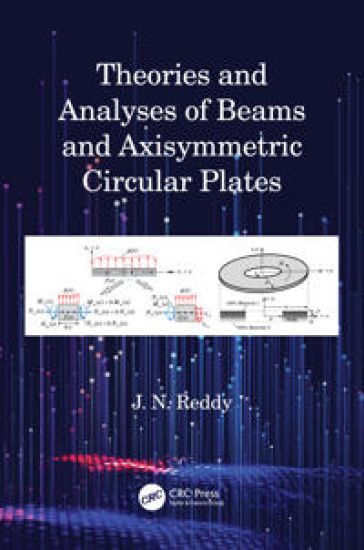
This comprehensive textbook compiles cutting-edge research on beams and circular plates, covering theories, analytical solutions, and numerical solutions of interest to students, researchers, and engineers working in industry. Detailing both classical and shear deformation theories, the book provides a complete study of beam and plate theories, their analytical (exact) solutions, variational solutions, and numerical solutions using the finite element method. Beams and plates are some of the most common structural elements used in many engineering structures. The book details both classical and advanced (i.e., shear deformation) theories, scaling in complexity to aid the reader in self-study, or to correspond with a taught course. It covers topics including equations of elasticity, equations of motion of the classical and first-order shear deformation theories, and analytical solutions for bending, buckling, and natural vibration. Additionally, it details static as well as transient response based on exact, the Navier, and variational solution approaches for beams and axisymmetric circular plates, and has dedicated chapters on linear and nonlinear finite element analysis of beams and circular plates. Theories and Analyses of Beams and Axisymmetric Circular Plates will be of interest to aerospace, civil, materials, and mechanical engineers, alongside students and researchers in solid and structural mechanics.
Continuum Thermodynamics and Material Modelling

Continuum Thermodynamics and Material Modelling

Kari Santaoja; J. N. Reddy

Cambridge University Press
2024
sidottu

Halvin toimitettuna 111,90 €

This concise and rigorous textbook introduces students to continuum thermodynamics, combining a complete treatment of the subject with practical applications to material modelling. It presents mathematical prerequisites and the foundations of continuum mechanics, then introduces more advanced topics such as theories for the investigation of material models. Taking the student step-by-step through the subject, it allows full understanding of the theory and how it relates to real-world practical applications. Packed with examples and illustrations to describe complex concepts and mathematical derivations, and including end-of-chapter problems with helpful hints, this is the ideal, accessible introduction to continuum thermodynamics for senior undergraduate and graduate students in mechanical, aeronautical and civil engineering.
Computational Methods in Engineering

Computational Methods in Engineering

J.N. Reddy

TAYLOR FRANCIS LTD
2024
sidottu
Computational Methods in Engineering: Finite Difference, Finite Volume, Finite Element, and Dual Mesh Control Domain Methods provides readers with the information necessary to choose appropriate numerical methods to solve a variety of engineering problems. Explaining common numerical methods in an accessible yet rigorous manner, the book details the finite element method (FEM), finite volume method (FVM) and importantly, a new numerical approach, dual mesh control domain method (DMCDM). Numerical methods are crucial to everyday engineering. The book begins by introducing the various methods and their applications, with example problems from a range of engineering disciplines including heat transfer, solid and structural mechanics, and fluid mechanics. It highlights the strengths of FEM, with its systematic procedure and modular steps, and then goes on to explain the uses of FVM. It explains how DMCDM embodies useful parts of both FEM and FVM, particularly in its use of the control domain method and how it can provide a comprehensive computational approach. The final chapters look at ways to use different numerical methods, primarily FEM and DMCDM, to solve typical problems of bending of beams, axisymmetric circular plates, and other nonlinear problems. This book is a useful guide to numerical methods for professionals and students in all areas of engineering and engineering mathematics.
Finite Element and Finite Volume Methods for Heat Transfer and Fluid Dynamics

Finite Element and Finite Volume Methods for Heat Transfer and Fluid Dynamics

J. N. Reddy; N. K. Anand; P. Roy

Cambridge University Press
2022
sidottu
Introduces the two most common numerical methods for heat transfer and fluid dynamics equations, using clear and accessible language. This unique approach covers all necessary mathematical preliminaries at the beginning of the book for the reader to sail smoothly through the chapters. Students will work step-by-step through the most common benchmark heat transfer and fluid dynamics problems, firmly grounding themselves in how the governing equations are discretized, how boundary conditions are imposed, and how the resulting algebraic equations are solved. Providing a detailed discussion of the discretization steps and time approximations, and clearly presenting concepts of explicit and implicit formulations, this graduate textbook has everything an instructor needs to prepare students for their exams and future careers. Each illustrative example shows students how to draw comparisons between the results obtained using the two numerical methods, and at the end of each chapter they can test and extend their understanding by working through the problems provided. A solutions manual is also available for instructors.
Theories and Analyses of Beams and Axisymmetric Circular Plates
This comprehensive textbook compiles cutting-edge research on beams and circular plates, covering theories, analytical solutions, and numerical solutions of interest to students, researchers, and engineers working in industry. Detailing both classical and shear deformation theories, the book provides a complete study of beam and plate theories, their analytical (exact) solutions, variational solutions, and numerical solutions using the finite element method. Beams and plates are some of the most common structural elements used in many engineering structures. The book details both classical and advanced (i.e., shear deformation) theories, scaling in complexity to aid the reader in self-study, or to correspond with a taught course. It covers topics including equations of elasticity, equations of motion of the classical and first-order shear deformation theories, and analytical solutions for bending, buckling, and natural vibration. Additionally, it details static as well as transient response based on exact, the Navier, and variational solution approaches for beams and axisymmetric circular plates, and has dedicated chapters on linear and nonlinear finite element analysis of beams and circular plates. Theories and Analyses of Beams and Axisymmetric Circular Plates will be of interest to aerospace, civil, materials, and mechanical engineers, alongside students and researchers in solid and structural mechanics.
An Introduction to Nonlinear Finite Element Analysis Second Edition
The second edition of An Introduction to Nonlinear Finite Element Analysis has the same objective as the first edition, namely, to facilitate an easy and thorough understanding of the details that are involved in the theoretical formulation, finite element model development, and solutions of nonlinear problems. The book offers an easy-to-understand treatment of the subject of nonlinear finite element analysis, which includes element development from mathematical models and numerical evaluation of the underlying physics. The new edition is extensively reorganized and contains substantial amounts of new material. Chapter 1 in the second edition contains a section on applied functional analysis. Chapter 2 on nonlinear continuum mechanics is entirely new. Chapters 3 through 8 in the new edition correspond to Chapter 2 through 8 of the first edition, but with additional explanations, examples, and exercise problems. Material on time dependent problems from Chapter 8 of the first edition is absorbed into Chapters 4 through 8 of the new edition. Chapter 9 is extensively revised and it contains up to date developments in the large deformation analysis of isotropic, composite and functionally graded shells. Chapter 10 of the first edition on material nonlinearity and coupled problems is reorganized in the second edition by moving the material on solid mechanics to Chapter 12 in the new edition and material on coupled problems to the new chapter, Chapter 10, on weak-form Galerkin finite element models of viscous incompressible fluids. Finally, Chapter 11 in the second edition is entirely new and devoted to least-squares finite element models of viscous incompressible fluids. Chapter 12 of the second edition is enlarged to contain finite element models of viscoelastic beams. In general, all of the chapters of the second edition contain additional explanations, detailed example problems, and additional exercise problems. Although all of the segments are in Fortran, the logic used in these Fortran programs is transparent and can be used in Matlab or C++ versions of the same. Thus the new edition more than replaces the first edition, and it is hoped that it is acquired by the library of every institution of higher learning as well as serious finite element analysts. The book may be used as a textbook for an advanced course (after a first course) on the finite element method or the first course on nonlinear finite element analysis. A solutions manual is available on request from the publisher to instructors who adopt the book as a textbook for a course.
The Finite Element Method for Initial Value Problems

The Finite Element Method for Initial Value Problems

Karan S. Surana; J. N. Reddy

CRC Press
2017
sidottu
Unlike most finite element books that cover time dependent processes (IVPs) in a cursory manner, The Finite Element Method for Initial Value Problems: Mathematics and Computations focuses on the mathematical details as well as applications of space-time coupled and space-time decoupled finite element methods for IVPs. Space-time operator classification, space-time methods of approximation, and space-time calculus of variations are used to establish unconditional stability of space-time methods during the evolution. Space-time decoupled methods are also presented with the same rigor. Stability of space-time decoupled methods, time integration of ODEs including the finite element method in time are presented in detail with applications. Modal basis, normal mode synthesis techniques, error estimation, and a posteriori error computations for space-time coupled as well as space-time decoupled methods are presented. This book is aimed at a second-semester graduate level course in FEM.
Energy Principles and Variational Methods in Applied Mechanics
A comprehensive guide to using energy principles and variational methods for solving problems in solid mechanics This book provides a systematic, highly practical introduction to the use of energy principles, traditional variational methods, and the finite element method for the solution of engineering problems involving bars, beams, torsion, plane elasticity, trusses, and plates. It begins with a review of the basic equations of mechanics, the concepts of work and energy, and key topics from variational calculus. It presents virtual work and energy principles, energy methods of solid and structural mechanics, Hamilton’s principle for dynamical systems, and classical variational methods of approximation. And it takes a more unified approach than that found in most solid mechanics books, to introduce the finite element method. Featuring more than 200 illustrations and tables, this Third Edition has been extensively reorganized and contains much new material, including a new chapter devoted to the latest developments in functionally graded beams and plates. Offers clear and easy-to-follow descriptions of the concepts of work, energy, energy principles and variational methodsCovers energy principles of solid and structural mechanics, traditional variational methods, the least-squares variational method, and the finite element, along with applications for eachProvides an abundance of examples, in a problem-solving format, with descriptions of applications for equations derived in obtaining solutions to engineering structuresFeatures end-of-the-chapter problems for course assignments, a Companion Website with a Solutions Manual, Instructor's Manual, figures, and more Energy Principles and Variational Methods in Applied Mechanics, Third Edition is both a superb text/reference for engineering students in aerospace, civil, mechanical, and applied mechanics, and a valuable working resource for engineers in design and analysis in the aircraft, automobile, civil engineering, and shipbuilding industries.
The Finite Element Method for Boundary Value Problems

The Finite Element Method for Boundary Value Problems

Karan S. Surana; J. N. Reddy

Productivity Press
2016
sidottu
Written by two well-respected experts in the field, The Finite Element Method for Boundary Value Problems: Mathematics and Computations bridges the gap between applied mathematics and application-oriented computational studies using FEM. Mathematically rigorous, the FEM is presented as a method of approximation for differential operators that are mathematically classified as self-adjoint, non-self-adjoint, and non-linear, thus addressing totality of all BVPs in various areas of engineering, applied mathematics, and physical sciences. These classes of operators are utilized in various methods of approximation: Galerkin method, Petrov-Galerkin Method, weighted residual method, Galerkin method with weak form, least squares method based on residual functional, etc. to establish unconditionally stable finite element computational processes using calculus of variations. Readers are able to grasp the mathematical foundation of finite element method as well as its versatility of applications. h-, p-, and k-versions of finite element method, hierarchical approximations, convergence, error estimation, error computation, and adaptivity are additional significant aspects of this book.
Design of Shape Memory Alloy (SMA) Actuators

Design of Shape Memory Alloy (SMA) Actuators

Ashwin Rao; A. R. Srinivasa; J. N. Reddy

Springer International Publishing AG
2015
nidottu
This short monograph presents an analysis and design methodology for shape memory alloy (SMA) components such as wires, beams, and springs for different applications. The solid-solid, diffusionless phase transformations in thermally responsive SMA allows them to demonstrate unique characteristics like superelasticity and shape memory effects. The combined sensing and actuating capabilities of such materials allows them to provide a system level response by combining multiple functions in a single material system. In SMA, the combined mechanical and thermal loading effects influence the functionality of such materials. The aim of this book is to make the analysis of these materials accessible to designers by developing a "strength of materials" approach to the analysis and design of such SMA components inspired from their various applications with a review of various factors influencing the design process for such materials.
An Introduction to Nonlinear Finite Element Analysis

An Introduction to Nonlinear Finite Element Analysis

J. N. Reddy

Oxford University Press
2014
sidottu
The second edition of An Introduction to Nonlinear Finite Element Analysis has the same objective as the first edition, namely, to facilitate an easy and thorough understanding of the details that are involved in the theoretical formulation, finite element model development, and solutions of nonlinear problems. The book offers an easy-to-understand treatment of the subject of nonlinear finite element analysis, which includes element development from mathematical models and numerical evaluation of the underlying physics. The new edition is extensively reorganized and contains substantial amounts of new material. Chapter 1 in the second edition contains a section on applied functional analysis. Chapter 2 on nonlinear continuum mechanics is entirely new. Chapters 3 through 8 in the new edition correspond to Chapter 2 through 8 of the first edition, but with additional explanations, examples, and exercise problems. Material on time dependent problems from Chapter 8 of the first edition is absorbed into Chapters 4 through 8 of the new edition. Chapter 9 is extensively revised and it contains up to date developments in the large deformation analysis of isotropic, composite and functionally graded shells. Chapter 10 of the first edition on material nonlinearity and coupled problems is reorganized in the second edition by moving the material on solid mechanics to Chapter 12 in the new edition and material on coupled problems to the new chapter, Chapter 10, on weak-form Galerkin finite element models of viscous incompressible fluids. Finally, Chapter 11 in the second edition is entirely new and devoted to least-squares finite element models of viscous incompressible fluids. Chapter 12 of the second edition is enlarged to contain finite element models of viscoelastic beams. In general, all of the chapters of the second edition contain additional explanations, detailed example problems, and additional exercise problems. Although all of the programming segments are in Fortran, the logic used in these Fortran programs is transparent and can be used in Matlab or C++ versions of the same. Thus the new edition more than replaces the first edition, and it is hoped that it is acquired by the library of every institution of higher learning as well as serious finite element analysts. The book may be used as a textbook for an advanced course (after a first course) on the finite element method or the first course on nonlinear finite element analysis. A solutions manual is available on request from the publisher to instructors who adopt the book as a textbook for a course.
Computational Modeling of Polymer Composites

Computational Modeling of Polymer Composites

Samit Roy; J.N. Reddy

CRC Press Inc
2013
sidottu
Computational Modeling of Polymer Composites: A Study of Creep and Environmental Effects details the development of polymeric materials and their use in smart materials and composite structures in aerospace and automotive industries. Based on the authors' work during the past 30 years, this book provides a strong understanding of the theories and associated finite element life-prediction models for elastic and viscoelastic response of polymers and polymer composites in aggressive environments. The subject is an interdisciplinary one where chemists, material scientists, and chemical, mechanical, and structural engineers contribute to the overall product. Books on polymer composites are usually of three types: material science, mechanics, and computational. This book combines mechanics of materials with the computational element. The authors suggest an introductory course on mechanics of materials to cover all bases. The book begins with mathematical preliminaries, equations of anisotropic elasticity, virtual work principles, and variational methods. It provides an introduction to the finite element method and finite element analysis of viscoelastic materials, and then moves on to the solvent diffusion process in polymers and polymeric composites, as well as the linear and nonlinear viscoelastic models and the implementation of finite element models of viscoelastic materials. Computational Modeling of Polymer Composites: A Study of Creep and Environmental Effects delves into both uniaxial and multiaxial cases and delayed failure before discussing the finite element analysis of the nonlinear diffusion process in polymers. It also includes non-Fickean diffusion of polymers, the coupled hygrothermal cohesive layer model for simulating debond growth in bimaterial interfaces, and the viscoelastic cohesive layer model for the prediction of interlaminar shear strength of carbon/epoxy composites. The final chapter covers a multi-scale viscoelastic cohesive layer model for predicting delamination in high temperature polymer composites. This book can be used as a reference or as a graduate course textbook on theory and/or finite element analysis of polymers and polymeric composites.
An Introduction to Continuum Mechanics

An Introduction to Continuum Mechanics

J. N. Reddy

Cambridge University Press
2013
sidottu

Halvin toimitettuna 95,30 €

This best-selling textbook presents the concepts of continuum mechanics in a simple yet rigorous manner. It introduces the invariant form as well as the component form of the basic equations and their applications to problems in elasticity, fluid mechanics and heat transfer, and offers a brief introduction to linear viscoelasticity. The book is ideal for advanced undergraduates and graduate students looking to gain a strong background in the basic principles common to all major engineering fields, and for those who will pursue further work in fluid dynamics, elasticity, plates and shells, viscoelasticity, plasticity, and interdisciplinary areas such as geomechanics, biomechanics, mechanobiology and nanoscience. The book features derivations of the basic equations of mechanics in invariant (vector and tensor) form and specification of the governing equations to various co-ordinate systems, and numerous illustrative examples, chapter summaries and exercise problems. This second edition includes additional explanations, examples and problems.
Mechanics of Solids and Structures

Mechanics of Solids and Structures

Roger T. Fenner; J.N. Reddy

CRC Press Inc
2012
sidottu
A popular text in its first edition, Mechanics of Solids and Structures serves as a course text for the senior/graduate (fourth or fifth year) courses/modules in the mechanics of solid/advanced strength of materials, offered in aerospace, civil, engineering science, and mechanical engineering departments. Now, Mechanics of Solid and Structure, Second Edition presents the latest developments in computational methods that have revolutionized the field, while retaining all of the basic principles and foundational information needed for mastering advanced engineering mechanics. Key changes to the second edition include full-color illustrations throughout, web-based computational material, and the addition of a new chapter on the energy methods of structural mechanics. Using authoritative, yet accessible language, the authors explain the construction of expressions for both total potential energy and complementary potential energy associated with structures. They explore how the principles of minimal total potential energy and complementary energy provide the means to obtain governing equations of the structure, as well as a means to determine point forces and displacements with ease using Castigliano’s Theorems I and II. The material presented in this chapter also provides a deeper understanding of the finite element method, the most popular method for solving structural mechanics problems. Integrating computer techniques and programs into the body of the text, all chapters offer exercise problems for further understanding. Several appendices provide examples, answers to select problems, and opportunities for investigation into complementary topics. Listings of computer programs discussed are available on the CRC Press website.
Finite Element Analysis of Composite Laminates

Finite Element Analysis of Composite Laminates

O.O. Ochoa; J.N. Reddy

Springer
2010
nidottu
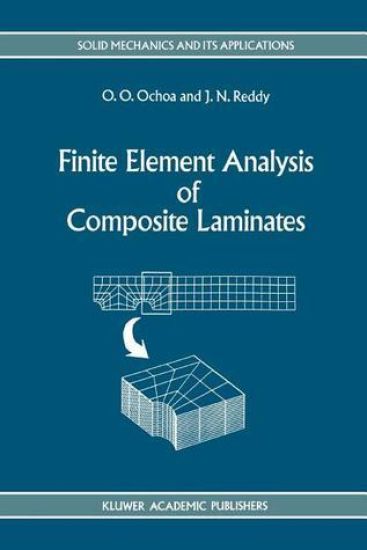
Composite materials are increasingly used in aerospace, underwater, and automotive structures. To take advantage of the full potential of composite materials, structural analysts and designers must have accurate mathematical models and design methods at their disposal. The objective of this monograph is to present the laminated plate theories and their finite element models to study the deformation, strength and failure of composite structures. Emphasis is placed on engineering aspects, such as the analytical descriptions, effective analysis tools, modeling of physical features, and evaluation of approaches used to formulate and predict the response of composite structures. The first chapter presents an overview of the text. Chapter 2 is devoted to the introduction of the definitions and terminology used in composite materials and structures. Anisotropic constitutive relations and Iaminate plate theories are also reviewed. Finite element models of laminated composite plates are presented in Chapter 3. Numerical evaluation of element coefficient matrices, post-computation of strains and stresses, and sample examples of laminated plates in bending and vibration are discussed. Chapter 4 introduces damage and failure criteria in composite laminates. Finally, Chapter 5 is dedicated to case studies involving various aspects and types of composite structures. Joints, cutouts, woven composites, environmental effects, postbuckling response and failure of composite laminates are discussed by considering specific examples.
The Finite Element Method in Heat Transfer and Fluid Dynamics
As Computational Fluid Dynamics (CFD) and Computational Heat Transfer (CHT) evolve and become increasingly important in standard engineering design and analysis practice, users require a solid understanding of mechanics and numerical methods to make optimal use of available software. The Finite Element Method in Heat Transfer and Fluid Dynamics, Third Edition illustrates what a user must know to ensure the optimal application of computational procedures—particularly the Finite Element Method (FEM)—to important problems associated with heat conduction, incompressible viscous flows, and convection heat transfer. This book follows the tradition of the bestselling previous editions, noted for their concise explanation and powerful presentation of useful methodology tailored for use in simulating CFD and CHT. The authors update research developments while retaining the previous editions’ key material and popular style in regard to text organization, equation numbering, references, and symbols. This updated third edition features new or extended coverage of: Coupled problems and parallel processing Mathematical preliminaries and low-speed compressible flows Mode superposition methods and a more detailed account of radiation solution methods Variational multi-scale methods (VMM) and least-squares finite element models (LSFEM) Application of the finite element method to non-isothermal flows Formulation of low-speed, compressible flowsWith its presentation of realistic, applied examples of FEM in thermal and fluid design analysis, this proven masterwork is an invaluable tool for mastering basic methodology, competently using existing simulation software, and developing simpler special-purpose computer codes. It remains one of the very best resources for understanding numerical methods used in the study of fluid mechanics and heat transfer phenomena.
An Introduction to Continuum Mechanics

An Introduction to Continuum Mechanics

J. N. Reddy

Cambridge University Press
2007
sidottu
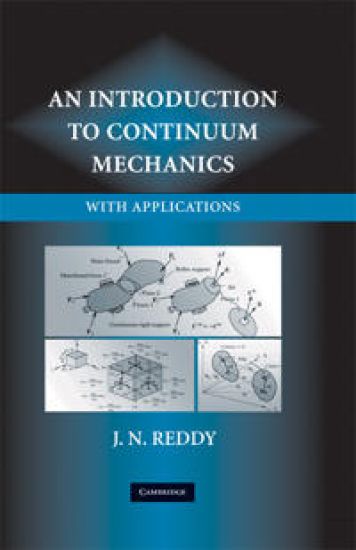
This textbook on continuum mechanics reflects the modern view that scientists and engineers should be trained to think and work in multidisciplinary environments. A course on continuum mechanics introduces the basic principles of mechanics and prepares students for advanced courses in traditional and emerging fields such as biomechanics and nanomechanics. This text introduces the main concepts of continuum mechanics simply with rich supporting examples but does not compromise mathematically in providing the invariant form as well as component form of the basic equations and their applications to problems in elasticity, fluid mechanics, and heat transfer. The book is ideal for advanced undergraduate and beginning graduate students. The book features: derivations of the basic equations of mechanics in invariant (vector and tensor) form and specializations of the governing equations to various coordinate systems; numerous illustrative examples; chapter-end summaries; and exercise problems to test and extend the understanding of concepts presented.
Theory and Analysis of Elastic Plates and Shells
Because plates and shells are common structural elements in aerospace, automotive, and civil engineering structures, engineers must understand the behavior of such structures through the study of theory and analysis. Compiling this information into a single volume, Theory and Analysis of Elastic Plates and Shells, Second Edition presents a complete, up-to-date, and unified treatment of classical and shear deformation plates and shells, from the basic derivation of theories to analytical and numerical solutions. Revised and updated, this second edition incorporates new information in most chapters, along with some rearrangement of topics to improve the clarity of the overall presentation. The book presents new material on the theory and analysis of shells, featuring an additional chapter devoted to the topic. The author also includes new sections that address Castigliano's theorems, axisymmetric buckling of circular plates, the relationships between the solutions of classical and shear deformation theories, and the nonlinear finite element analysis of plates. The book provides many illustrations of theories, formulations, and solution methods, resulting in an easy-to-understand presentation of the topics. Like the previous edition, this book remains a suitable textbook for a course on plates and shells in aerospace, civil, and mechanical engineering curricula and continues to serve as a reference for industrial and academic structural engineers and scientists.