
Kirjailija
J. R. McNeill
Kirjat ja teokset yhdessä paikassa: 16 kirjaa, julkaisuja vuosilta 2001–2026, suosituimpiin kuuluu The Human Web. Vertaile teosten hintoja ja tarkista saatavuus suomalaisista kirjakaupoista.
Nimi esiintyy myös muodoissa: J.R. McNeill
16 kirjaa
Kirjojen julkaisuvuodet: 2001–2026.
A leader in the field presents a cohesive narrative of world history that effectively addresses the main challenge of the introductory survey: how to navigate beginning students through the vast detail of the subject. McNeill uses connective webs—along which trade, religious beliefs, technologies, pathogens and much more travelled—to organise details and keep the big picture in view. Students emerge with clear takeaways and a strong sense of the basic dynamics of world history. Together with digital resources that amplify the webs approach and highlight diverse types of evidence, John McNeill’s The Webs of Humankind offers a clear and effective teaching tool for the world history survey course.
A leader in the field presents a cohesive narrative of world history that effectively addresses the main challenge of the introductory survey: how to navigate beginning students through the vast detail of the subject. McNeill uses connective webs—along which trade, religious beliefs, technologies, pathogens and much more travelled—to organise details and keep the big picture in view. Students emerge with clear takeaways and a strong sense of the basic dynamics of world history. Together with digital resources that amplify the webs approach and highlight diverse types of evidence, John McNeill’s The Webs of Humankind offers a clear and effective teaching tool for the world history survey course.
Decadence and decay : from ancient Rome to the present
Faramerz Dabhiowala; Melanie Grundmann; Richard Whatmore; Mattias Hessérus; Adoreé Villany; Andrew Huddleston; Saul David; Andrew Preston; Daniela Cammack; Pernille Røge; Adam Tooze; J.R. McNeill; Jonathan Rees; Robert Beuregard; William O’Reilly; Michael Nelson; Peter Heather; Robert Coates-Stephans; Neil McLynn; Richard Miles
Bokförlaget Stolpe
2019
sidottu
Halvin toimitettuna 40,40 €
The fear of living in the end times has a long history. In Decadence and Decay, a group of distinguished international scholars describe how societies over time have handled and interpreted the concept of decline. In times of unrest and transition, declinism the notion that a culture or civilisation is headed towards irreversible decline tends to capture the public imagination. The essays in this volume address how notions of decadence and decay have been used both as opprobrium and as a form of self-definition and empowerment an instrument to protect individualism against collectivistic oppression. From ancient Rome to the present, ideas and expressions of decadence and decay have played a critical role in how we perceive the world.
The Great Acceleration
J. R. McNeill; Peter Engelke
The Belknap Press
2016
nidottu
Halvin toimitettuna 30,60 €
The Earth has entered a new age—the Anthropocene—in which humans are the most powerful influence on global ecology. Since the mid-twentieth century, the accelerating pace of energy use, greenhouse gas emissions, and population growth has thrust the planet into a massive uncontrolled experiment. The Great Acceleration explains its causes and consequences, highlighting the role of energy systems, as well as trends in climate change, urbanization, and environmentalism. More than any other factor, human dependence on fossil fuels inaugurated the Anthropocene. Before 1700, people used little in the way of fossil fuels, but over the next two hundred years coal became the most important energy source. When oil entered the picture, coal and oil soon accounted for seventy-five percent of human energy use. This allowed far more economic activity and produced a higher standard of living than people had ever known—but it created far more ecological disruption. We are now living in the Anthropocene. The period from 1945 to the present represents the most anomalous period in the history of humanity’s relationship with the biosphere. Three-quarters of the carbon dioxide humans have contributed to the atmosphere has accumulated since World War II ended, and the number of people on Earth has nearly tripled. So far, humans have dramatically altered the planet’s biogeochemical systems without consciously managing them. If we try to control these systems through geoengineering, we will inaugurate another stage of the Anthropocene. Where it might lead, no one can say for sure.
This book explores the links among ecology, disease, and international politics in the context of the Greater Caribbean - the landscapes lying between Surinam and the Chesapeake - in the seventeenth through early twentieth centuries. Ecological changes made these landscapes especially suitable for the vector mosquitoes of yellow fever and malaria, and these diseases wrought systematic havoc among armies and would-be settlers. Because yellow fever confers immunity on survivors of the disease, and because malaria confers resistance, these diseases played partisan roles in the struggles for empire and revolution, attacking some populations more severely than others. In particular, yellow fever and malaria attacked newcomers to the region, which helped keep the Spanish Empire Spanish in the face of predatory rivals in the seventeenth and early eighteenth centuries. In the late eighteenth and through the nineteenth century, these diseases helped revolutions to succeed by decimating forces sent out from Europe to prevent them.
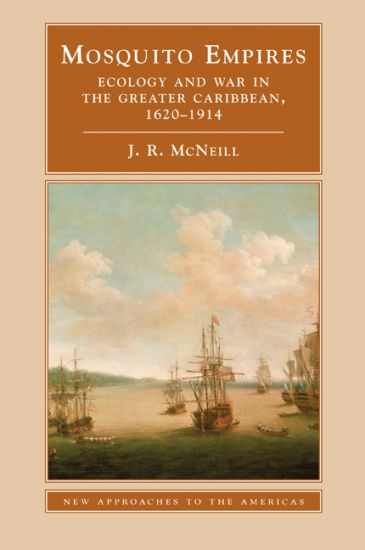
This book explores the links among ecology, disease, and international politics in the context of the Greater Caribbean - the landscapes lying between Surinam and the Chesapeake - in the seventeenth through early twentieth centuries. Ecological changes made these landscapes especially suitable for the vector mosquitoes of yellow fever and malaria, and these diseases wrought systematic havoc among armies and would-be settlers. Because yellow fever confers immunity on survivors of the disease, and because malaria confers resistance, these diseases played partisan roles in the struggles for empire and revolution, attacking some populations more severely than others. In particular, yellow fever and malaria attacked newcomers to the region, which helped keep the Spanish Empire Spanish in the face of predatory rivals in the seventeenth and early eighteenth centuries. In the late eighteenth and through the nineteenth century, these diseases helped revolutions to succeed by decimating forces sent out from Europe to prevent them.
The Human Web
J. R. McNeill; William H. McNeill
WW Norton Co
2004
nidottu
Halvin toimitettuna 37,90 €
World-historical questions such as these, the subjects of major works by Jared Diamond, David Landes, and others, are now of great moment as global frictions increase. In a spirited and original contribution to this quickening discussion, two renowned historians, father and son, explore the webs that have drawn humans together in patterns of interaction and exchange, cooperation and competition, since earliest times. Whether small or large, loose or dense, these webs have provided the medium for the movement of ideas, goods, power, and money within and across cultures, societies, and nations. From the thin, localized webs that characterized agricultural communities twelve thousand years ago, through the denser, more interactive metropolitan webs that surrounded ancient Sumer, Athens, and Timbuktu, to the electrified global web that today envelops virtually the entire world in a maelstrom of cooperation and competition, J. R. McNeill and William H. McNeill show human webs to be a key component of world history and a revealing framework of analysis. Avoiding any determinism, environmental or cultural, the McNeills give us a synthesizing picture of the big patterns of world history in a rich, open-ended, concise account.
This book describes and analyses the environmental history of the mountain areas of the Mediterranean world, focusing on Turkey, Greece, Italy, Spain, and Morocco. The author examines the land and its people and concludes that great changes in the nineteenth and twentieth centuries created the often barren and depopulated countrysides of today. These changes, he suggests, lie behind much of the social and political turbulence of modern times as mountain people came to terms with worsening conditions. Written in a lively style, the book is the first environmental history of the Mediterranean area.
The history of the twentieth century is most often told through its world wars, the rise and fall of communism, or its economic upheavals. In his startling book, J. R. McNeill gives us our first general account of what may prove to be the most significant dimension of the twentieth century: its environmental history. To a degree unprecedented in human history, we have refashioned the earth's air, water, and soil, and the biosphere of which we are a part. Based on exhaustive research, McNeill's story—a compelling blend of anecdotes, data, and shrewd analysis—never preaches: it is our definitive account. This is a volume in The Global Century Series (general editor, Paul Kennedy).