Kirjojen hintavertailu – 12 859 818 kirjaa ja 27 kauppaa

Kirjailija

Jaak Panksepp

Kirjat ja teokset yhdessä paikassa: 4 kirjaa, julkaisuja vuosilta 2012–2018, suosituimpiin kuuluu The Emotional Foundations of Personality. Vertaile teosten hintoja ja tarkista saatavuus suomalaisista kirjakaupoista.

4 kirjaa

Kirjojen julkaisuvuodet: 2012–2018.

The Emotional Foundations of Personality

The Emotional Foundations of Personality

Kenneth L. Davis; Jaak Panksepp; Mark Solms

WW Norton Co
2018
sidottu

Halvin toimitettuna 37,20 €

This book presents the wealth of scientific evidence that our personality emerges from evolved primary emotions shared by all mammals. Yes, your dog feels love—and many other things too. These subcortically generated emotions bias our actions, alter our perceptions, guide our learning, provide the basis for our thoughts and memories, and become regulated over the course of our lives. Understanding personality development from the perspective of mammals is a groundbreaking approach and one that sheds new light on the ways in which we as humans respond to life events, both good and bad. Jaak Panksepp, famous for discovering laughter in rats and for creating the field of affective neuroscience, died in April 2017. This book forms part of his lasting legacy and impact on a wide range of scientific and humanistic disciplines. It will be essential reading for anyone trying to understand how we act in the world and the world’s impact on us.
Inklusion, leg og empati

Inklusion, leg og empati

Susan Hart; Marianne Bentzen; Colwyn Trevarthen; Jaak Panksepp; Bonnie Mark Goldstein; Pat Ogden; Serena Potter; Dr Dorothea Rahm; Christine Lakoseljac-Andreasen; Eldbjørg Wedaa; Ulla Holck; Helle Jensen; Marlo Winstead; Phyllis Rubin; Alexandre Duarte; Stine Lindahl Jacobsen; Knud Hellborn; Gitte Jørgensen

Gyldendal
2015
nidottu
Inklusion, leg og empati er skrevet til lærere, pædagoger, psykologer og andre, der arbejder med børn, og som gerne vil etablere følelsesmæssigt modnende gruppefællesskaber med 4-12-årige børn. Bogens forfattere er fagpersoner fra mange steder i verden, som alle har støttet børns udviklingsproces gennem kreative tilgange, så børnene har fået mulighed for at udvikle sig til personer med en høj mentaliseringskapacitet, som kan indgå i konstruktive fællesskaber. Alle bogens kapitler handler om, hvordan gruppeoplevelser bidrager til og understøtter børns voksende kapacitet til at indgå i konstruktive og livsbekræftende samspil med andre. I denne nye udgave af bogen er kapitlet om det udviklingsbaserede børnegruppeprogram NUSSA blevet omskrevet, da programmet er overtaget af Susan Hart og tilpasset neuroaffektiv udviklingspsykologi. ”Når børn kommer i skole, møder de udfordringen i at tilegne sig nye kognitive færdigheder, men en lige så vigtig udfordring ligger i at tilegne sig nye former for samspil med en bredere gruppe af andre børn og voksne […] Kapitlerne i denne bog inviterer os til at se på de mange kreative metoder, forfatterne har fundet til at udstrække de kvaliteter og fordele, der kendetegner tidlige, legende og afstemte dyadiske relationer, til arbejdet med større børn i grupper.” Phyllis Booth i bogens forord
Emotions and Psychopathology

Emotions and Psychopathology

Manfred Clynes; Jaak Panksepp

Springer-Verlag New York Inc.
2012
nidottu
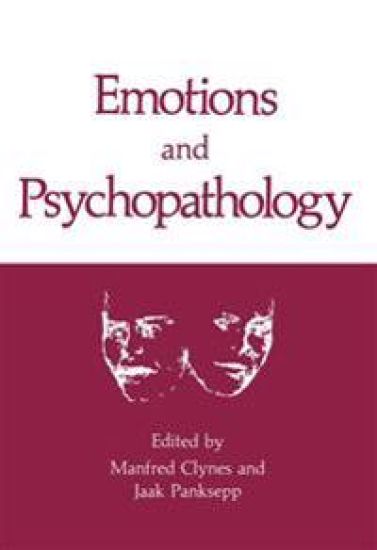
This book summarises the proceedings of a symposium on "Emotions and Psychopathology" which was held by the Department of Psychology of Bowling Green State University from September 26-27, 1986. It is coming to be realized that to understand the underlying structure and dynamics of many psychopathologies, it is essential to understand the nature of emotions. The aim of this symposium was to gather a group of investigators and thinkers who would have valuable and unique perspectives on the nature of emotions and on their relationship to psychic disorders. The main participants were Manfred Clynes, Helen Block Lewis, Michael Liebowitz, Marvin Minsky, Robert Plutchik, John Paul Scott and Jaak Panksepp. Ted Melnechuk chaired the half-day of round table discussion on the day following the symposium, and Gail Zivin and Larry Stettner presented informal position statements on ethologi­ during the round table. On the evening before the symposium, Elliot cal approaches Valenstein of The University of Michigan presented a pre-symposium colloquium entitled "Great and Desperate Cures" which summarized his most recent contribu­ tion to the Psychosurgery debate. We should like to refer you to his excellent book on the subject, with the same title, (Basic Books,1986), which can help forewarn us of possible future worries in the application of biological technologies. Paul Byers who did not attend the meeting was invited to write a chapter summarizing cultural and societal issues which were not formally covered at the meeting.
The Archaeology of Mind

The Archaeology of Mind

Jaak Panksepp; Lucy Biven

WW Norton Co
2012
sidottu

Halvin toimitettuna 61,50 €

A look at the seven emotional systems of the brain by the researcher who discovered them. What makes us happy? What makes us sad? How do we come to feel a sense of enthusiasm? What fills us with lust, anger, fear, or tenderness? Traditional behavioral and cognitive neuroscience have yet to provide satisfactory answers. The Archaeology of Mind presents an affective neuroscience approach-which takes into consideration basic mental processes, brain functions, and emotional behaviors that all mammals share-to locate the neural mechanisms of emotional expression. It reveals-for the first time- the deep neural sources of our values and basic emotional feelings. This book elaborates on the seven emotional systems that explain how we live and behave. These systems originate in deep areas of the brain that are remarkably similar across all mammalian species. When they are disrupted, we find the origins of emotional disorders: - SEEKING: how the brain generates a euphoric and expectant response - FEAR: how the brain responds to the threat of physical danger and death - RAGE: sources of irritation and fury in the brain - LUST: how sexual desire and attachments are elaborated in the brain - CARE: sources of maternal nurturance - GRIEF: sources of non-sexual attachments - PLAY: how the brain generates joyous, rough-and-tumble interactions - SELF: a hypothesis explaining how affects might be elaborated in the brain The book offers an evidence-based evolutionary taxonomy of emotions and affects and, as such, a brand-new clinical paradigm for treating psychiatric disorders in clinical practice.