Kirjojen hintavertailu – 12 903 725 kirjaa ja 27 kauppaa

Kirjailija

Jack Zevin

Kirjat ja teokset yhdessä paikassa: 17 kirjaa, julkaisuja vuosilta 2010–2023, suosituimpiin kuuluu Creative Teaching for All. Vertaile teosten hintoja ja tarkista saatavuus suomalaisista kirjakaupoista.

17 kirjaa

Kirjojen julkaisuvuodet: 2010–2023.

Social Studies for the Twenty-First Century

Social Studies for the Twenty-First Century

Jack Zevin

TAYLOR FRANCIS LTD
2023
nidottu
Now in its 5th edition, this popular text offers practical, interesting, exciting ways to teach social studies and a multitude of instructional and professional resources for teachers. Theory, curriculum, methods, and assessment are woven into a comprehensive model for setting objectives; planning lessons, units, and courses; choosing classroom strategies; and constructing tests for some of the field's most popular and enduring programs. The reflective and integrative framework emphasizes building imagination, insight, and critical thinking into everyday classrooms; encourages problem-solving attitudes and behavior; and provokes analysis, reflection, and debate. Throughout the text, all aspects of curriculum and instruction are viewed from a tripartite perspective that divides social studies instruction into didactic (factual), reflective (analytical), and affective (judgmental) components. These three components are seen as supporting one another, building the groundwork for taking stands on issues, past and present. At the center is the author's belief that the heart and soul of social studies instruction, perhaps all teaching, lies in stimulating the production of ideas; looking at knowledge from others' viewpoints; and formulating for oneself a set of goals, values, and beliefs that can be explained and justified in open discussion. This new edition is heavily revised and condensed to promote ease of use. "Build Your Own Lesson" additions to each chapter encourage improvisation and inquiry-based teaching and learning across subjects. A Companion Website offers additional activities, lessons, and resources for pre-service and practicing social studies teachers.
Social Studies for the Twenty-First Century

Social Studies for the Twenty-First Century

Jack Zevin

TAYLOR FRANCIS LTD
2023
sidottu
Now in its 5th edition, this popular text offers practical, interesting, exciting ways to teach social studies and a multitude of instructional and professional resources for teachers. Theory, curriculum, methods, and assessment are woven into a comprehensive model for setting objectives; planning lessons, units, and courses; choosing classroom strategies; and constructing tests for some of the field's most popular and enduring programs. The reflective and integrative framework emphasizes building imagination, insight, and critical thinking into everyday classrooms; encourages problem-solving attitudes and behavior; and provokes analysis, reflection, and debate. Throughout the text, all aspects of curriculum and instruction are viewed from a tripartite perspective that divides social studies instruction into didactic (factual), reflective (analytical), and affective (judgmental) components. These three components are seen as supporting one another, building the groundwork for taking stands on issues, past and present. At the center is the author's belief that the heart and soul of social studies instruction, perhaps all teaching, lies in stimulating the production of ideas; looking at knowledge from others' viewpoints; and formulating for oneself a set of goals, values, and beliefs that can be explained and justified in open discussion. This new edition is heavily revised and condensed to promote ease of use. "Build Your Own Lesson" additions to each chapter encourage improvisation and inquiry-based teaching and learning across subjects. A Companion Website offers additional activities, lessons, and resources for pre-service and practicing social studies teachers.

Suspicious History

Suspicious History

Jack Zevin

Rowman Littlefield
2021
nidottu
Suspicious aims at providing teachers and students of history and related social sciences with ideas for critical thinking about past and present applied to documentation, images, and historical writing. Issues of perspective, bias, storytelling, patriotism and heroism, as well as interpretation are distributed among different chapters, along with guidance for making discussion provocative and involving, in light of principles for rethinking history.
Suspicious History

Suspicious History

Jack Zevin

Rowman Littlefield
2021
sidottu
Suspicious aims at providing teachers and students of history and related social sciences with ideas for critical thinking about past and present applied to documentation, images, and historical writing. Issues of perspective, bias, storytelling, patriotism and heroism, as well as interpretation are distributed among different chapters, along with guidance for making discussion provocative and involving, in light of principles for rethinking history.
Geography as Inquiry

Geography as Inquiry

Mark Newman; Jack Zevin

Rowman Littlefield
2016
sidottu
Geography as Inquiry invites teachers and learners to explore geography in exciting ways, across key concepts, connected to history and the social sciences, reestablishing its place in the social studies and history curriculum.
Geography as Inquiry

Geography as Inquiry

Mark Newman; Jack Zevin

Rowman Littlefield
2016
nidottu
Geography as Inquiry invites teachers and learners to explore geography in exciting ways, across key concepts, connected to history and the social sciences, reestablishing its place in the social studies and history curriculum.
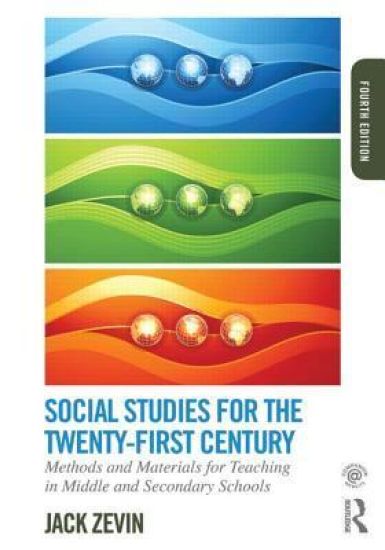
Social Studies for the Twenty-First Century
Now in its 4th edition, this popular text offers practical, interesting, exciting ways to teach social studies and a multitude of instructional and professional resources for teachers. Theory, curriculum, methods, and assessment are woven into a comprehensive model for setting objectives; planning lessons, units, and courses; choosing classroom strategies; and constructing tests for some of the field's most popular and enduring programs. The reflective and integrative framework emphasizes building imagination, insight, and critical thinking into everyday classrooms; encourages problem-solving attitudes and behavior; and provokes analysis, reflection, and debate. The text includes separate chapters on teaching each of the major areas of the social studies curriculum. Throughout the text, all aspects of curriculum and instruction are viewed from a tripartite perspective that divides social studies instruction into didactic (factual), reflective (analytical), and affective (judgmental) components. These three components are seen as supporting one another, building the groundwork for taking stands on issues, past and present. At the center is the author's belief that the heart and soul of social studies instruction, perhaps all teaching, lies in stimulating the production of ideas; looking at knowledge from others' viewpoints; and formulating for oneself a set of goals, values, and beliefs that can be explained and justified in open discussion. New in the Fourth Edition: Clear links to the The National Council for the Social Studies College, Career and Civic Life C3 Framework for Social Studies State Standards Attention to impact of high-stakes testing, Common Core State Standards, and related ongoing developments Expanded and critical review of the use of internet, web, and PowerPoint technologies Coverage of how to incorporate the many social science, humanities, and STEM fields to enrich the social studies Updates and revisions throughout, including new research reports reflecting current findings, new examples, more media and materials resources, particularly digital resources, new and updated pedagogical features Companion Website - new for this edition
Young Citizens of the World

Young Citizens of the World

Marilynne Boyle-Baise; Jack Zevin

Routledge
2013
sidottu
Young Citizens of the World takes a clear stance: Social studies is about citizenship education that is informed, deliberative, and activist—citizenship not only as a noun, something one studies, but as a verb, something one DOES. Its holistic, multicultural approach is based on this clear curricular and pedagogical purpose. Straightforward, engaging, and highly interactive, the book encourages students (and their teachers) to become informed, think it through, and take action. Each chapter is written as a civic engagement which is teacher-ready for use in elementary classrooms. A set of six teaching strategies that are constructive, inquiry-driven, dramatic, and deliberative bring the curricular framework to life through intensive, integrated meaningful studies of special places, important people, and significant times. Readers are invited to rehearse the projects in their social studies education courses and then to reinterpret them for their classrooms. The projects are supported by important resources for teaching, including supportive children’s literature, links to internet sites, and visual sources and by a Companion Website that enhances and extends the text.
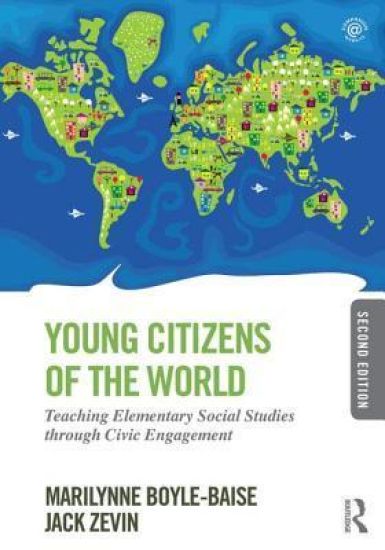
Young Citizens of the World

Young Citizens of the World

Marilynne Boyle-Baise; Jack Zevin

Routledge
2013
nidottu
Young Citizens of the World takes a clear stance: Social studies is about citizenship education that is informed, deliberative, and activist—citizenship not only as a noun, something one studies, but as a verb, something one DOES. Its holistic, multicultural approach is based on this clear curricular and pedagogical purpose. Straightforward, engaging, and highly interactive, the book encourages students (and their teachers) to become informed, think it through, and take action. Each chapter is written as a civic engagement which is teacher-ready for use in elementary classrooms. A set of six teaching strategies that are constructive, inquiry-driven, dramatic, and deliberative bring the curricular framework to life through intensive, integrated meaningful studies of special places, important people, and significant times. Readers are invited to rehearse the projects in their social studies education courses and then to reinterpret them for their classrooms. The projects are supported by important resources for teaching, including supportive children’s literature, links to internet sites, and visual sources and by a Companion Website that enhances and extends the text.
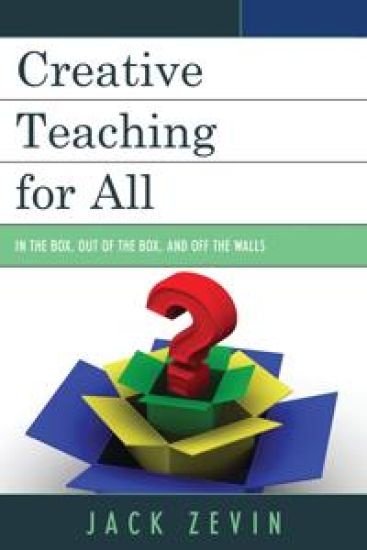
Creative Teaching for All

Creative Teaching for All

Jack Zevin

Rowman Littlefield Education
2013
sidottu
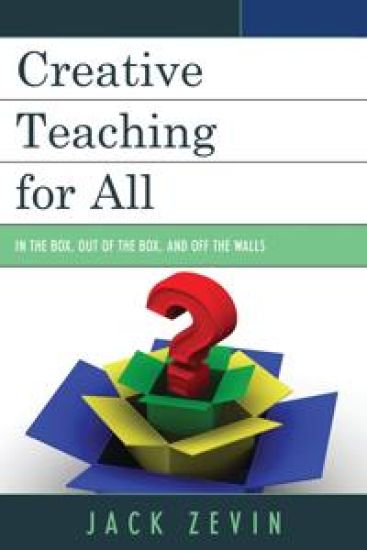
Read Creative Teaching for All as an antidote to rapidly growing pressures for quick and easy teacher results, and constant evaluations. Employ creative ideas to resist teaching to the (usually factual) test, and to the many choking rules, standards, cores, and state regulations that strangle motivation and destroy experimentation. Reclaim teacher control of curriculum design and instructional methods across all fields by boldly going ‘outside’, even off the walls, where teachers have lived happier lives before the invention of rubrics and rules. Become the truly creative teacher to which you have aspired! Highlights of the book: ·Explores and expands opportunities for engaging student conversation and ideas ·Adds variety and depth to your teaching methods ·Hone questioning and critical thinking skills ·Move from lower to higher levels ·Reinvent instruction at home, work, or in classrooms as places of imagination and enjoyment.
Creative Teaching for All

Creative Teaching for All

Jack Zevin

Rowman Littlefield Education
2013
nidottu
Read Creative Teaching for All as an antidote to rapidly growing pressures for quick and easy teacher results, and constant evaluations. Employ creative ideas to resist teaching to the (usually factual) test, and to the many choking rules, standards, cores, and state regulations that strangle motivation and destroy experimentation. Reclaim teacher control of curriculum design and instructional methods across all fields by boldly going ‘outside’, even off the walls, where teachers have lived happier lives before the invention of rubrics and rules. Become the truly creative teacher to which you have aspired! Highlights of the book: ·Explores and expands opportunities for engaging student conversation and ideas · Adds variety and depth to your teaching methods · Hone questioning and critical thinking skills · Move from lower to higher levels ·Reinvent instruction at home, work, or in classrooms as places of imagination and enjoyment
Teaching U.S. History as Mystery

Teaching U.S. History as Mystery

David Gerwin; Jack Zevin

Routledge
2010
sidottu
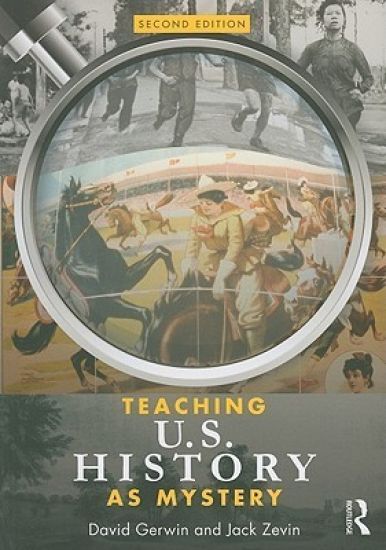
Presenting U. S. history as contested interpretations of compelling problems, this text offers a clear set of principles and strategies, together with case studies and "Mystery Packets" of documentary materials from key periods in American history, that teachers can use with their students to promote and sustain problem-finding and problem-solving in history and social studies classrooms. Structured to encourage new attitudes toward history as hands-on inquiry, conflicting interpretation, and myriad uncertainties, the whole point is to create a user-friendly way of teaching history "as it really is" - with all its problems, issues, unknowns, and value clashes. Students and teachers are invited to think anew as active participants in learning history rather than as passive sponges soaking up pre-arranged and often misrepresented people and events. New in the Second Edition: New chapters on Moundbuilders, and the Origins of Slavery; expanded Gulf of Tonkin chapter now covering the Vietnam and Iraq wars; teaching tips in this edition draw on years of teacher experience in using mysteries in their classrooms.
Teaching U.S. History as Mystery

Teaching U.S. History as Mystery

David Gerwin; Jack Zevin

Routledge
2010
nidottu
Presenting U. S. history as contested interpretations of compelling problems, this text offers a clear set of principles and strategies, together with case studies and "Mystery Packets" of documentary materials from key periods in American history, that teachers can use with their students to promote and sustain problem-finding and problem-solving in history and social studies classrooms. Structured to encourage new attitudes toward history as hands-on inquiry, conflicting interpretation, and myriad uncertainties, the whole point is to create a user-friendly way of teaching history "as it really is" - with all its problems, issues, unknowns, and value clashes. Students and teachers are invited to think anew as active participants in learning history rather than as passive sponges soaking up pre-arranged and often misrepresented people and events. New in the Second Edition: New chapters on Moundbuilders, and the Origins of Slavery; expanded Gulf of Tonkin chapter now covering the Vietnam and Iraq wars; teaching tips in this edition draw on years of teacher experience in using mysteries in their classrooms.
Teaching World History as Mystery

Teaching World History as Mystery

Jack Zevin; David Gerwin

Routledge
2010
sidottu
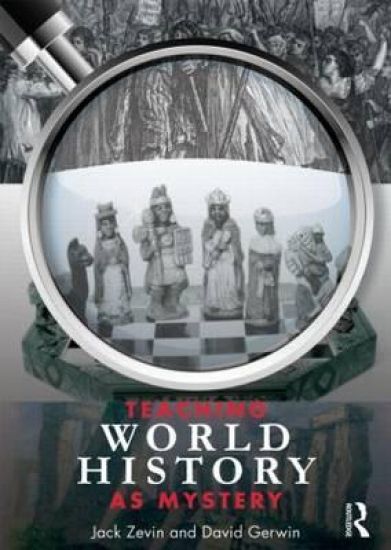
Offering a philosophy, methodology, and examples for history instruction that are active, imaginative, and provocative, this text presents a fully developed pedagogy based on problem-solving methods that promote reasoning and judgment and restore a sense of imagination and participation to classroom learning. It is designed to draw readers into the detective process that characterizes the work of professional historians and social scientists - sharing raw data, defining terms, building interpretations, and testing competing theories. An inquiry framework drives both the pedagogy and the choice of historical materials, with selections favoring the unsolved, controversial, and fragmented rather than the neatly wrapped up analysis of past events. Teaching World History as Mystery: Provides a balanced combination of interestingly arranged historical content, and clearly explained instructional strategies Features case studies of commonly and not so commonly taught topics within a typical world/global history curriculum using combinations of primary and secondary documents Discusses ways of dealing with ethical and moral issues in world history classrooms, drawing students into persisting questions of historical truth, bias, and judgment
Teaching World History as Mystery

Teaching World History as Mystery

Jack Zevin; David Gerwin

Routledge
2010
nidottu
Offering a philosophy, methodology, and examples for history instruction that are active, imaginative, and provocative, this text presents a fully developed pedagogy based on problem-solving methods that promote reasoning and judgment and restore a sense of imagination and participation to classroom learning. It is designed to draw readers into the detective process that characterizes the work of professional historians and social scientists - sharing raw data, defining terms, building interpretations, and testing competing theories. An inquiry framework drives both the pedagogy and the choice of historical materials, with selections favoring the unsolved, controversial, and fragmented rather than the neatly wrapped up analysis of past events. Teaching World History as Mystery: Provides a balanced combination of interestingly arranged historical content, and clearly explained instructional strategies Features case studies of commonly and not so commonly taught topics within a typical world/global history curriculum using combinations of primary and secondary documents Discusses ways of dealing with ethical and moral issues in world history classrooms, drawing students into persisting questions of historical truth, bias, and judgment
Teaching on a Tightrope

Teaching on a Tightrope

Jack Zevin

Rowman Littlefield Education
2010
sidottu
Teaching on a Tightrope offers those seeking to play the teacher's role a way of thinking about the major components of teaching. These components or dimensions are described in terms of pairings that interact and overlap with each other, e.g., teaching as art and science, content and process, theory and practice, cognition and emotion. Each pairing is focused on the overall relationship and communication between actor/actress, the teacher, and audience, the students. Throughout the book, a rationale is proposed that a truly great teacher must learn how to balance the many components of teaching to fit both subject and audience. Success depends upon the knowledge, skill, and performance of the one playing teacher in reaching those in the student roles. Practice must be informed by theory, content by process, cognition by emotion; no single factor can stand by itself, but must link to others. By expanding your understanding of a teacher's many roles, you can experiment with a wide variety of instructional methods to motivate and sustain student learning. Reliance on one technique, lecturing or group work, from this point of view does not guarantee success in creating interested learners. Much more is need to achieve a joining of ideas, techniques, subject, and atmosphere, above all, attention to audience needs and interests, anxieties and problems. Communication, the heart of teaching should be thought of as at least a two way, or better yet, a multi-path interchange of ideas and emotions. As teachers grow in experience and skill, they draw upon many sources for inspiration and satisfaction. They slowly integrate facts, ideas, concepts, and feelings into an overall philosophy that guides their choices of effective methods and materials in promoting learning. A balance emerges from competing factors and audience adaptations, or doesn't, leading to a sense of euphoria and success, or a feeling of depression and failure. Teaching is portrayed as difficult and rewarding, yet often disappointing as well,
Teaching on a Tightrope

Teaching on a Tightrope

Jack Zevin

Rowman Littlefield Education
2010
nidottu
Teaching on a Tightrope offers those seeking to play the teacher's role a way of thinking about the major components of teaching. These components or dimensions are described in terms of pairings that interact and overlap with each other, e.g., teaching as art and science, content and process, theory and practice, cognition and emotion. Each pairing is focused on the overall relationship and communication between actor/actress, the teacher, and audience, the students. Throughout the book, a rationale is proposed that a truly great teacher must learn how to balance the many components of teaching to fit both subject and audience. Success depends upon the knowledge, skill, and performance of the one playing teacher in reaching those in the student roles. Practice must be informed by theory, content by process, cognition by emotion; no single factor can stand by itself, but must link to others. By expanding your understanding of a teacher's many roles, you can experiment with a wide variety of instructional methods to motivate and sustain student learning. Reliance on one technique, lecturing or group work, from this point of view does not guarantee success in creating interested learners. Much more is need to achieve a joining of ideas, techniques, subject, and atmosphere, above all, attention to audience needs and interests, anxieties and problems. Communication, the heart of teaching should be thought of as at least a two way, or better yet, a multi-path interchange of ideas and emotions. As teachers grow in experience and skill, they draw upon many sources for inspiration and satisfaction. They slowly integrate facts, ideas, concepts, and feelings into an overall philosophy that guides their choices of effective methods and materials in promoting learning. A balance emerges from competing factors and audience adaptations, or doesn't, leading to a sense of euphoria and success, or a feeling of depression and failure. Teaching is portrayed as difficult and rewarding, yet often disappointing as well, as a better teacher slowly emerges, and perhaps becomes the great teacher we would all like to be.