Kirjojen hintavertailu – 12 903 724 kirjaa ja 27 kauppaa

Kirjailija

Jacob K. White

Kirjat ja teokset yhdessä paikassa: 4 kirjaa, julkaisuja vuosilta 1986–2011, suosituimpiin kuuluu Relaxation Techniques for the Simulation of VLSI Circuits. Vertaile teosten hintoja ja tarkista saatavuus suomalaisista kirjakaupoista.

4 kirjaa

Kirjojen julkaisuvuodet: 1986–2011.

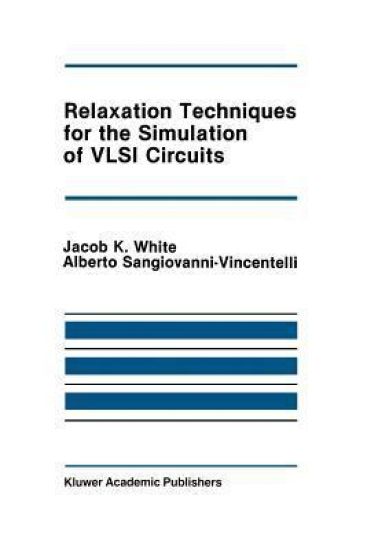
Relaxation Techniques for the Simulation of VLSI Circuits

Relaxation Techniques for the Simulation of VLSI Circuits

Jacob K. White; Alberto L. Sangiovanni-Vincentelli

Springer-Verlag New York Inc.
2011
nidottu
Circuit simulation has been a topic of great interest to the integrated circuit design community for many years. It is a difficult, and interesting, problem be­ cause circuit simulators are very heavily used, consuming thousands of computer hours every year, and therefore the algorithms must be very efficient. In addi­ tion, circuit simulators are heavily relied upon, with millions of dollars being gambled on their accuracy, and therefore the algorithms must be very robust. At the University of California, Berkeley, a great deal of research has been devoted to the study of both the numerical properties and the efficient imple­ mentation of circuit simulation algorithms. Research efforts have led to several programs, starting with CANCER in the 1960's and the enormously successful SPICE program in the early 1970's, to MOTIS-C, SPLICE, and RELAX in the late 1970's, and finally to SPLICE2 and RELAX2 in the 1980's. Our primary goal in writing this book was to present some of the results of our current research on the application of relaxation algorithms to circuit simu­ lation. As we began, we realized that a large body of mathematical and exper­ imental results had been amassed over the past twenty years by graduate students, professors, and industry researchers working on circuit simulation. It became a secondary goal to try to find an organization of this mass of material that was mathematically rigorous, had practical relevance, and still retained the natural intuitive simplicity of the circuit simulation subject.
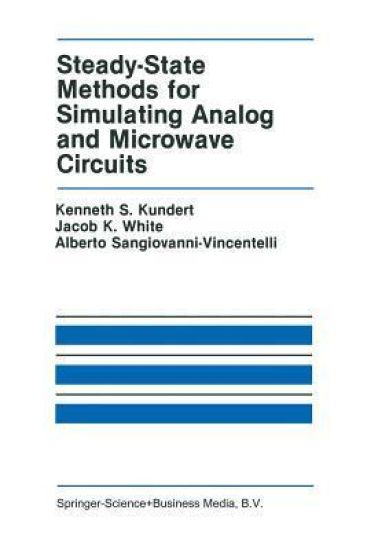
Steady-State Methods for Simulating Analog and Microwave Circuits

Steady-State Methods for Simulating Analog and Microwave Circuits

Kenneth S. Kundert; Jacob K. White; Alberto L. Sangiovanni-Vincentelli

Springer-Verlag New York Inc.
2010
nidottu
The motivation for starting the work described in this book was the interest that Hewlett-Packard's microwave circuit designers had in simulation techniques that could tackle the problem of finding steady­ state solutions for nonlinear circuits, particularly circuits containing distributed elements such as transmission lines. Examining the problem of computing steady-state solutions in this context has led to a collection of novel numerical algorithms which we have gathered, along with some background material, into this book. Although we wished to appeal to as broad an audience as possible, to treat the subject in depth required maintaining a narrow focus. Our compromise was to assume that the reader is familiar with basic numerical methods, such as might be found in [dahlquist74] or [vlach83], but not assume any specialized knowledge of methods for steady-state problems. Although we focus on algorithms for computing steady-state solutions of analog and microwave circuits, the methods herein are general in nature and may find use in other disciplines. A number of new algorithms are presented, the contributions primarily centering around new approaches to harmonic balance and mixed frequency-time methods. These methods are described, along with appropriate background material, in what we hope is a reasonably satisfying blend of theory, practice, and results. The theory is given so that the algorithms can be fully understood and their correctness established.
Steady-State Methods for Simulating Analog and Microwave Circuits

Steady-State Methods for Simulating Analog and Microwave Circuits

Kenneth S. Kundert; Jacob K. White; Alberto L. Sangiovanni-Vincentelli

Springer
1990
sidottu
The motivation for starting the work described in this book was the interest that Hewlett-Packard's microwave circuit designers had in simulation techniques that could tackle the problem of finding steady­ state solutions for nonlinear circuits, particularly circuits containing distributed elements such as transmission lines. Examining the problem of computing steady-state solutions in this context has led to a collection of novel numerical algorithms which we have gathered, along with some background material, into this book. Although we wished to appeal to as broad an audience as possible, to treat the subject in depth required maintaining a narrow focus. Our compromise was to assume that the reader is familiar with basic numerical methods, such as might be found in [dahlquist74] or [vlach83], but not assume any specialized knowledge of methods for steady-state problems. Although we focus on algorithms for computing steady-state solutions of analog and microwave circuits, the methods herein are general in nature and may find use in other disciplines. A number of new algorithms are presented, the contributions primarily centering around new approaches to harmonic balance and mixed frequency-time methods. These methods are described, along with appropriate background material, in what we hope is a reasonably satisfying blend of theory, practice, and results. The theory is given so that the algorithms can be fully understood and their correctness established.
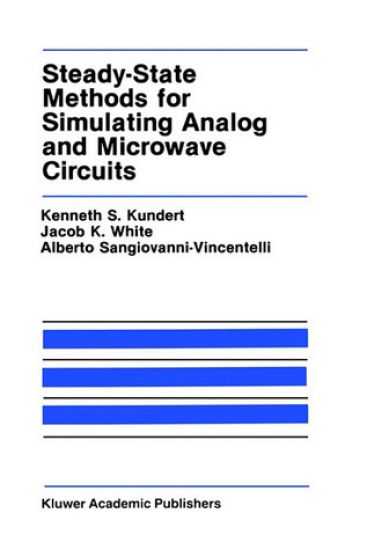
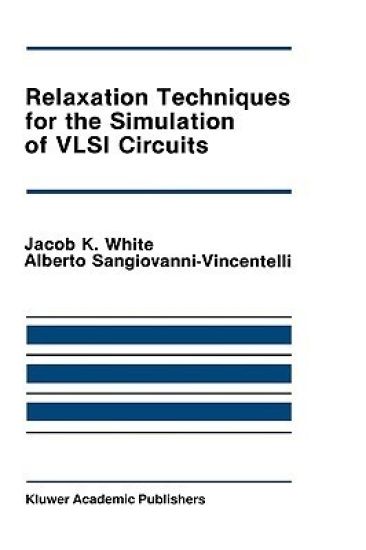
Relaxation Techniques for the Simulation of VLSI Circuits

Relaxation Techniques for the Simulation of VLSI Circuits

Jacob K. White; Alberto L. Sangiovanni-Vincentelli

Kluwer Academic Publishers
1986
sidottu
Circuit simulation has been a topic of great interest to the integrated circuit design community for many years. It is a difficult, and interesting, problem be­ cause circuit simulators are very heavily used, consuming thousands of computer hours every year, and therefore the algorithms must be very efficient. In addi­ tion, circuit simulators are heavily relied upon, with millions of dollars being gambled on their accuracy, and therefore the algorithms must be very robust. At the University of California, Berkeley, a great deal of research has been devoted to the study of both the numerical properties and the efficient imple­ mentation of circuit simulation algorithms. Research efforts have led to several programs, starting with CANCER in the 1960's and the enormously successful SPICE program in the early 1970's, to MOTIS-C, SPLICE, and RELAX in the late 1970's, and finally to SPLICE2 and RELAX2 in the 1980's. Our primary goal in writing this book was to present some of the results of our current research on the application of relaxation algorithms to circuit simu­ lation. As we began, we realized that a large body of mathematical and exper­ imental results had been amassed over the past twenty years by graduate students, professors, and industry researchers working on circuit simulation. It became a secondary goal to try to find an organization of this mass of material that was mathematically rigorous, had practical relevance, and still retained the natural intuitive simplicity of the circuit simulation subject.