Kirjojen hintavertailu – 12 859 818 kirjaa ja 27 kauppaa

Kirjailija

Jacques Rancière

Kirjat ja teokset yhdessä paikassa: 98 kirjaa, julkaisuja vuosilta 1991–2026, suosituimpiin kuuluu Glänta 1(2014) Migration 1. Vertaile teosten hintoja ja tarkista saatavuus suomalaisista kirjakaupoista.

Nimi esiintyy myös muodoissa: Jacques Ranciere

98 kirjaa

Kirjojen julkaisuvuodet: 1991–2026.

The Aesthetic Unconscious

The Aesthetic Unconscious

Jacques Rancière

Polity Press
2009
nidottu

Halvin toimitettuna 30,50 €

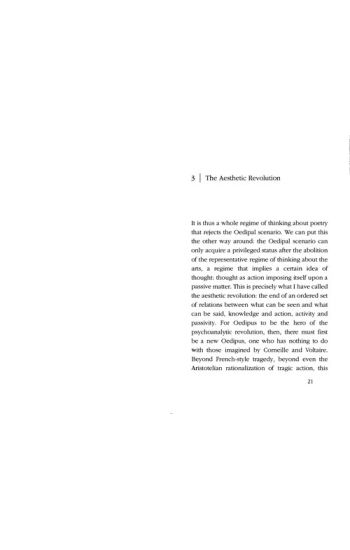
This book is not concerned with the use of Freudian concepts for the interpretation of literary and artistic works. Rather, it is concerned with why this interpretation plays such an important role in demonstrating the contemporary relevance of psychoanalytic concepts. In order for Freud to use the Oedipus complex as a means for the interpretation of texts, it was necessary first of all for a particular notion of Oedipus, belonging to the Romantic reinvention of Greek antiquity, to have produced a certain idea of the power of that thought which does not think, and the power of that speech which remains silent. From this it does not follow that the Freudian unconscious was already prefigured by the aesthetic unconscious. Freud's 'aesthetic' analyses reveal instead a tension between the two forms of unconscious. In this concise and brilliant text Rancière brings out this tension and shows us what is at stake in this confrontation.
The Aesthetic Unconscious

The Aesthetic Unconscious

Jacques Rancière

Polity Press
2009
sidottu
This book is not concerned with the use of Freudian concepts for the interpretation of literary and artistic works. Rather, it is concerned with why this interpretation plays such an important role in demonstrating the contemporary relevance of psychoanalytic concepts. In order for Freud to use the Oedipus complex as a means for the interpretation of texts, it was necessary first of all for a particular notion of Oedipus, belonging to the Romantic reinvention of Greek antiquity, to have produced a certain idea of the power of that thought which does not think, and the power of that speech which remains silent. From this it does not follow that the Freudian unconscious was already prefigured by the aesthetic unconscious. Freud's 'aesthetic' analyses reveal instead a tension between the two forms of unconscious. In this concise and brilliant text Rancière brings out this tension and shows us what is at stake in this confrontation.
Aesthetics and Its Discontents

Aesthetics and Its Discontents

Jacques Rancière

Polity Press
2009
sidottu
Only yesterday aesthetics stood accused of concealing cultural games of social distinction. Now it is considered a parasitic discourse from which artistic practices must be freed. But aesthetics is not a discourse. It is a historical regime of the identification of art. This regime is paradoxical, because it founds the autonomy of art only at the price of suppressing the boundaries separating its practices and its objects from those of everyday life and of making free aesthetic play into the promise of a new revolution. Aesthetics is not a politics by accident but in essence. But this politics operates in the unresolved tension between two opposed forms of politics: the first consists in transforming art into forms of collective life, the second in preserving from all forms of militant or commercial compromise the autonomy that makes it a promise of emancipation. This constitutive tension sheds light on the paradoxes and transformations of critical art. It also makes it possible to understand why today?s calls to free art from aesthetics are misguided and lead to a smothering of both aesthetics and politics in ethics.
Aesthetics and Its Discontents

Aesthetics and Its Discontents

Jacques Rancière

Polity Press
2009
nidottu
Translated by Steven Corcoran Only yesterday aesthetics stood accused of concealing cultural games of social distinction. Now it is considered a parasitic discourse from which artistic practices must be freed. But aesthetics is not a discourse. It is an historical regime of the identification of art. This regime is paradoxical, because it founds the autonomy of art only at the price of suppressing the boundaries separating its practices and its objects from those of everyday life and of making free aesthetic play into the promise of a new revolution. Aesthetics is not a politics by accident but in essence. But this politics operates in the unresolved tension between two opposed forms of politics: the first consists in transforming art into forms of collective life, the second in preserving from all forms of militant or commercial compromise the autonomy that makes it a promise of emancipation. This constitutive tension sheds light on the paradoxes and transformations of critical art. It also makes it possible to understand why today?s calls to free art from aesthetics are misguided and lead to a smothering of both aesthetics and politics in ethics.
Ist Kunst widerständig?

Ist Kunst widerständig?

Jacques Rancière

Merve Verlag GmbH
2008
nidottu
Ranci?re schreibt über den Streit. Über den Streit, der die Politik gründet und den Streit, den die Ästhetik entfachen kann. Der Politik geht eine Aufteilung des Sinnlichen und somit eine ,erste Ästhetik' vorweg - Politik selbst ist der Streit um die Anordnung des Sichtbaren und Sagbaren. Jacques Ranci?re identifiziert drei große historische Formationen dieser Ordnungen des Sinnlichen: das ethische Regime, das Repräsentations-Regime und das ästhetische Regime der Kunst. Den Einsatz des ästhetischen Regimes, das unser Denken bis heute fundiert, markiert Ranci?re mit Schiller. Geprägt ist es von einer Ambivalenz, die Kunst zum einen als eigenen Erfahrungsraum denkbar macht wie auch zum anderen als einen Erfahrungsraum beschreibt, der ein allgemeiner Erfahrungsraum aller werden könnte und somit dem Ästhetischen ein revolutionäres Potential einschreibt.
Hatet mot demokratin

Hatet mot demokratin

Jacques Rancière

Tankekraft förlag
2007
nidottu
Det finns idag ett utbrett hat mot demokratin, säger Jacques Rancière i denna utmanande och omdebatterade bok. De som ligger bakom detta hat är inte de man kunde ha förväntat sig. Demokratins allvarligaste fiender finns bland de som mest högljutt utger sig för att vara dess försvarare. Än igår kunde de liberala ställa demokratins dygder mot totalitarismens fasor, samtidigt som revolutionärerna förkastade den formella demokratins skeninrättningar i namn av en mer verklig, kommande demokrati. Detta hör idag till en svunnen tid. På samma gång som vissa regeringar sysslar med att exportera demokrati med vapenmakt, finns det en reaktionär intelligentia som i alla aspekter av det offentliga och det privata livet vill avslöja den demokratiska individualismens olycksbådande symptom och egalitarismens katastrofala härjningar, som förstör alla kollektiva värden, framkallar en ny totalitarism och tvingar mänskligheten till självmord. För att förstå denna ideologiska mutation räcker det inte med att skriva in den i det globala pengastyrets samtid. Man måste gå tillbaka till den ursprungliga skandalen i idén om folkets styre och granska de komplexa kopplingarna mellan demokrati, politik, republik och representation. Med en sådan ansträngning kan det vara möjligt att bakom gårdagens halvhjärtade kärleksförklaringar och dagens hatiska raseriutbrott återfinna den demokratiska idéns ständigt nya och ständigt hotade subversiva kraft.
Film Fables

Film Fables

Jacques Rancière

Berg Publishers
2006
nidottu
Film Fables traces the history of modern cinema. Encyclopedic in scope, Film Fables is that rare work that manages to combine extraordinary breadth and analysis with a lyricism which attests time and again to a love of cinema. Jacques Ranciere moves effortlessly from Eisenstein's and Murnau's transition from theatre to film to Fritz Lang's confrontation with television, from the classical poetics of Mann's Westerns to Ray's romantic poetics of the image, from Rossellini's neo-realism to Deleuze's philosophy of the cinema and Marker's documentaries. The Film Fable shows us how, between its images and its stories, the cinema tells its truth.
Disagreement

Disagreement

Jacques Rancière

University of Minnesota Press
2004
nidottu

Halvin toimitettuna 33,40 €

“Is there any such thing as political philosophy?” So begins this provocative book by one of the foremost figures in Continental thought. Here, Jacques RanciÈre brings a new and highly useful set of terms to the vexed debate about political effectiveness and “the end of politics.” What precisely is at stake in the relationship between “philosophy” and the adjective “political”? In Disagreement, RanciÈre explores the apparent contradiction between these terms and reveals the uneasy meaning of their union in the phrase “political philosophy”-a juncture related to age-old attempts in philosophy to answer Plato’s devaluing of politics as a “democratic egalitarian” process. According to RanciÈre, the phrase also expresses the paradox of politics itself: the absence of a proper foundation. Politics, he argues, begins when the “demos” (the “excessive” or unrepresented part of society) seeks to disrupt the order of domination and distribution of goods “naturalized” by police and legal institutions. In addition, the notion of “equality” operates as a game of contestation that constantly substitutes litigation for political action and community. This game, RanciÈre maintains, operates by a primary logic of “misunderstanding.” In turn, political philosophy has always tried to substitute the “politics of truth” for the politics of appearances. Disagreement investigates the various transformations of this regime of “truth” and their effects on practical politics. RanciÈre then distinguishes what we mean by “democracy” from the practices of a consensual system in order to unravel the ramifications of the fashionable phrase “the end of politics.” His conclusions will be of interest to readers concerned with political questions from the broadest to the most specific and local.
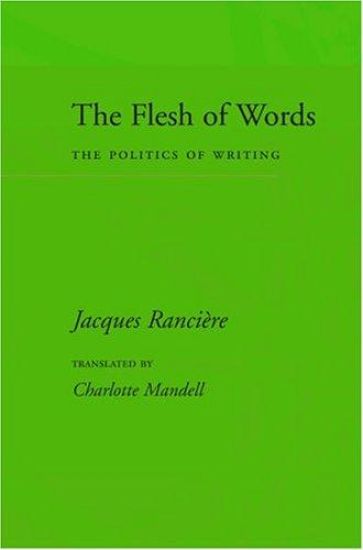
The Flesh of Words

The Flesh of Words

Jacques Rancière

Stanford University Press
2004
pokkari

Halvin toimitettuna 32,50 €

This new collection of challenging literary studies plays with a foundational definition of Western culture: the word become flesh. But the word become flesh is not, or no longer, a theological already-given. It is a millennial goal or telos toward which each text strives. Both witty and immensely erudite, Jacques Rancière leads the critical reader through a maze of arrivals toward the moment, perhaps always suspended, when the word finds its flesh. That is what he, a valiant and good-humored companion to these texts, goes questing for through seven essays examining a wide variety of familiar and unfamiliar works. A text is always a commencement, the word setting out on its excursions through the implausible vicissitudes of narrative and the bizarre phantasmagorias of imagery, Don Quixote's unsent letter reaching us through generous Balzac, lovely Rimbaud, demonic Althusser. The word is on its way to an incarnation that always lies ahead of the writer and the reader both, in this anguished democracy of language where the word is always taking on its flesh.
The Flesh of Words

The Flesh of Words

Jacques Rancière

Stanford University Press
2004
sidottu
This new collection of challenging literary studies plays with a foundational definition of Western culture: the word become flesh. But the word become flesh is not, or no longer, a theological already-given. It is a millennial goal or telos toward which each text strives. Both witty and immensely erudite, Jacques Rancière leads the critical reader through a maze of arrivals toward the moment, perhaps always suspended, when the word finds its flesh. That is what he, a valiant and good-humored companion to these texts, goes questing for through seven essays examining a wide variety of familiar and unfamiliar works. A text is always a commencement, the word setting out on its excursions through the implausible vicissitudes of narrative and the bizarre phantasmagorias of imagery, Don Quixote's unsent letter reaching us through generous Balzac, lovely Rimbaud, demonic Althusser. The word is on its way to an incarnation that always lies ahead of the writer and the reader both, in this anguished democracy of language where the word is always taking on its flesh.
The Philosopher and His Poor

The Philosopher and His Poor

Jacques Rancière

Duke University Press
2004
pokkari
What has philosophy to do with the poor? If, as has often been supposed, the poor have no time for philosophy, then why have philosophers always made time for them? Why is the history of philosophy-from Plato to Karl Marx to Jean-Paul Sartre to Pierre Bourdieu-the history of so many figures of the poor: plebes, men of iron, the demos, artisans, common people, proletarians, the masses? Why have philosophers made the shoemaker, in particular, a remarkably ubiquitous presence in this history? Does philosophy itself depend on this thinking about the poor? If so, can it ever refrain from thinking for them? Jacques RanciÈre’s The Philosopher and His Poor meditates on these questions in close readings of major texts of Western thought in which the poor have played a leading role-sometimes as the objects of philosophical analysis, sometimes as illustrations of philosophical argument. Published in France in 1983 and made available here for the first time in English, this consummate study assesses the consequences for Marx, Sartre, and Bourdieu of Plato’s admonition that workers should do “nothing else” than their own work. It offers innovative readings of these thinkers’ struggles to elaborate a philosophy of the poor. Presenting a left critique of Bourdieu, the terms of which are largely unknown to an English-language readership, The Philosopher and His Poor remains remarkably timely twenty years after its initial publication.
The Philosopher and His Poor

The Philosopher and His Poor

Jacques Rancière

Duke University Press
2004
sidottu
What has philosophy to do with the poor? If, as has often been supposed, the poor have no time for philosophy, then why have philosophers always made time for them? Why is the history of philosophy-from Plato to Karl Marx to Jean-Paul Sartre to Pierre Bourdieu-the history of so many figures of the poor: plebes, men of iron, the demos, artisans, common people, proletarians, the masses? Why have philosophers made the shoemaker, in particular, a remarkably ubiquitous presence in this history? Does philosophy itself depend on this thinking about the poor? If so, can it ever refrain from thinking for them? Jacques RanciÈre’s The Philosopher and His Poor meditates on these questions in close readings of major texts of Western thought in which the poor have played a leading role-sometimes as the objects of philosophical analysis, sometimes as illustrations of philosophical argument. Published in France in 1983 and made available here for the first time in English, this consummate study assesses the consequences for Marx, Sartre, and Bourdieu of Plato’s admonition that workers should do “nothing else” than their own work. It offers innovative readings of these thinkers’ struggles to elaborate a philosophy of the poor. Presenting a left critique of Bourdieu, the terms of which are largely unknown to an English-language readership, The Philosopher and His Poor remains remarkably timely twenty years after its initial publication.
Short Voyages to the Land of the People

Short Voyages to the Land of the People

Jacques Rancière

Stanford University Press
2003
pokkari
This book analyzes a range of texts that seek, in different ways, to represent "the people." Rancière approaches these texts as travel narratives or ethnographies whose authors have traveled not to distant or exotic lands but across class lines. In this truly comparative study, he examines Wordsworth's poetry, the utopian discourse of the Saint-Simoniens, the correspondence and theater of Büchner, Claude Genoux's Mémoires d'un enfant de la Savoie, Michelet's theories of history, the prose and poetry of Rilke, and the performance of Ingrid Bergman in Rossellini's postwar film Europe 51. Rancière examines the various forms of displacement that affect his subjects, enabling each to become foreign to the sites and trajectories commonly known as reality. He argues convincingly that "the people" have no proper signification in the texts under consideration, instead, they function as points of reality upon which the voyager can drape a conceptual framework shaped by the circumstances not of the other, but of the self.
Short Voyages to the Land of the People

Short Voyages to the Land of the People

Jacques Rancière

Stanford University Press
2003
sidottu
This book analyzes a range of texts that seek, in different ways, to represent "the people." Rancière approaches these texts as travel narratives or ethnographies whose authors have traveled not to distant or exotic lands but across class lines. In this truly comparative study, he examines Wordsworth's poetry, the utopian discourse of the Saint-Simoniens, the correspondence and theater of Büchner, Claude Genoux's Mémoires d'un enfant de la Savoie, Michelet's theories of history, the prose and poetry of Rilke, and the performance of Ingrid Bergman in Rossellini's postwar film Europe 51. Rancière examines the various forms of displacement that affect his subjects, enabling each to become foreign to the sites and trajectories commonly known as reality. He argues convincingly that "the people" have no proper signification in the texts under consideration, instead, they function as points of reality upon which the voyager can drape a conceptual framework shaped by the circumstances not of the other, but of the self.
Names Of History

Names Of History

Jacques Rancière

University of Minnesota Press
1994
nidottu
History in our day is still a story, and yet one from which we expect to tell the truth - not just the facts, the names and events of the past, but the invisible order and forces behind them. How can the language of history balance these seemingly contrary tasks - the narrative, the scientific, and the political? This is the question Jacques Ranciere explores in "The names of history", a meditation on the poetics of historical knowledge. In the works of writers from Jules Michelet to Fernand Braudel, Ranciere traces an ongoing revolution in historical study, a movement that challenged, in the practice of language, the opposition of science and literature. By way of a commentary on Erich Auerbach, he shows how fictional narrative intertwines with historical narrative to produce a "truth" that retains mythical elements. The poetics of knowledge Ranciere develops here is an attempt to identify the literary procedures by which historical discourse escapes literature and gives itself the status of a science. His book is also an appreciation of Braudel, whose work in the Annales school greatly advanced this project. Ranciere follows and extends Braudel's discursive production of new agencies of history, which accounts for both the material conditions in which history takes place and the language in which it is written.
The Ignorant Schoolmaster

The Ignorant Schoolmaster

Jacques Rancière

Stanford University Press
1991
pokkari

Halvin toimitettuna 33,40 €

This extraordinary book can be read on several levels. Primarily, it is the story of Joseph Jacotot, an exiles French schoolteacher who discovered in 1818 an unconventional teaching method that spread panic throughout the learned community of Europe. Knowing no Flemish, Jacotot found himself able to teach in French to Flemish students who knew no French; knowledge, Jacotot concluded, was not necessary to teach, nor explication necessary to learn. The results of this unusual experiment in pedagogy led him to announce that all people were equally intelligent. From this postulate, Jacotot devised a philosophy and a method for what he called "intellectual emancipation"—a method that would allow, for instance, illiterate parents to themselves teach their children how to read. The greater part of the book is devoted to a description and analysis of Jacotot's method, its premises, and (perhaps most important) its implications for understanding both the learning process and the emancipation that results when that most subtle of hierarchies, intelligence, is overturned. The book, as Kristin Ross argues in her introduction, has profound implications for the ongoing debate about education and class in France that has raged since the student riots of 1968, and it affords Rancière an opportunity (albeit indirectly) to attack the influential educational and sociological theories of Pierre Bourdieu (and others) that Rancière sees as perpetuating inequality.