Kirjailija
Jagdish Mehra
Kirjat ja teokset yhdessä paikassa: 18 kirjaa, julkaisuja vuosilta 1974–2011, suosituimpiin kuuluu Golden Age Of Theoretical Physics, The (Boxed Set Of 2 Volumes). Vertaile teosten hintoja ja tarkista saatavuus suomalaisista kirjakaupoista.
18 kirjaa
Kirjojen julkaisuvuodet: 1974–2011.
This study deals with the development of, and the current discussion about, the interpretation of quantum mechanics. The following topics are discussed: 1. The Copenhagen In terpretation; 2. Formal Problems of Quantum Mechanics; 3. Process of Measurement and the Equation of Motion; 4. Macroscopic Level of Description; 5. Search for Hidden Variables; 6. The Notion of 'Reality' and the Epistemology of Quantum Mechanics; and 7. Quantum Mechanics and the Explanation of Life. The Bohr-Einstein dialogue on the validity of the quan tum mechanical description of physical reality lasted over two decades. Since the early nineteen-fifties, Eugene Wigner has provided much of the point and counterpoint of the continuing discussion on the interpretation and epistemolo gy of quantum mechanics. We have explored Wigner's views in some detail against the background of historical develop ment and current debate. Professor Eugene Wigner has sustained me over many years in my work on the conceptual development of mod ern physics by his kindness and encouragement. This study owes its existence to his direct inspiration, and to his suggestion to me in April 1971 that it would be of interest to write an account of the interpretation of quantum me chanics and the current discussion about it. XII PREFACE This study was completed in September 1972. Signifi cant new developments have occurred since then in the dis cussion of questions related to the epistemology of quan tum mechanics.
Jagdish Mehra's historical account of the Solvay Conferences from 1911 to 1973 demonstrates not only the great influence which these conferences have had on the development of modern physics, but it also shows clearly how far-sighted and well planned were the intentions of Ernest Solvay when he took the initiative for organizing a new type of international conferences. In contrast to the conventional meetings in which reports are given on the successful solution of scientific problems, the Solvay Conferences were conceived to help directly in solving specific problems of unusual difficulty. The importance of the quantum structure of Nature had become well under stood already by 1911, but at that time there was no hope for an answer to the ex tremely difficult new questions posed by the atomic phenomena. The new conferences should therefore be devoted primarily to thorough discussions of such problems be tween a small number of the most competent physicists, and Ernest Solvay was guided by the hope that the discussions would eventually lead to a real and substantial progress. The earliest Solvay Conferences which I attended were those of 1927, 1930 and 1933, and they served this purpose extremely well. In 1926 the mathematical formalism of quantum-and wave-mechanics approached its final shape, but the interpretation was still controversial. Schrodinger hoped that his matter waves could be considered as waves in three-dimensional space and time, and that the discontinuous feature of quantum 'jumps' could be avoided thereby.
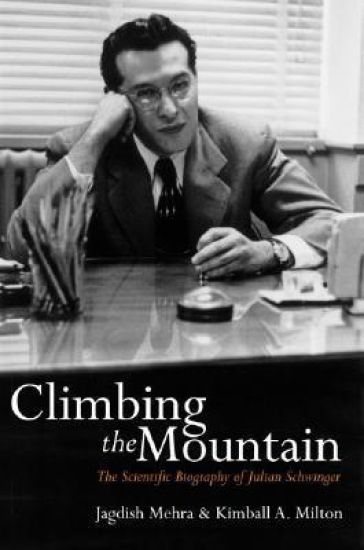
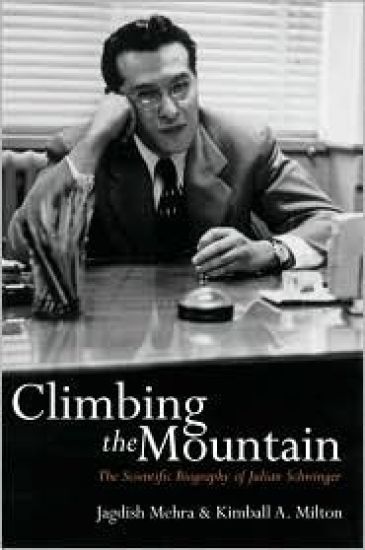
Julian Schwinger was one of the leading theoretical physicists of the twentieth century. His contributions are as important, and as pervasive, as those of Richard Feynman, with whom (and with Sin-itiro Tomonaga) he shared the 1965 Nobel Prize for Physics. Yet, while Feynman is universally recognized as a cultural icon, Schwinger is little known even to many within the physics community. In his youth, Julian Schwinger was a nuclear physicist, turning to classical electrodynamics after World War II. In the years after the war, he was the first to renormalize quantum electrodynamics. Subsequently, he presented the most complete formulation of quantum field theory and laid the foundations for the electroweak synthesis of Glashow, Weinberg, and Salam, and he made fundamental contributions to the theory of nuclear magnetic resonance, to many-body theory, and to quantum optics. He developed a unique approach to quantum mechanics, measurement algebra, and a general quantum action principle. His discoveries include 'Feynman's' parameters and 'Glauber's' coherent states; in later years he also developed an alternative to operator field theory which he called Source Theory, reflecting his profound phenomenological bent. His late work on the Thomas-Fermi model of atoms and on the Casimir effect continues to be an inspiration to a new generation of physicists. This biography describes the many strands of his research life, while tracing the personal life of this private and gentle genius.
The Conceptual Completion and Extensions of Quantum Mechanics 1932-1941. Epilogue: Aspects of the Further Development of Quantum Theory 1942-1999
Jagdish Mehra
Springer-Verlag New York Inc.
2001
nidottu
Quantum Theory, together with the principles of special and general relativity, constitute a scientific revolution that has profoundly influenced the way in which we think about the universe and the fundamental forces that govern it. The Historical Development of Quantum Theory is a definitive historical study of that scientific work and the human struggles that accompanied it from the beginning. Drawing upon such materials as the resources of the Archives for the History of Quantum Physics, the Niels Bohr Archives, and the archives and scientific correspondence of the principal quantum physicists, as well as Jagdish Mehra's personal discussions over many years with most of the architects of quantum theory, the authors have written a rigorous scientific history of quantum theory in a deeply human context. This multivolume work presents a rich account of an intellectual triumph: a unique analysis of the creative scientific process. The Historical Development of Quantum Theory is science, history, and biography, all wrapped in the story of a great human enterprise. Its lessons will be an aid to those working in the sciences and humanities alike.
The Conceptual Completion and Extensions of Quantum Mechanics 1932-1941. Epilogue: Aspects of the Further Development of Quantum Theory 1942-1999
Jagdish Mehra
Springer-Verlag New York Inc.
2001
sidottu
Quantum Theory, together with the principles of special and general relativity, constitute a scientific revolution that has profoundly influenced the way in which we think about the universe and the fundamental forces that govern it. The Historical Development of Quantum Theory is a definitive historical study of that scientific work and the human struggles that accompanied it from the beginning. Drawing upon such materials as the resources of the Archives for the History of Quantum Physics, the Niels Bohr Archives, and the archives and scientific correspondence of the principal quantum physicists, as well as Jagdish Mehra's personal discussions over many years with most of the architects of quantum theory, the authors have written a rigorous scientific history of quantum theory in a deeply human context. This multivolume work presents a rich account of an intellectual triumph: a unique analysis of the creative scientific process. The Historical Development of Quantum Theory is science, history, and biography, all wrapped in the story of a great human enterprise. Its lessons will be an aid to those working in the sciences and humanities alike.
Golden Age Of Theoretical Physics, The (Boxed Set Of 2 Volumes)
Jagdish Mehra
World Scientific Publishing Co Pte Ltd
2001
sidottu
The Golden Age of Theoretical Physics brings together 37 selected essays. Many of these essays were first presented as lectures at various universities in Europe and the USA, and then published as reports or articles. Their enlarged, final versions were published in the joint work of Jagdish Mehra and Helmut Rechenberg, The Historical Development of Quantum Theory, while the other essays were published as articles in scientific journals or in edited books. Here they are published together as a tribute to the Mehra-Rechenberg collaboration sustained for several decades, and cover various aspects of quantum theory, the special and general theories of relativity, the foundations of statistical mechanics, and some of their fundamental applications. Two essays, ‘Albert Einstein's “First” Paper’ (Essay 1) and ‘The Dream of Leonardo da Vinci’ (Essay 37), lie outside the major themes treated in this book, but are included here because of their historical interest. The origin of each essay is explained in a footnote. This book deals with the most important themes developed in the first 40 years of the twentieth century by some of the greatest pioneers and architects of modern physics. It is a vital source of information about what can veritably be described as ‘the golden age of theoretical physics’.
The Probability Interpretation and the Statistical Transformation Theory, the Physical Interpretation, and the Empirical and Mathematical Foundations of Quantum Mechanics 1926–1932
Jagdish Mehra; Helmut Rechenberg
Springer-Verlag New York Inc.
2000
nidottu
Quantum Theory, together with the principles of special and general relativity, constitute a scientific revolution that has profoundly influenced the way in which we think about the universe and the fundamental forces that govern it. The Historical Development of Quantum Theory is a definitive historical study of that scientific work and the human struggles that accompanied it from the beginning. Drawing upon such materials as the resources of the Archives for the History of Quantum Physics, the Niels Bohr Archives, and the archives and scientific correspondence of the principal quantum physicists, as well as Jagdish Mehra's personal discussions over many years with most of the architects of quantum theory, the authors have written a rigorous scientific history of quantum theory in a deeply human context. This multivolume work presents a rich account of an intellectual triumph: a unique analysis of the creative scientific process. The Historical Development of Quantum Theory is science, history, and biography, all wrapped in the story of a great human enterprise. Its lessons will be an aid to those working in the sciences and humanities alike.
Part 1 Schrödinger in Vienna and Zurich 1887–1925
Jagdish Mehra; Helmut Rechenberg
Springer-Verlag New York Inc.
2000
nidottu
Quantum Theory, together with the principles of special and general relativity, constitute a scientific revolution that has profoundly influenced the way in which we think about the universe and the fundamental forces that govern it. The Historical Development of Quantum Theory is a definitive historical study of that scientific work and the human struggles that accompanied it from the beginning. Drawing upon such materials as the resources of the Archives for the History of Quantum Physics, the Niels Bohr Archives, and the archives and scientific correspondence of the principal quantum physicists, as well as Jagdish Mehra's personal discussions over many years with most of the architects of quantum theory, the authors have written a rigorous scientific history of quantum theory in a deeply human context. This multivolume work presents a rich account of an intellectual triumph: a unique analysis of the creative scientific process. The Historical Development of Quantum Theory is science, history, and biography, all wrapped in the story of a great human enterprise. Its lessons will be an aid to those working in the sciences and humanities alike.
The Historical Development of Quantum Theory
Jagdish Mehra; Helmut Rechenberg
Springer-Verlag New York Inc.
2000
nidottu
Quantum Theory, together with the principles of special and general relativity, constitute a scientific revolution that has profoundly influenced the way in which we think about the universe and the fundamental forces that govern it. The Historical Development of Quantum Theory is a definitive historical study of that scientific work and the human struggles that accompanied it from the beginning. Drawing upon such materials as the resources of the Archives for the History of Quantum Physics, the Niels Bohr Archives, and the archives and scientific correspondence of the principal quantum physicists, as well as Jagdish Mehra's personal discussions over many years with most of the architects of quantum theory, the authors have written a rigorous scientific history of quantum theory in a deeply human context. This multivolume work presents a rich account of an intellectual triumph: a unique analysis of the creative scientific process. The Historical Development of Quantum Theory is science, history, and biography, all wrapped in the story of a great human enterprise. Its lessons will be an aid to those working in the sciences and humanities alike.
The Formulation of Matrix Mechanics and Its Modifications 1925–1926
Jagdish Mehra; Helmut Rechenberg
Springer-Verlag New York Inc.
2000
nidottu
Quantum Theory, together with the principles of special and general relativity, constitute a scientific revolution that has profoundly influenced the way in which we think about the universe and the fundamental forces that govern it. The Historical Development of Quantum Theory is a definitive historical study of that scientific work and the human struggles that accompanied it from the beginning. Drawing upon such materials as the resources of the Archives for the History of Quantum Physics, the Niels Bohr Archives, and the archives and scientific correspondence of the principal quantum physicists, as well as Jagdish Mehra's personal discussions over many years with most of the architects of quantum theory, the authors have written a rigorous scientific history of quantum theory in a deeply human context. This multivolume work presents a rich account of an intellectual triumph: a unique analysis of the creative scientific process. The Historical Development of Quantum Theory is science, history, and biography, all wrapped in the story of a great human enterprise. Its lessons will be an aid to those working in the sciences and humanities alike.
The Historical Development of Quantum Theory
Jagdish Mehra; Helmut Rechenberg
Springer-Verlag New York Inc.
2000
nidottu
Quantum Theory, together with the principles of special and general relativity, constitute a scientific revolution that has profoundly influenced the way in which we think about the universe and the fundamental forces that govern it. The Historical Development of Quantum Theory is a definitive historical study of that scientific work and the human struggles that accompanied it from the beginning. Drawing upon such materials as the resources of the Archives for the History of Quantum Physics, the Niels Bohr Archives, and the archives and scientific correspondence of the principal quantum physicists, as well as Jagdish Mehra's personal discussions over many years with most of the architects of quantum theory, the authors have written a rigorous scientific history of quantum theory in a deeply human context. This multivolume work presents a rich account of an intellectual triumph: a unique analysis of the creative scientific process. The Historical Development of Quantum Theory is science, history, and biography, all wrapped in the story of a great human enterprise. Its lessons will be an aid to those working in the sciences and humanities alike.
The Quantum Theory of Planck, Einstein, Bohr and Sommerfeld: Its Foundation and the Rise of Its Difficulties 1900–1925
Jagdish Mehra; Helmut Rechenberg
Springer-Verlag New York Inc.
2000
nidottu
Quantum Theory, together with the principles of special and general relativity, constitute a scientific revolution that has profoundly influenced the way in which we think about the universe and the fundamental forces that govern it. The Historical Development of Quantum Theory is a definitive historical study of that scientific work and the human struggles that accompanied it from the beginning. Drawing upon such materials as the resources of the Archives for the History of Quantum Physics, the Niels Bohr Archives, and the archives and scientific correspondence of the principal quantum physicists, as well as Jagdish Mehra's personal discussions over many years with most of the architects of quantum theory, the authors have written a rigorous scientific history of quantum theory in a deeply human context. This multivolume work presents a rich account of an intellectual triumph: a unique analysis of the creative scientific process. The Historical Development of Quantum Theory is science, history, and biography, all wrapped in the story of a great human enterprise. Its lessons will be an aid to those working in the sciences and humanities alike.
The Discovery of Quantum Mechanics 1925
Jagdish Mehra; Helmut Rechenberg
Springer-Verlag New York Inc.
2000
nidottu
Quantum Theory, together with the principles of special and general relativity, constitute a scientific revolution that has profoundly influenced the way in which we think about the universe and the fundamental forces that govern it. The Historical Development of Quantum Theory is a definitive historical study of that scientific work and the human struggles that accompanied it from the beginning. Drawing upon such materials as the resources of the Archives for the History of Quantum Physics, the Niels Bohr Archives, and the archives and scientific correspondence of the principal quantum physicists, as well as Jagdish Mehra's personal discussions over many years with most of the architects of quantum theory, the authors have written a rigorous scientific history of quantum theory in a deeply human context. This multivolume work presents a rich account of an intellectual triumph: a unique analysis of the creative scientific process. The Historical Development of Quantum Theory is science, history, and biography, all wrapped in the story of a great human enterprise. Its lessons will be an aid to those working in the sciences and humanities alike.
The Probability Interpretation and the Statistical Transformation Theory, the Physical Interpretation, and the Empirical and Mathematical Foundations of Quantum Mechanics 1926–1932
Jagdish Mehra; Helmut Rechenberg
Springer-Verlag New York Inc.
2000
sidottu
Quantum Theory, together with the principles of special and general relativity, constitute a scientific revolution that has profoundly influenced the way in which we think about the universe and the fundamental forces that govern it. The Historical Development of Quantum Theory is a definitive historical study of that scientific work and the human struggles that accompanied it from the beginning. Drawing upon such materials as the resources of the Archives for the History of Quantum Physics, the Niels Bohr Archives, and the archives and scientific correspondence of the principal quantum physicists, as well as Jagdish Mehra's personal discussions over many years with most of the architects of quantum theory, the authors have written a rigorous scientific history of quantum theory in a deeply human context. This multivolume work presents a rich account of an intellectual triumph: a unique analysis of the creative scientific process. The Historical Development of Quantum Theory is science, history, and biography, all wrapped in the story of a great human enterprise. Its lessons will be an aid to those working in the sciences and humanities alike.
Julian Schwinger was one of the leading theoretical physicists of the twentieth century. His contributions are as important, and as pervasive, as those of Richard Feynman, with whom (and with Sin-itiro Tomonaga) he shared the 1965 Nobel Prize for Physics. Yet, while Feynman is universally recognized as a cultural icon, Schwinger is little known even to many within the physics community. In his youth, Julian Schwinger was a nuclear physicist, turning to classical electrodynamics after World War II. In the years after the war, he was the first to renormalize quantum electrodynamics. Subsequently, he presented the most complete formulation of quantum field theory and laid the foundations for the electroweak synthesis of Glashow, Weinberg, and Salam, and he made fundamental contributions to the theory of nuclear magnetic resonance, to many-body theory, and to quantum optics. He developed a unique approach to quantum mechanics, measurement algebra, and a general quantum action principle. His discoveries include 'Feynman's' parameters and 'Glauber's' coherent states; in later years he also developed an alternative to operator field theory which he called Source Theory, reflecting his profound phenomenological bent. His late work on the Thomas-Fermi model of atoms and on the Casimir effect continues to be an inspiration to a new generation of physicists. This biography describes the many strands of his research life, while tracing the personal life of this private and gentle genius.
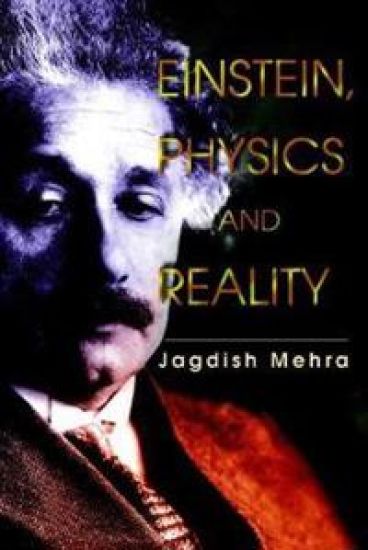
Albert Einstein was one of the principal founders of the quantum and relativity theories. Until 1925, when the Bose-Einstein statistics was discovered, he made great contributions to the foundations of quantum theory. However, after the discovery of quantum mechanics by Heisenberg and wave mechanics by Schrödinger, with the consequent development of the principles of uncertainty and complementarity, it would seem that Einstein's views completely changed. In his theory of the Brownian motion, Einstein had invoked the theory of probability to establish the reality of atoms and molecules; but, in 1916-17, when he wished to predict the exact instant when an atom would radiate — and developed his theory of the A and B coefficients — he wondered whether the “quantum absorption and emission of light could ever be understood in the sense of the complete causality requirement, or would a statistical residue remain? I must admit that there I lack the courage of my convictions. But I would be very unhappy to renounce complete causality”, as he wrote to his friend Max Born. However, he wrote later to Born that quantum mechanics “is certainly imposing”, but “an inner voice tells me that it is not the real thing … It does not bring us closer to the secret of the ‘Old One’. I, at any rate, am convinced that He is not playing at dice”. At the 1927 and 1930 Solvay Conferences on Physics in Brussels, Einstein engaged in profound discussions with Niels Bohr and others about his conviction regarding classical determinism versus the statistical causality of quantum mechanics. To the end of his life he retained his belief in a deterministic philosophy. This highly interesting book explores Einstein's views on the nature and structure of physics and reality.
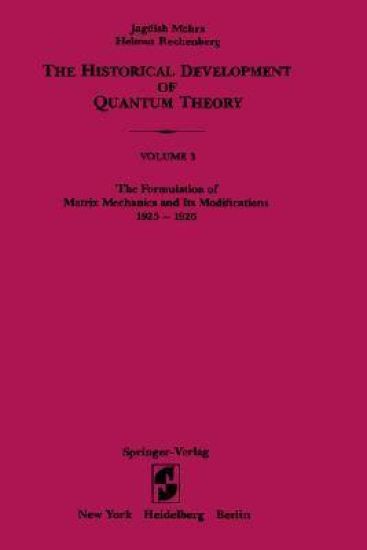
The Formulation of Matrix Mechanics and Its Modifications 1925–1926
Jagdish Mehra; Helmut Rechenberg
Springer-Verlag New York Inc.
1982
sidottu
Quantum Theory, together with the principles of special and general relativity, constitute a scientific revolution that has profoundly influenced the way in which we think about the universe and the fundamental forces that govern it. The Historical Development of Quantum Theory is a definitive historical study of that scientific work and the human struggles that accompanied it from the beginning. Drawing upon such materials as the resources of the Archives for the History of Quantum Physics, the Niels Bohr Archives, and the archives and scientific correspondence of the principal quantum physicists, as well as Jagdish Mehra's personal discussions over many years with most of the architects of quantum theory, the authors have written a rigorous scientific history of quantum theory in a deeply human context. This multivolume work presents a rich account of an intellectual triumph: a unique analysis of the creative scientific process. The Historical Development of Quantum Theory is science, history, and biography, all wrapped in the story of a great human enterprise. Its lessons will be an aid to those working in the sciences and humanities alike.
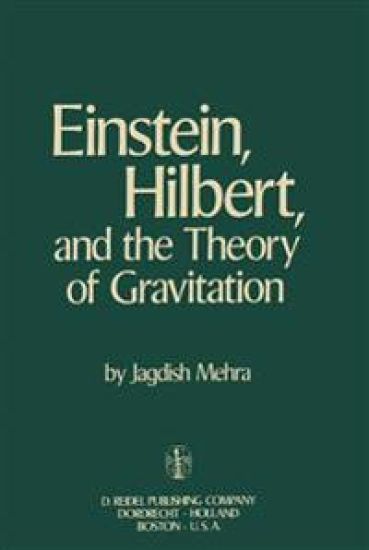
Einstein, Hilbert, and The Theory of Gravitation
Jagdish Mehra
Kluwer Academic Publishers
1974
nidottu
Some time ago I published a small piece * dealing with a charming little essay on 'the state of ether in magnetic fields', which the sixteen-year-old Einstein had written while he was awaiting admission to the E. T. H. in Zurich. This paper sought to trace the continuity between Einstein's early interest in electrodynamics and his later work on the special and general relativity theories. On reading this paper, Professor Eugene Wigner asked me whether David Hilbert had not independently discovered the field equations of gravitation. ** His impression from his stay in Gottingen (where Wigner had been Hilbert's assistant for one year in the late nineteen-twenties) was that Hilbert had indeed done so, and he asked me if it was true. I replied to Professor Wigner about Hilbert's contribution to the theory of gravitation. t He kindly encouraged me to expand my account to deal with the intricate and exciting details of the early years in the formulation of the general relativity theory of gravitation. This is what I have sought to do in this study. Albert Einstein created the general relativity theory of gravitation and dominated its development through the rest of his life. His early work on the theory of gravitation, from 1912 to 1916, had the drama of high adventure. It culminated in the establishment of its foundations which have remained unassailed by the theoretical and experimental work of succeeding decades.