Kirjojen hintavertailu – 12 903 725 kirjaa ja 27 kauppaa

Kirjailija

Jagdish Sheth

Kirjat ja teokset yhdessä paikassa: 27 kirjaa, julkaisuja vuosilta 2002–2024, suosituimpiin kuuluu Firms of Endearment. Vertaile teosten hintoja ja tarkista saatavuus suomalaisista kirjakaupoista.

27 kirjaa

Kirjojen julkaisuvuodet: 2002–2024.

The Global Rule of Three

The Global Rule of Three

Jagdish Sheth; Can Uslay; Raj Sisodia

Springer Nature Switzerland AG
2020
nidottu
**Finalist for the 2022 Leonard L. Berry Marketing Book Award from the American Marketing Association, which recognizes the top marketing books annually** In our increasingly digital, mobile, and global world, the existing theories of business and economics have lost much of their appeal with the phenomenal rise of Chindia, the reality of Brexit, the turmoil caused by the Covid-19 pandemic, and the seismic shifting of the global center of gravity from west to east. In the area of innovation, the traditional thinking that a developed country, often the US, will come up with the next major innovation, launch at home first, and then take it to other markets does not ring true anymore. Similarly, the world where conglomerates go bargain-hunting for acquisitions in emerging markets has been turned upside-down. This book reveals and illustrates the Global Rule of Three phenomenon, which stipulates that in competitive markets only three companies (which the authors call "generalists") can dominate the market. All other players in the market are specialists. Further, whereas the financial performance of generalists improves as market share increases, specialist companies see a decrease in financial performance as their market share increases, as the latter are margin-driven companies. This theory powerfully captures the evolution of global markets and what executives must do to succeed. It is based on empirical analyses of hundreds of markets and industries in the US and globally. Competitive markets evolve in a predictable fashion across industries and geographies, where every industry goes through a similar lifecycle from beginning to end (or revitalization). From local to regional to national markets, the last stop in the evolution of markets is going global. The pattern is so consistent that it represents a distinct and natural market structure at every level. The authors offer strategies that generalists and specialist should follow to stay competitive as well as twelve expansion strategies for global companies from emerging markets. This book chronicles this global evolution and provides impactfulmanagerial implications for executives and students of marketing and corporate strategy alike.

The Sustainability Edge

The Sustainability Edge

Suhas Apte; Jagdish Sheth

Rotman/UTP Publishing
2016
sidottu
Business leaders need to embrace sustainability in order to ensure the lasting success of their organizations. Co-authors Suhas Apte and Jagdish Sheth bring their expertise from practice and from academia to illustrate how business leaders can embed sustainability in a truly holistic and transformative way. Through an examination of such companies as Walmart, AT&T, IKEA and the Tata Group, Apte and Sheth have developed a proven and actionable framework rooted in the real world success of these companies. The case studies reveal how business leaders proactively engage, energize and promote market sustainability to all of their stakeholders including customers, employees, suppliers, investors and the government. The Sustainability Edge enables companies to critically engage their stakeholders and influence them to accept sustainability as part of their core mission.
The Business School in the Twenty-First Century

The Business School in the Twenty-First Century

Howard Thomas; Peter Lorange; Jagdish Sheth

Cambridge University Press
2013
sidottu
Questions about the status, identity and legitimacy of business schools in the modern university system continue to stimulate debate amongst deans, educational policy makers and commentators. In this book, three world experts share their critical insights on management education and new business school models in the USA, Europe and Asia, on designing the business school of the future, and how to make it work. They look at how the business school is changing and focus in particular on emergent global challenges and innovations in curricula, professional roles, pedagogy, uses of technology and organisational delineations. Set within the context of a wider discussion about management as a profession, the authors provide a systematic, historical perspective, analysing major trends in business school models, and reviewing a wealth of current literature, to provide an informed and unique perspective that is firmly grounded in practical and experimental analysis.
The 4 A's of Marketing

The 4 A's of Marketing

Jagdish Sheth; Rajendra Sisodia

Routledge
2011
sidottu
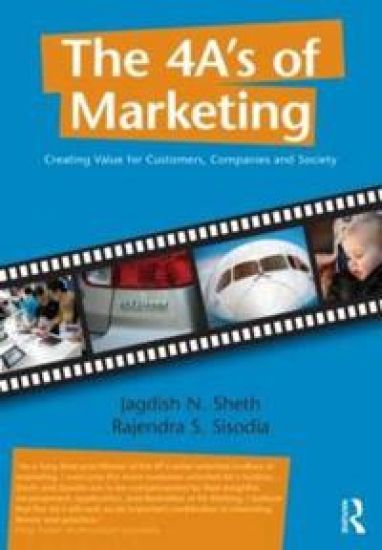
The authors present a powerful and tested approach that helps managers see a business’s every action through the eyes of its customers. This approach is organized around the values that matter most to customers: Acceptability, Affordability, Accessibility and Awareness. Taken together, these attributes are called the "4A’s." The 4A framework derives from a customer-value perspective based on the four distinct roles that customers play in the market: seekers, selectors, payers and users. For a marketing campaign to succeed, it must achieve high marks on all four A’s, using a blend of marketing and non-marketing resources. The 4A framework helps companies create value for customers by identifying exactly what they want and need, as well as by uncovering new wants and needs. (For example, none of us knew we "needed" an iPad until Apple created it.) That means not only ensuring that customers are aware of the product, but also ensuring that the product is affordable, accessible and acceptable to them. Throughout this book, the authors demonstrate how looking at the world through the 4A lens helps companies avoid marketing myopia (an excessive focus on the product) as well as managerial myopia (an excessive focus on process). In fact, it is a powerful way to operationalize the marketing concept; it enables managers to look at the world through the customer’s eyes. This ability has become an absolute necessity for success in today’s hyper-competitive marketplace.
The 4 A's of Marketing

The 4 A's of Marketing

Jagdish Sheth; Rajendra Sisodia

Routledge
2011
nidottu
The authors present a powerful and tested approach that helps managers see a business’s every action through the eyes of its customers. This approach is organized around the values that matter most to customers: Acceptability, Affordability, Accessibility and Awareness. Taken together, these attributes are called the "4A’s." The 4A framework derives from a customer-value perspective based on the four distinct roles that customers play in the market: seekers, selectors, payers and users. For a marketing campaign to succeed, it must achieve high marks on all four A’s, using a blend of marketing and non-marketing resources. The 4A framework helps companies create value for customers by identifying exactly what they want and need, as well as by uncovering new wants and needs. (For example, none of us knew we "needed" an iPad until Apple created it.) That means not only ensuring that customers are aware of the product, but also ensuring that the product is affordable, accessible and acceptable to them. Throughout this book, the authors demonstrate how looking at the world through the 4A lens helps companies avoid marketing myopia (an excessive focus on the product) as well as managerial myopia (an excessive focus on process). In fact, it is a powerful way to operationalize the marketing concept; it enables managers to look at the world through the customer’s eyes. This ability has become an absolute necessity for success in today’s hyper-competitive marketplace.
The Rule of Three

The Rule of Three

Jagdish Sheth; Rajendra Sisodia

The Free Press
2010
pokkari
Name any industry and more likely than not you will find that the three strongest, most efficient companies control 70 to 90 percent of the market. Here are just a few examples:McDonald's, Burger King, and Wendy'sGeneral Mills, Kellogg, and PostNike, Adidas, and ReebokBank of America, Chase Manhattan, and Banc OneAmerican, United, and Delta Merck, Johnson & Johnson, and Bristol-Myers SquibbBased on extensive studies of market forces, the distinguished business school strategists and corporate advisers Jagdish Sheth and Rajendra Sisodia show that natural competitive forces shape the vast majority of companies under "the rule of three." This stunning new concept has powerful strategic implications for businesses large and small alike. Drawing on years of research covering hundreds of industries both local and global, The Rule of Three documents the evolution of markets into two complementary sectors -- generalists, which cater to a large, mainstream group of customers; and specialists, which satisfy the needs of customers at both the high and low ends of the market. Any company caught in the middle ("the ditch") is likely to be swallowed up or destroyed. Sheth and Sisodia show how most markets resemble a shopping mall with specialty shops anchored by large stores. Drawing wisdom from these markets, The Rule of Three offers counterintuitive insights, with suggested strategies for the "Big 3" players, as well as for mid-sized companies that may want to mount a challenge and for specialists striving to flourish in the shadow of industry giants. The book explains how to recognize signs of market disruptions that can result in serious reversals and upheavals for companies caught unprepared. Such disruptions include new technologies, regulatory shifts, innovations in distribution and packaging, demographic and cultural shifts, and venture capital as well as other forms of investor funding. Years in the making and sweeping in scope, The Rule of Three provides authoritative, research-based insights into market dynamics that no business manager should be without.
Clients for Life

Clients for Life

Andrew Sobel; Jagdish Sheth

The Free Press
2002
pokkari
Business consulting and related professional services represent a 350 billion dollar industry- and they're growing in a huge way. But things aren't as rosy as this figure might suggest. All too many consulting jobs, are brief, one-shot engagements- situations by which most professionals can't survive. The most pressing concern today for six million professional advisors is this: In our bottom-line era, how can I make myself stand out and become indispensable to my clients for the long haul? CLIENTS FOR LIFE has the answers. Featuring interviews with CEOs of such leading corporations as Kodak and American Express, Sheth and Sobel, two of the field's preeminent authorities, outline a series of proven skills and techniques that seperate the extraordinary from the ordinary. Readers will learn how to build trust through consistency and reliability, balance professional independence with client devotion, practice crucial "big picture thinking" and much more.