Kirjojen hintavertailu – 12 859 826 kirjaa ja 27 kauppaa

Kirjailija

Jaime Gil-Aluja

Kirjat ja teokset yhdessä paikassa: 11 kirjaa, julkaisuja vuosilta 1997–2014, suosituimpiin kuuluu Towards an Advanced Modelling of Complex Economic Phenomena. Vertaile teosten hintoja ja tarkista saatavuus suomalaisista kirjakaupoista.

Nimi esiintyy myös muodoissa: Jaime Gil Aluja

11 kirjaa

Kirjojen julkaisuvuodet: 1997–2014.

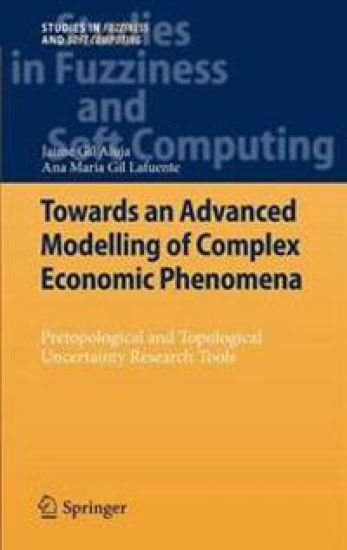
Towards an Advanced Modelling of Complex Economic Phenomena

Towards an Advanced Modelling of Complex Economic Phenomena

Jaime Gil Aluja; Anna M. Gil-Lafuente

Springer-Verlag Berlin and Heidelberg GmbH Co. K
2014
nidottu
Little by little we are being provided with an arsenal of operative instruments of a non-numerical nature, in the shape of models and algorithms, capable of providing answers to the “aggressions” which our economics and management systems must withstand, coming from an environment full of turmoil. In the work which we are presenting, we dare to propose a set of elements from which we hope arise focuses capable of renewing those structures of economic thought which are upheld by the geometrical idea. The concepts of pretopology and topology, habitually marginalized in economics and management studies, have centred our interest in recent times. We consider that it is not possible to conceive formal structures capable of representing the Darwinism concept of economic behaviour today without recurring to this fundamental generalisation of metric spaces. In our attempts to find a solid base to the structures proposed for the treatment of economic phenomena, we have frequently resorted to the theory of clans and the theory of affinities with results which we believe to be satisfactory. We would like to go further, establishing, if possible, the connection between their axiomatics at the same time as developing some uncertain pretopologies and topologies capable of linking previously unconnected theories, at the sametime easing the creation of other new theories.

Globalisation, GovernanceEthics

Globalisation, GovernanceEthics

Clement A Tisdell; Jaime Gil Aluja

Nova Science Publishers Inc
2013
pokkari
The globalisation of commerce and science means that new structures of governance are required to handle new and novel situations, such as across state and institutional boundaries. Sound governance, including elements that encourage foresight, is an important ingredient of managing global and local crisis situations. These crises are ever more apparent as a result of interdependence between consumer, firms and states across the world, especially with the ever increasing advent of instantaneous and low cost communication. This book examines the role of governance in local and multi-national businesses and in local, national and international political forums and organisations.
Investment in Uncertainty

Investment in Uncertainty

Jaime Gil-Aluja

Springer
2012
nidottu
FIRST PART Preparation of the Investment 1. Investments in the Company 19 The decline of stability . . 19 The change in direction of studies on the investment process. 25 Basic elements for arithmetical study of selection 29 Thc study of selection from non-numerical elements. 37 2. Programming Investment Activity 49 Classical programming techniques. 49 Handling of an investment programme. 56 Incorporation of costs into investment projects . . . . . . . . . . . . . . . . . . 66 Estimating financial needs throughout the process. 72 3. Financial Risk of Investment 85 Financial aspects of the investment process. 85 Determination of the financial capacity of the investment . . 89 From pre-diagnosis to diagnosis. 102 Numerical determination of the financial risk of an investment. 106 4. Analysis of financial products for the investment 113 Aspects prior to product analysis. 113 Analysis by means of the clan concept . . . . . . . . . . . . . . . . . . . 117 Obtaining affinities and thc use of codes . . . . . . . . . . . . . . . . . . . . . . . . . . . . . . . . . . . . . . . . . . . . . 123 Grouping the characteristics of the products by means of the Moore closing. 126 From product grouping to affinities . . . . . . . . . . . . . . . . . . . . . . . . . . . . . . . . . . . . . . . . . . . . . . . . . . . . . . . . . 134 10 / Index SECOND PART Selection 5. A first approximation to selection models 145 Updating of monetary currents 145 Incorporation of the lack of precision of interests rates . . . . . . . . . . . . . . . . 153 The hypothesis of known net values and fuzzy rate of interest . . . . . . 157 6. Selection of investments in an economy with inflation 165 Estimate of monetary currents at constant prices . . . . . . . . . . . . . . . . . . . 165 Estimate of monetary currents at prices for each period . . . . . . . 172 The hypothesis of different rates of inflation . . . . 180 7.
Towards an Advanced Modelling of Complex Economic Phenomena

Towards an Advanced Modelling of Complex Economic Phenomena

Jaime Gil Aluja; Anna M. Gil-Lafuente

Springer-Verlag Berlin and Heidelberg GmbH Co. K
2011
sidottu
Little by little we are being provided with an arsenal of operative instruments of a non-numerical nature, in the shape of models and algorithms, capable of providing answers to the “aggressions” which our economics and management systems must withstand, coming from an environment full of turmoil. In the work which we are presenting, we dare to propose a set of elements from which we hope arise focuses capable of renewing those structures of economic thought which are upheld by the geometrical idea. The concepts of pretopology and topology, habitually marginalized in economics and management studies, have centred our interest in recent times. We consider that it is not possible to conceive formal structures capable of representing the Darwinism concept of economic behaviour today without recurring to this fundamental generalisation of metric spaces. In our attempts to find a solid base to the structures proposed for the treatment of economic phenomena, we have frequently resorted to the theory of clans and the theory of affinities with results which we believe to be satisfactory. We would like to go further, establishing, if possible, the connection between their axiomatics at the same time as developing some uncertain pretopologies and topologies capable of linking previously unconnected theories, at the sametime easing the creation of other new theories.

The Interactive Management of Human Resources in Uncertainty

The Interactive Management of Human Resources in Uncertainty

Jaime Gil-Aluja

Springer-Verlag New York Inc.
2011
nidottu
101 17. The company job balance sheet 101 18. The personnel and jobs structure 119 19. Work in homogeneous groups 125 20. Incorporation of Galois lattices 130 21. The selection of teams for associated tasks 134 22. A brief reference to costs 138 23. Problems associated with personnel assignment 140 The Hungarian assignment algorithm 24. 148 Theoretical elements of the Hungarian algorithm 25. 158 Assignment by means of the "Branch and Bound" 26. 170 Changes, abilities and costs 27. 181 28. Development of the capacity of initiative 186 29. Specialization or adaptable qualification 190 30. Incorporation of uncertainty 206 Economic incidence of passing of over from specialisation 31. to adaptable qualification 214 32. Retraining through the acquisition of new abilities 218 REFERENCES 222 FINAL CONSIDERATIONS 224 VI PREFACE The ups and downs faced by society during the latter half of the XX'Th century, have left remnants, from the uncertainty of which could emerge a different way of living together. This not only includes new ways of looking at more or less old problems, it also means a profound change of the very foundations on which investigation is based.
Fuzzy Sets in the Management of Uncertainty

Fuzzy Sets in the Management of Uncertainty

Jaime Gil-Aluja

Springer-Verlag Berlin and Heidelberg GmbH Co. K
2010
nidottu
Fuzzy Sets in the Management of Uncertainty presents an overview of current problems in business management, primarily for those situations involving decision making of an economic-financial nature. The monograph therefore discusses problems of planning, programming, control and brings light to the entire financial network in its three phases: raising funds, analysis and investment. Special attention is paid to production processes and marketing of products and services. This monograph is a highly readable overview and introduction for scientists, professionals, graduate students, managers and consultants in the growing field of applications and fuzzy logic in the field of management.
Elements for a Theory of Decision in Uncertainty

Elements for a Theory of Decision in Uncertainty

Jaime Gil-Aluja

Springer-Verlag New York Inc.
2010
nidottu
Decisions in uncertainty Scientific reaction to change During latter decades, the basic elements that have traditionally made up the society in wh ich economic activity develops, have been submitted to the effect of multiple aggressions as a consequence of the outcome of events motivated by the nature itself of the human being, always seeking a level of happiness that is never reached. In a very brief manner we are accustomed to mention these by using words such as revolution, profound changes, convulsions . . . . , the results of which are manifest through non-linear reactions that lead to a future charged with uncertainty. To get to know, explain and treat this new world constitutes one of the many objectives of those who desire a society in the service of man, and for those who aspire to the fact of the concept of mutuality transcending the use­ less limits of the printed word. But for this it will be necessary to overcome a whole realm of obstacles placed in the way by those comfortably embedded in old principles, decrepit ideas and are not willing to open the windows of their mind to receive the fresh air of a new era.
Fuzzy Sets in the Management of Uncertainty

Fuzzy Sets in the Management of Uncertainty

Jaime Gil-Aluja

Springer-Verlag Berlin and Heidelberg GmbH Co. K
2004
sidottu
Fuzzy Sets in the Management of Uncertainty presents an overview of current problems in business management, primarily for those situations involving decision making of an economic-financial nature. The monograph therefore discusses problems of planning, programming, control and brings light to the entire financial network in its three phases: raising funds, analysis and investment. Special attention is paid to production processes and marketing of products and services. This monograph is a highly readable overview and introduction for scientists, professionals, graduate students, managers and consultants in the growing field of applications and fuzzy logic in the field of management.
Elements for a Theory of Decision in Uncertainty
Decisions in uncertainty Scientific reaction to change During latter decades, the basic elements that have traditionally made up the society in wh ich economic activity develops, have been submitted to the effect of multiple aggressions as a consequence of the outcome of events motivated by the nature itself of the human being, always seeking a level of happiness that is never reached. In a very brief manner we are accustomed to mention these by using words such as revolution, profound changes, convulsions . . . . , the results of which are manifest through non-linear reactions that lead to a future charged with uncertainty. To get to know, explain and treat this new world constitutes one of the many objectives of those who desire a society in the service of man, and for those who aspire to the fact of the concept of mutuality transcending the use­ less limits of the printed word. But for this it will be necessary to overcome a whole realm of obstacles placed in the way by those comfortably embedded in old principles, decrepit ideas and are not willing to open the windows of their mind to receive the fresh air of a new era.
Investment in Uncertainty

Investment in Uncertainty

Jaime Gil-Aluja

Springer
1998
sidottu
FIRST PART Preparation of the Investment 1. Investments in the Company 19 The decline of stability . . 19 The change in direction of studies on the investment process. 25 Basic elements for arithmetical study of selection 29 Thc study of selection from non-numerical elements. 37 2. Programming Investment Activity 49 Classical programming techniques. 49 Handling of an investment programme. 56 Incorporation of costs into investment projects . . . . . . . . . . . . . . . . . . 66 Estimating financial needs throughout the process. 72 3. Financial Risk of Investment 85 Financial aspects of the investment process. 85 Determination of the financial capacity of the investment . . 89 From pre-diagnosis to diagnosis. 102 Numerical determination of the financial risk of an investment. 106 4. Analysis of financial products for the investment 113 Aspects prior to product analysis. 113 Analysis by means of the clan concept . . . . . . . . . . . . . . . . . . . 117 Obtaining affinities and thc use of codes . . . . . . . . . . . . . . . . . . . . . . . . . . . . . . . . . . . . . . . . . . . . . 123 Grouping the characteristics of the products by means of the Moore closing. 126 From product grouping to affinities . . . . . . . . . . . . . . . . . . . . . . . . . . . . . . . . . . . . . . . . . . . . . . . . . . . . . . . . . 134 10 / Index SECOND PART Selection 5. A first approximation to selection models 145 Updating of monetary currents 145 Incorporation of the lack of precision of interests rates . . . . . . . . . . . . . . . . 153 The hypothesis of known net values and fuzzy rate of interest . . . . . . 157 6. Selection of investments in an economy with inflation 165 Estimate of monetary currents at constant prices . . . . . . . . . . . . . . . . . . . 165 Estimate of monetary currents at prices for each period . . . . . . . 172 The hypothesis of different rates of inflation . . . . 180 7.
The Interactive Management of Human Resources in Uncertainty
101 17. The company job balance sheet 101 18. The personnel and jobs structure 119 19. Work in homogeneous groups 125 20. Incorporation of Galois lattices 130 21. The selection of teams for associated tasks 134 22. A brief reference to costs 138 23. Problems associated with personnel assignment 140 The Hungarian assignment algorithm 24. 148 Theoretical elements of the Hungarian algorithm 25. 158 Assignment by means of the "Branch and Bound" 26. 170 Changes, abilities and costs 27. 181 28. Development of the capacity of initiative 186 29. Specialization or adaptable qualification 190 30. Incorporation of uncertainty 206 Economic incidence of passing of over from specialisation 31. to adaptable qualification 214 32. Retraining through the acquisition of new abilities 218 REFERENCES 222 FINAL CONSIDERATIONS 224 VI PREFACE The ups and downs faced by society during the latter half of the XX'Th century, have left remnants, from the uncertainty of which could emerge a different way of living together. This not only includes new ways of looking at more or less old problems, it also means a profound change of the very foundations on which investigation is based.