
Kirjojen hintavertailu – 12 903 725 kirjaa ja 27 kauppaa

Kirjailija

Jaime Nava

Kirjat ja teokset yhdessä paikassa: 2 kirjaa, julkaisuja vuosilta 2014–2016, suosituimpiin kuuluu Algorithmic Aspects of Analysis, Prediction, and Control in Science and Engineering. Vertaile teosten hintoja ja tarkista saatavuus suomalaisista kirjakaupoista.

2 kirjaa

Kirjojen julkaisuvuodet: 2014–2016.

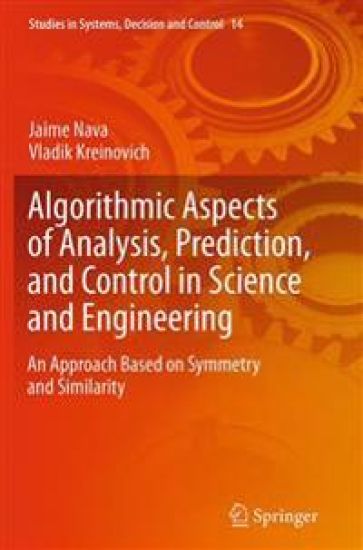
Algorithmic Aspects of Analysis, Prediction, and Control in Science and Engineering

Algorithmic Aspects of Analysis, Prediction, and Control in Science and Engineering

Jaime Nava; Vladik Kreinovich

Springer-Verlag Berlin and Heidelberg GmbH Co. K
2016
nidottu
This book demonstrates how to describe and analyze a system's behavior and extract the desired prediction and control algorithms from this analysis. A typical prediction is based on observing similar situations in the past, knowing the outcomes of these past situations, and expecting that the future outcome of the current situation will be similar to these past observed outcomes. In mathematical terms, similarity corresponds to symmetry, and similarity of outcomes to invariance. This book shows how symmetries can be used in all classes of algorithmic problems of sciences and engineering: from analysis to prediction to control. Applications cover chemistry, geosciences, intelligent control, neural networks, quantum physics, and thermal physics. Specifically, it is shown how the approach based on symmetry and similarity can be used in the analysis of real-life systems, in the algorithms of prediction, and in the algorithms of control.
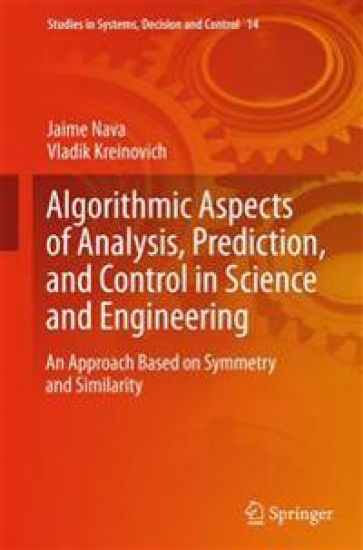
Algorithmic Aspects of Analysis, Prediction, and Control in Science and Engineering

Algorithmic Aspects of Analysis, Prediction, and Control in Science and Engineering

Jaime Nava; Vladik Kreinovich

Springer-Verlag Berlin and Heidelberg GmbH Co. K
2014
sidottu
This book demonstrates how to describe and analyze a system's behavior and extract the desired prediction and control algorithms from this analysis. A typical prediction is based on observing similar situations in the past, knowing the outcomes of these past situations, and expecting that the future outcome of the current situation will be similar to these past observed outcomes. In mathematical terms, similarity corresponds to symmetry, and similarity of outcomes to invariance. This book shows how symmetries can be used in all classes of algorithmic problems of sciences and engineering: from analysis to prediction to control. Applications cover chemistry, geosciences, intelligent control, neural networks, quantum physics, and thermal physics. Specifically, it is shown how the approach based on symmetry and similarity can be used in the analysis of real-life systems, in the algorithms of prediction, and in the algorithms of control.