Kirjojen hintavertailu – 12 859 828 kirjaa ja 27 kauppaa

Kirjailija

Jairo Nunes

Kirjat ja teokset yhdessä paikassa: 7 kirjaa, julkaisuja vuosilta 2004–2025, suosituimpiin kuuluu The Syntax of Portuguese. Vertaile teosten hintoja ja tarkista saatavuus suomalaisista kirjakaupoista.

7 kirjaa

Kirjojen julkaisuvuodet: 2004–2025.

The Syntax of Portuguese

The Syntax of Portuguese

Mary A. Kato; Ana Maria Martins; Jairo Nunes

Cambridge University Press
2025
pokkari
Portuguese is the second most spoken Romance language in the world, and due to recent interest in comparative syntax, the literature on its syntax has increased exponentially, resulting in exciting discoveries of a range of aspects that have hitherto been overlooked. This book provides a theoretically grounded overview of the major syntactic properties of Portuguese, focusing on the differences between European and Brazilian Portuguese. It shows from a theoretical point of view how different syntactic properties are interconnected by comparing and contrasting the variances between pronominal and agreement systems, null subjects, null complements, and word order. It also highlights how small differences in the specification of syntactic properties may yield quite different dialects. It introduces key theoretical points without technical jargon, making the content accessible to specialist and non-specialists alike. It is essential reading for both academic researchers and students of Portuguese language, comparative syntax, Romance linguistics, and theoretical syntax.
The Syntax of Portuguese

The Syntax of Portuguese

Mary A. Kato; Ana Maria Martins; Jairo Nunes

Cambridge University Press
2023
sidottu
Portuguese is the second most spoken Romance language in the world, and due to recent interest in comparative syntax, the literature on its syntax has increased exponentially, resulting in exciting discoveries of a range of aspects that have hitherto been overlooked. This book provides a theoretically grounded overview of the major syntactic properties of Portuguese, focusing on the differences between European and Brazilian Portuguese. It shows from a theoretical point of view how different syntactic properties are interconnected by comparing and contrasting the variances between pronominal and agreement systems, null subjects, null complements, and word order. It also highlights how small differences in the specification of syntactic properties may yield quite different dialects. It introduces key theoretical points without technical jargon, making the content accessible to specialist and non-specialists alike. It is essential reading for both academic researchers and students of Portuguese language, comparative syntax, Romance linguistics, and theoretical syntax.
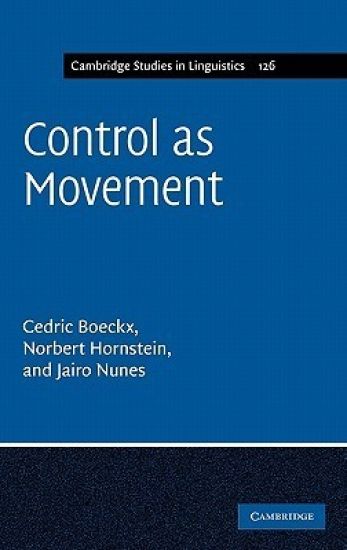
Control as Movement

Control as Movement

Cedric Boeckx; Norbert Hornstein; Jairo Nunes

Cambridge University Press
2014
pokkari
The Movement Theory of Control (MTC) makes one major claim: that control relations in sentences like 'John wants to leave' are grammatically mediated by movement. This goes against the traditional view that such sentences involve not movement, but binding, and analogizes control to raising, albeit with one important distinction: whereas the target of movement in control structures is a theta position, in raising it is a non-theta position; however the grammatical procedures underlying the two constructions are the same. This book presents the main arguments for MTC and shows it to have many theoretical advantages, the biggest being that it reduces the kinds of grammatical operations that the grammar allows, an important advantage in a minimalist setting. It also addresses the main arguments against MTC, using examples from control shift, adjunct control, and the control structure of 'promise', showing MTC to be conceptually, theoretically, and empirically superior to other approaches.
Control as Movement

Control as Movement

Cedric Boeckx; Norbert Hornstein; Jairo Nunes

Cambridge University Press
2010
sidottu
The Movement Theory of Control (MTC) makes one major claim: that control relations in sentences like 'John wants to leave' are grammatically mediated by movement. This goes against the traditional view that such sentences involve not movement, but binding, and analogizes control to raising, albeit with one important distinction: whereas the target of movement in control structures is a theta position, in raising it is a non-theta position; however the grammatical procedures underlying the two constructions are the same. This book presents the main arguments for MTC and shows it to have many theoretical advantages, the biggest being that it reduces the kinds of grammatical operations that the grammar allows, an important advantage in a minimalist setting. It also addresses the main arguments against MTC, using examples from control shift, adjunct control, and the control structure of 'promise', showing MTC to be conceptually, theoretically, and empirically superior to other approaches.
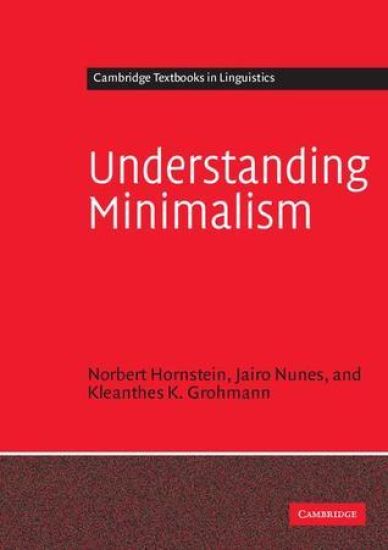
Understanding Minimalism

Understanding Minimalism

Norbert Hornstein; Jairo Nunes; Kleanthes K. Grohmann

Cambridge University Press
2005
pokkari
Understanding Minimalism, first published in 2005, is an introduction to the Minimalist Program - the model of syntactic theory within generative linguistics. Accessibly written, it presents the basic principles and techniques of the minimalist program, looking firstly at analyses within Government and Binding Theory (the Minimalist Program's predecessor), and gradually introducing minimalist alternatives. Minimalist models of grammar are presented in a step-by-step fashion, and the ways in which they contrast with GB analyses are clearly explained. Spanning a decade of minimalist thinking, this textbook will enable students to develop a feel for the sorts of questions and problems that minimalism invites, and to master the techniques of minimalist analysis. Over 100 exercises are provided, encouraging them to put these skills into practice. Understanding Minimalism will be an invaluable text for intermediate and advanced students of syntactic theory, and will set a solid foundation for further study and research within Chomsky's minimalist framework.
Understanding Minimalism

Understanding Minimalism

Norbert Hornstein; Jairo Nunes; Kleanthes K. Grohmann

Cambridge University Press
2005
sidottu
Understanding Minimalism, first published in 2005, is an introduction to the Minimalist Program - the model of syntactic theory within generative linguistics. Accessibly written, it presents the basic principles and techniques of the minimalist program, looking firstly at analyses within Government and Binding Theory (the Minimalist Program's predecessor), and gradually introducing minimalist alternatives. Minimalist models of grammar are presented in a step-by-step fashion, and the ways in which they contrast with GB analyses are clearly explained. Spanning a decade of minimalist thinking, this textbook will enable students to develop a feel for the sorts of questions and problems that minimalism invites, and to master the techniques of minimalist analysis. Over 100 exercises are provided, encouraging them to put these skills into practice. Understanding Minimalism will be an invaluable text for intermediate and advanced students of syntactic theory, and will set a solid foundation for further study and research within Chomsky's minimalist framework.
Linearization of Chains and Sideward Movement
This highly original monograph treats movement operations within the Minimalist Program. Jairo Nunes argues that traces are not grammatical primitives and that their properties follow from deeper features of the system, and, in particular, that the phonetic realization of traces is determined by linearization computations coupled with economy conditions regarding deletion. He proposes a version of the copy theory of movement according to which movement must be construed as a description of the interaction of the independent operations Copy, Merge, Form Chain, and Chain Reduction. Empirical evidence to support this claim includes instances of "sideward movement" between subtrees in a derivation. According to this analysis, the linearization of chains in the phonological component constrains sideward movement so that it is possible to account for standard properties of multiple gap constructions, including parasitic gap and ATB constructions, without construction-specific operations or principles that are not independently motivated. Theoretical linguists will find Linearization of Chains and Sideward Movement of great interest both theoretically and empirically. The version of the copy theory of movement proposed by Nunes will stir debate and shape future research in the field.