
Kirjailija
Jamal Qaiser
Kirjat ja teokset yhdessä paikassa: 17 kirjaa, julkaisuja vuosilta 2018–2024, suosituimpiin kuuluu Covid-19: Falsche Pandemie. Vertaile teosten hintoja ja tarkista saatavuus suomalaisista kirjakaupoista.
17 kirjaa
Kirjojen julkaisuvuodet: 2018–2024.
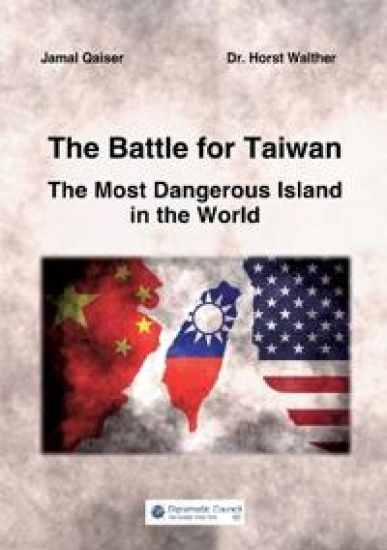
The power struggle between the United States of America and the People's Republic of China (PRC) for global supremacy is coming to a head. The small island of Taiwan - officially the "Republic of China" - represents the "tipping point" in this area of conflict, which could turn open hostility into a war between the two superpowers. For the PRC, Taiwan is a self-evident part of its own state; the USA treats Taiwan just as naturally as an independent state that belongs to its sphere of influence and which must be defended at all costs. With Russia's invasion of Ukraine, it has become clear how quickly such tensions can escalate into war. It is to be expected that, in order to defend its global supremacy, the USA will deploy the same Western alliance against China that it has put in place against Russia. In other words: If we have been engaged in some kind of "indirect war" against Russia since 2022, a similar if not worse scenario is in store if the conflict between the PRC and the USA assumes a military dimension. If the war over Ukraine has already hit Europe hard, a military confrontation between the two superpowers over Taiwan would shake Europe politically and, above all, economically. Europe has for a long time regarded itself as having a neutral stance to the USA and the PRC - this political classification would be shattered overnight. If the supply from the PRC dried up and the sales markets there were to disappear, this would drive Europe to the brink of economic ruin. Moreover, Taiwan's failure as the world's largest contract manufacturer of computer chips would have devastating effects on the global economy. This topical and explosive book analyses the background and draws possible scenarios for the future.
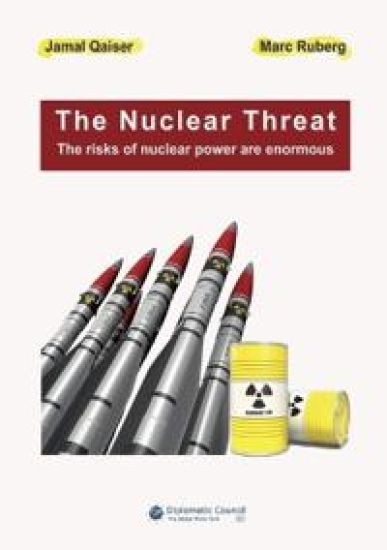
The nuclear threat comes from two directions. Firstly, as a result of a possible catastrophe, a maximum conceivable accident that can be assumed, in the peaceful use of nuclear power for energy supply. Secondly, from a likely military escalation to nuclear war. As different as both scenarios are, the consequences can be similarly devastating. In addition, there is the yet unresolved question of "where to dispose of radioactive waste". This question is still unresolved, not only in Germany, but around the globe. Nevertheless, a renaissance of nuclear power is imminent for several reasons. New mini-reactors promise energy right where it is needed - and big money for investors. The commercial exploitation of nuclear fusion is on the verge of a breakthrough. So far, all nuclear reactors have "only" worked with nuclear fission. Nuclear fusion, which is many times more powerful, has so far only been used in two places: in the sun and other stars, and in atomic bombs. Moreover, there is the foreseeable use of nuclear power in the forthcoming conquest of space, for example to supply energy to settlements on the moon and Mars. Above all, the Damocles sword of military use is hovering in the face of new types of weapons from drones with artificial intelligence and killer satellites in space. The escalation of the conflicts between the United States of America, Russia and China makes the nuclear threat as topical today as it was during the Cold War.

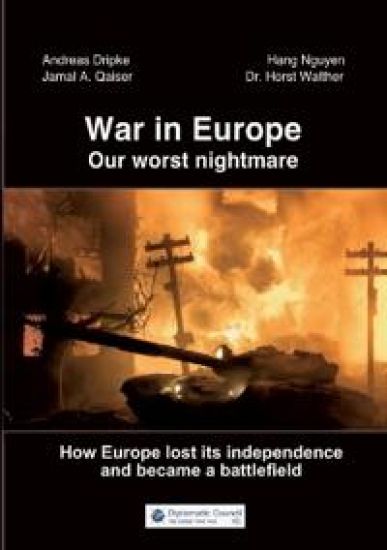
Europe has become the battlefield of a merciless proxy war between the superpowers. The war erupted in 2022, but it has been in the offing for more than two decades. In the wake of the Cold War, Western Europe sought to achieve a peace process in Eastern Europe. The Federal Republic of Germany's Ostpolitik (German policy towards Eastern Europe) is an example of this. Russia became a partner, almost even a friend. However, at the same time, NATO, under US leadership, expanded further and further east. This development brought the peace process to a standstill and eventually reversed it. Today, Russia and the USA are irreconcilably opposed to each other in Europe. The Russian invasion of Ukraine in spring 2022 has made any peaceful agreement between Europe and Russia impossible for the foreseeable future. Europe is committed to the USA and not only vis- -vis Russia. For according to the will of the USA, this front is also to be positioned vis- -vis the People's Republic of China. This fatal development is critically connected to the fact that Europe has not succeeded in creating an independent and autonomous position for itself in world politics. The "Old Continent" has become dependent on the USA, Russia and China, from which there seems to be no escape. Europe has become the pawn of the superpowers. The battle for Europe has begun.

Krieg in Europa - Unser schlimmster Albtraum
Andreas Dripke; Hang Nguyen; Jamal Qaiser
Diplomatic Council e.V.
2022
nidottu
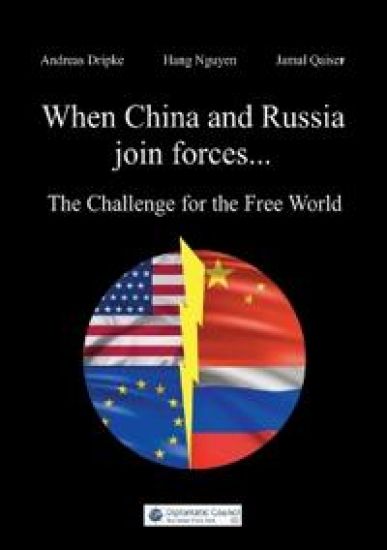
When China and Russia join forces
Andreas Dripke; Hang Nguyen; Jamal Qaiser
Diplomatic Council e.V.
2022
pokkari
On February 24, 2022, Russia launched the invasion of Ukraine. Just 20 days earlier, Russian President Vladimir Putin and Chinese leader Xi Jinping had signed an "Alliance Treaty." This was no coincidence: Beijing and Moscow are closer than commonly perceived in the West. The two countries are not "bosom friends," but they are united in an irrepressible desire to crush the supremacy of the United States of America. And both countries are clearly committed to a common social system, namely communism. This is diametrically opposed to the Western concept of democracy under the rule of law and individual freedom for humanity. If the most populous state on earth, the People's Republic of China, and the largest country on this planet in terms of area, the Russian Federation, join forces against the West, our democracy, freedom and rule of law will be in acute danger. There is no way for Europe to stay out of this culture war. But there is an opportunity to take a clear stance in order to achieve maximum security for the people of Europe in an uncertain era. In this grippingly written book, nonfiction author Andreas Dripke, UN advisor Hang Nguyen, and peace activist Jamal Qaiser vividly demonstrate what can happen when China and Russia join forces. This much can be revealed: It forbodes nothing good

Wenn sich China und Russland verbünden...
Andreas Dripke; Hang Nguyen; Jamal Qaiser
Diplomatic Council e.V.
2022
nidottu
Das Versagen des Westens in Afghanistan, Syrien und der Ukraine
Hang Nguyen; Jamal Qaiser
Diplomatic Council e.V.
2022
nidottu
Meticulously researched, formulated with suspense and with a great deal of empathy for those suffering from the horrors of war, the authors give a brutally honest recount of the conflicts in Afghanistan, Syria and Ukraine - and more Far beyond that, this book is about the global mechanisms of power. All three countries exemplify the callous principle of proxy wars. Here, the power games of the superpowers enfold in regions that happen to serve as "venues." The authors highlight the impotence of the United Nations as well as the paralysis of the European Union. Beyond analysis and accusation, Hang Nguyen and Jamal Qaiser outline concrete ways in which peace processes can be initiated and steered towards success. Not only, but also in Afghanistan, Syria and Ukraine.

The war in Afghanistan is one of the longest-running wars. However, with the Taliban taking complete control of Afghanistan, we still hope that the country housing over 30 million people can stabilize itself. For this purpose, it is essential to discuss the complexity of the Afghan war and what can be the way forward. Therefore, intending to mitigate the suffering of Afghan people and bring peace, this book examines the intricacy of the Afghan war while discussing the history of war, factors shaping the war strategy, what went wrong, and the current situation in Afghanistan. Afghan people had suffered due to the long-standing conflict in Afghanistan, and they are still suffering. The future peacebuilding, good governance, and sustainable development in Afghanistan depend on its human capital. The world cannot abandon these people now. Afghan people took the toll to fight terrorism, and this is when they shall get support from the international community. "Afghanistan - The Battered Land" appeals to the international community, governments, and the United Nations to ensure sustainable peace in Afghanistan while discussing some possibilities.


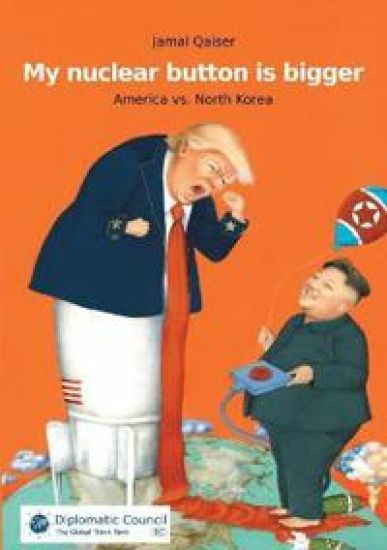
Jamal Qaiser describes what is actually behind the conflict between the United States and North Korea. What forces apart from mainstream reporting really exist, how this conflict can be resolved and how we can secure long-term peace in this world. He also describes the role of capitalism in this conflict and why the United States is compelled to wage new wars all the time. If we want to prevent a war in North Korea, we urgently need a single European foreign policy. The DC Commissioner for UN Affairs explains in his latest book why there is no way around it. About the author: The German-Pakistani entrepreneur, writer, Peace Activist and Social Political Advisor Jamal Qaiser, completed his studies for OPM at the Harvard Business School and the Transition to Leadership programme of the University of Oxford Said Business School. Jamal Qaiser advises various companies and political parties, NGOs, humanist organisations and governmental apparatus. Since 2016 he has advised as UN-Commissioner for UN-Affairs for the Diplomatic Council the economic and UN Social Council - one think tank at the United Nations has the highest consultative status, i.e. the Economic and Social Council of the UN. His book published in 2016: "Der fremde Erfolgsfaktor - Why we urgently need immigrants in Germany," attracted a great deal of attention both nationally and internationally. In the same year he won the international getAbstract Book Award with his work from a selection of over 10,000 non-fiction books.