Kirjojen hintavertailu – 12 859 818 kirjaa ja 27 kauppaa
Kirjailija
James Boyd White
Kirjat ja teokset yhdessä paikassa: 17 kirjaa, julkaisuja vuosilta 1985–2022, suosituimpiin kuuluu When Words Lose Their Meaning. Vertaile teosten hintoja ja tarkista saatavuus suomalaisista kirjakaupoista.
St. Augustine’s Confessions is heralded as a classic of Western culture. Yet when James Boyd White first tried to read it in translation, it seemed utterly dull. Its ideas struck him as platitudinous and its prose felt drab. It was only when he started to read the text in Latin that he began to see the originality and depth of Augustine’s work. In Let in the Light, White invites readers to join him in a close and engaged encounter with the Confessions in which they will come to share his experience of the book’s power and profundity by reading at least some of it in Augustine’s own language. He offers an accessible guide to reading the text in Latin, line by line—even for those who have never studied the language. Equally attuned to the resonances of individual words and the deeper currents of Augustine’s culture, Let in the Light considers how the form and nuances of the Latin text allow greater insight into the work and its author. White shows how to read Augustine’s prose with care and imagination, rewarding sustained attention and broader reflection. Let in the Light brings new life to a classic work, guiding readers to experience the immediacy, urgency, and vitality of Augustine’s Confessions.
St. Augustine’s Confessions is heralded as a classic of Western culture. Yet when James Boyd White first tried to read it in translation, it seemed utterly dull. Its ideas struck him as platitudinous and its prose felt drab. It was only when he started to read the text in Latin that he began to see the originality and depth of Augustine’s work. In Let in the Light, White invites readers to join him in a close and engaged encounter with the Confessions in which they will come to share his experience of the book’s power and profundity by reading at least some of it in Augustine’s own language. He offers an accessible guide to reading the text in Latin, line by line—even for those who have never studied the language. Equally attuned to the resonances of individual words and the deeper currents of Augustine’s culture, Let in the Light considers how the form and nuances of the Latin text allow greater insight into the work and its author. White shows how to read Augustine’s prose with care and imagination, rewarding sustained attention and broader reflection. Let in the Light brings new life to a classic work, guiding readers to experience the immediacy, urgency, and vitality of Augustine’s Confessions.
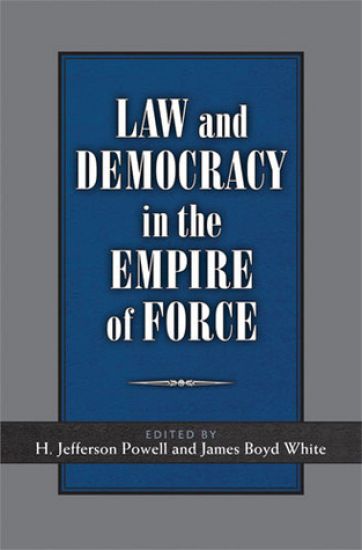
The authors of this book share a concern for the state of law and democracy in our country, which to many seems to have deteriorated badly. Deep changes are visible in a wide array of phenomena: judicial opinions, the teaching of law, legal practice, international relations, legal scholarship, congressional deliberations, and the culture of contemporary politics. In each of these intersections between law, culture, and politics, traditional expectations have been transformed in ways that pose a threat to the continued vitality and authority of law and democracy. The authors analyze specific instances in which such a decline has occurred or is threatened, tracing them to "the empire of force," a phrase borrowed from Simone Weil. This French intellectual applied the term not only to the brute force used by police and soldiers but, more broadly, to the underlying ways of thinking, talking, and imagining that make that sort of force possible, including propaganda, unexamined ideology, sentimental clichés, and politics by buzzwords, all familiar cultural forms. Based on the underlying crisis and its causes, the editors and authors of these essays agree that neither law nor democracy can survive where the empire of force dominates. Yet each manages to find a ground for hope in our legal and democratic culture. H. Jefferson Powell is Frederic Cleaveland Professor of Law and Divinity at Duke University and has served in both the federal and state governments, as a deputy assistant attorney general and as principal deputy solicitor general in the U. S. Department of Justice and as special counsel to the attorney general of North Carolina. His latest book is Constitutional Conscience: The Moral Dimension of Judicial Decision. James Boyd White is Hart Wright Professor of Law emeritus and Professor of English emeritus, at the University of Michigan. His latest book is Living Speech: Resisting the Empire of Force." An extraordinary collection of provocative, insightful, and inspiring essays on the future of law and democracy in the twenty-first century."---Geoffrey R. Stone, Edward H. Levi Distinguished Service Professor of Law, University of Chicago"These thoughtful essays diagnose democracy's perilous present, and---more importantly---they explore avenues to democracy's rescue through humanization of law."---Kenneth L. Karst, David G. Price and Dallas P. Price Professor of Law Emeritus, UCLAContributorsMartin Böhmer, Universidad de San Andres, Buenos Aires, ArgentinaM. Cathleen Kaveny, University of Notre DameHoward Lesnick, University of PennsylvaniaThe Honorable John T. Noonan Jr., Ninth Circuit Court of AppealsH. Jefferson Powell, Duke UniversityJedediah Purdy, Duke UniversityJed Rubenfeld, Yale UniversityA. W. Brian Simpson, University of MichiganBarry Sullivan, Jenner and Block LLP, ChicagoJoseph Vining, University of MichiganRobin West, Georgetown UniversityJames Boyd White, University of Michigan
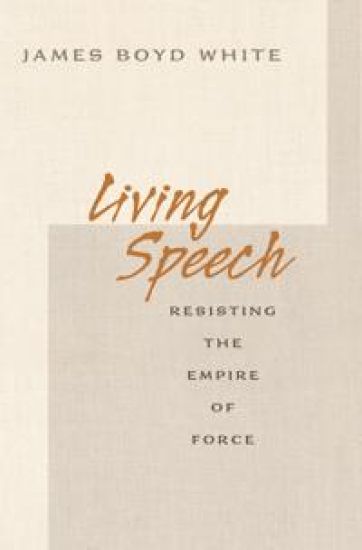
Language is our key to imagining the world, others, and ourselves. Yet sometimes our ways of talking dehumanize others and trivialize human experience. In war other people are imagined as enemies to be killed. The language of race objectifies those it touches, and propaganda disables democracy. Advertising reduces us to consumers, and cliches destroy the life of the imagination. How are we to assert our humanity and that of others against the forces in the culture and in our own minds that would deny it? What kind of speech should the First Amendment protect? How should judges and justices themselves speak? These questions animate James Boyd White's Living Speech, a profound examination of the ethics of human expression--in the law and in the rest of life. Drawing on examples from an unusual range of sources--judicial opinions, children's essays, literature, politics, and the speech-out-of-silence of Quaker worship--White offers a fascinating analysis of the force of our languages. Reminding us that every moment of speech is an occasion for gaining control of what we say and who we are, he shows us that we must practice the art of resisting the forces of inhumanity built into our habits of speech and thought if we are to become more capable of love and justice--in both law and life.
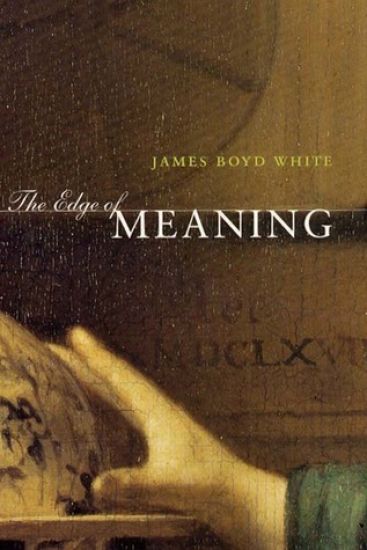
Certain questions are basic to the human condition: how we imagine the world, and ourselves and others within it; how we confront the constraints of language and the limits of our own minds; and how we use imagination to give meaning to past experiences and to shape future ones. These are the questions James Boyd White addresses in "The Edge of Meaning", exploring each through its application to great works of Western culture - "Huckleberry Finn", the "Odyssey", and the paintings of Vermeer among them. In doing so, White creates a deeply moving and insightful book and presents an inspiring conception of mind, language and the essence of living.
How do you imagine the world, and yourself and others within it? How do you confront the constraints of language, the evils of your particular culture, the limits of your own mind? How do you use what you imagine to give meaning to your past experience and shape your expectations for the future? Such are the questions that drive "The Edge of Meaning", by the distinguished humanist and lawyer James Boyd White. With the delicacy, range and style for which he is known, White brings these questions to a series of great works from Western culture. These provocative discussions reveal different kinds of language - from words to brushstrokes - that both enable and constrain our understanding. These include Thoreau's "Walden", Twain's "Huckleberry Finn", Homer's "Odyssey", and Plato's "Phaedrus", as well as the paintings of Vermeer, the structure of a modern legal case, and the poetry of Robert Frost and George Herbert. Throughout, White examines his own experience in light of this complex set of questions, drawing the reader further into the intricacies of our search for understanding. The sequence of the book's chapters also eloquently retraces the universal human quest for meaning, from the youthful belief that we can make sense of it all, to the ways in which we continue to pursue the possibility of meaning even when we realize that the world's uncertainty extends to our own minds and imaginations. Addressing the most fundamental imaginative and intellectual activity of human life, this moving book presents an inspiring conception of an art of mind and language that enables us to live with the uncertainty and fluidity that are themselves the essence of living.
In this collection of essays, James Boyd White continues his work in the rhetorical and literary analysis of law, seeing it as a system for the creation of social meaning. White's focus is on the intellectual and ethical possibilities of law, based on the view that law is not merely a logical enterprise, nor a mere matter of politics and power, but rather an activity of the whole mind, including its imaginative and affective capacities. The essays here are united by two basic themes. First, the essays suggest that law can usefully be regarded not only as a set of rules designed to produce results in the material world, as it usually is regarded, but also as an imaginative and intellectual activity that has as its end the claim of meaning for human experience, both individual and collective. Second, they argue that education, including in the law, works by the constant modification of expectation by experience. White claims that as we grow, whether as individuals or as a community, we constantly shape our expectations to our experiences. This happens with particular force and clarity in the law, which seeks to create both a certain set of expectations--this is how it works as a system of regulation--and a series of occasions and methods for their revision. White's interest is in the way these understandings can affect legal teaching, practice, and criticism. The essays in this book examine such topics as the nature of legal education; the possibilities for writing in the law for both judges and lawyers; the relation between the practice of making and claiming meaning as it works in the law and in literatures more usually though of as imaginative, such as poetry or drama; the ways in which the law talks, and ought to talk, about business corporations, religion, and individual judgments; and the ethical possibilities of the practice of law when it is conceived of as a field for the making of meaning. From Expectation to Experience will be of interest to lawyers, legal scholars, as well as students of law, law and literature, and ethics and literature. James Boyd White is Hart Wright Professor of Law, Professor of English, and Adjunct Professor of Classical Studies, University of Michigan.
To which institutions or social practices should we grant authority? When should we instead assert our own sense of what is right or good or necessary? In this text, the author shows how texts by some of the important thinkers and writers - including Plato, Shakespeare, Dickinson, Mandela and Lincoln - answer these questions in the way they wrestle with the claims of the world and self in particular historical and cultural contexts. As they define the institutions or practices for which they claim (or resist) authority, they create authorities of their own, in the modes of thought and expression they employ. They imagine their world anew and transform the languages that give it meaning. In so doing, White maintains, these works teach us about how to read and judge claims of authority made by others upon us; how to decide to which institutions and practices we should grant authority; and how to create authorities of our own through our thoughts and arguments.
To which institutions or social practices should we grant authority? When should we instead assert our own sense of what is right or good or necessary? In this book, James Boyd White shows how texts by some of our most important thinkers and writers - including Plato, Shakespeare, Dickinson, Mandela and Lincoln - answer these questions, not in the abstract, but in the way they wrestle with the claims of the world and self in particular historical and cultural contexts. As they define afresh the institutions or practices for which they claim (or resist) authority, they create authorities of their own, in the very modes of thought and expression they employ. They imagine their world anew and transform the languages that give it meaning. In so doing, White maintains, these works teach us about how to read and judge claims of authority made by others upon us; how to decide to which institutions and practices we should grant authority; and how to create authorities of our own through our thoughts and arguments.
White extends his conception of United States law as a constitutive rhetoric shaping American legal culture that he proposed in When Words Lose Their Meaning, and asks how Americans can and should criticize this culture and the texts it creates. In determining if a judicial opinion is good or bad, he explores the possibility of cultural criticism, the nature of conceptual language, the character of economic and legal discourse, and the appropriate expectations for critical and analytic writing. White employs his unique approach by analyzing individual cases involving the Fourth Amendment of the United States constitution and demonstrates how a judge translates the facts and the legal tradition, creating a text that constructs a political and ethical community with its readers.
White extends his theory of law as constitutive rhetoric, asking how one may criticize the legal culture and the texts within it. "A fascinating study of the language of the law... This book is to be highly recommended: certainly, for those who find the time to read it, it will broaden the mind, and give lawyers a new insight into their role."--New Law Journal
Through fresh readings of texts ranging from Homer's Iliad, Swift's Tale of a Tub, and Austen's Emma through the United States Constitution and McCulloch v. Maryland, James Boyd White examines the relationship between an individual mind and its language and culture as well as the "textual community" established between writer and audience. These striking textual analyses develop a rhetoric—a "way of reading" that can be brought to any text but that, in broader terms, becomes a way of learning that can shape the reader's life." In this ambitious and demanding work of literary criticism, James Boyd White seeks to communicate 'a sense of reading in a new and different way.' . . . [White's] marriage of lawyerly acumen and classically trained literary sensibility—equally evident in his earlier work, The Legal Imagination—gives the best parts of When Words Lose Their Meaning a gravity and moral earnestness rare in the pages of contemporary literary criticism."—Roger Kimball, American Scholar"James Boyd White makes a state-of-the-art attempt to enrich legal theory with the insights of modern literary theory. Of its kind, it is a singular and standout achievement. . . . [White's] selections span the whole range of legal, literary, and political offerings, and his writing evidences a sustained and intimate experience with these texts. Writing with natural elegance, White manages to be insightful and inciteful. Throughout, his timely book is energized by an urgent love of literature and law and their liberating potential. His passion and sincerity are palpable."—Allan C. Hutchinson, Yale Law Journal"Undeniably a unique and significant work. . . . When Words Lose Their Meaning is a rewarding book by a distinguished legal scholar. It is a showcase for the most interesting sort of inter-disciplinary work: the kind that brings together from traditionally separate fields not so much information as ideas and approaches."—R. B. Kershner, Jr., Georgia Review