Kirjojen hintavertailu – 12 903 725 kirjaa ja 27 kauppaa

Kirjailija

James Buchanan

Kirjat ja teokset yhdessä paikassa: 148 kirjaa, julkaisuja vuosilta 1979–2026, suosituimpiin kuuluu Modern Atheism Under Its Forms of Pantheism, Materialism, Secularism, Development, and Natural Laws (Cram Edition). Vertaile teosten hintoja ja tarkista saatavuus suomalaisista kirjakaupoista.

148 kirjaa

Kirjojen julkaisuvuodet: 1979–2026.

Moral Science & Moral Order

Moral Science & Moral Order

James Buchanan

Liberty Fund Inc
2001
sidottu
This volume presents a representative sampling of James M Buchanan's philosophical views as he deals with fundamental problems of moral science and moral order. As one might expect, Buchanan always goes back to fundamental principles first. From there, his observations and conclusions range far and wide from his own discipline. The thirty essays collected in MORAL SCIENCE AND MORAL ORDER are divided into these categories: methods and models; belief and consequence; moral community and moral order; moral science, equality, and justice; contractarian encounters. In his foreword, Hartmut Kliemt says, "The British and Scottish Moralists of the Enlightenment period would have felt very comfortable with James Buchanan. Like them, Buchanan may be seen as a 'man of letters' who concerns himself with fundamental problems of moral science and moral order. But, also like them, Buchanan is not a secondhand dealer in old ideas. On the contrary, taking as inspiration classical philosopher-economists (in particular, Adam Smith), Buchanan not only proposes new applications of the neoclassical economic paradigm, he also addresses, in innovative ways, fundamental issues of his discipline and beyond." Kliemt's lengthy foreword highlights some of the major philosophical currents with which Buchanan is engaged in the papers collected in this volume. His introduction to these philosophies provides an excellent grounding for economists and all readers who may not be familiar with the philosophical and fundamental issues Buchanan undertakes.
Federalism Liberty & the Law

Federalism Liberty & the Law

James Buchanan

Liberty Fund Inc
2001
sidottu
As diverse as the papers presented in this volume may seem at first glance, all of them touch on two characteristic themes of James Buchanan's work: the respect for individual sovereignty and the threat of monopoly power on the rights of the individual. In his foreword, Hartmut Kliemt says, "As opposed to more extreme and more utopian libertarians, (Buchanan) well understands that in our world it takes a state to defend the individual from the state. Buchanan, therefore, is not an anarchist but, rather, what may be called a 'reluctant anarchist' who accepts both that the state is the greatest threat to individual sovereignty and that without some statelike monopoly, individual sovereignty cannot be protected." The twenty-six essays included in FEDERALISM, LIBERTY, AND THE LAW are grouped into these categories: the analytics of federalism; federalism and freedom; liberty, man, and the state; the constitution of markets; economists, efficiency, and the law; law, money, and crime. The central issue that unites the pieces in this volume is monopoly power and its control. As a libertarian, Buchanan sees government as the greatest threat -- and also the greatest protector -- of individual liberties.
Ideas, Persons & Events

Ideas, Persons & Events

James Buchanan

Liberty Fund Inc
2001
sidottu
This final volume (save for the Index) in Liberty Fund's 'The Collected Works of James M Buchanan' acquaints us most intimately with the man himself. Included are essays and short pieces that shed light on Buchanan's view of the world. Ranging from personal reflections on the art and science of economics, to restatements of his central themes and reminiscences of his encounters and collaborations with other great thinkers, this volume presents James Buchanan as a multidimensional human being, not just as a great economic and political thinker. The thirty-three pieces collected in IDEAS, PERSONS, AND EVENTS are grouped into these categories: autobiographical and personal reflections; reflections on fellow political economists; political economy in the post-socialist century; reform without romance. As Hartmut Kliemt states in his foreword, "The personal and the theoretical are often inseparably intertwined in the essays of this volume... As a case in point, consider James Buchanan's account of his relationship to Frank Knight. This account not only sheds some interesting light on the personal element in the development of science, it also offers some new perspectives on the concept of the 'relatively absolute absolutes', which has been so central to Buchanan's thinking in general."
Federalism Liberty & the Law

Federalism Liberty & the Law

James Buchanan

Liberty Fund Inc
2001
nidottu
As diverse as the papers presented in this volume may seem at first glance, all of them touch on two characteristic themes of James Buchanan's work: the respect for individual sovereignty and the threat of monopoly power on the rights of the individual. In his foreword, Hartmut Kliemt says, "As opposed to more extreme and more utopian libertarians, (Buchanan) well understands that in our world it takes a state to defend the individual from the state. Buchanan, therefore, is not an anarchist but, rather, what may be called a 'reluctant anarchist' who accepts both that the state is the greatest threat to individual sovereignty and that without some statelike monopoly, individual sovereignty cannot be protected." The twenty-six essays included in FEDERALISM, LIBERTY, AND THE LAW are grouped into these categories: the analytics of federalism; federalism and freedom; liberty, man, and the state; the constitution of markets; economists, efficiency, and the law; law, money, and crime. The central issue that unites the pieces in this volume is monopoly power and its control. As a libertarian, Buchanan sees government as the greatest threat -- and also the greatest protector -- of individual liberties.
Ideas, Persons & Events

Ideas, Persons & Events

James Buchanan

Liberty Fund Inc
2001
nidottu
This final volume (save for the Index) in Liberty Fund's 'The Collected Works of James M Buchanan' acquaints us most intimately with the man himself. Included are essays and short pieces that shed light on Buchanan's view of the world. Ranging from personal reflections on the art and science of economics, to restatements of his central themes and reminiscences of his encounters and collaborations with other great thinkers, this volume presents James Buchanan as a multidimensional human being, not just as a great economic and political thinker. The thirty-three pieces collected in IDEAS, PERSONS, AND EVENTS are grouped into these categories: autobiographical and personal reflections; reflections on fellow political economists; political economy in the post-socialist century; reform without romance. As Hartmut Kliemt states in his foreword, "The personal and the theoretical are often inseparably intertwined in the essays of this volume... As a case in point, consider James Buchanan's account of his relationship to Frank Knight. This account not only sheds some interesting light on the personal element in the development of science, it also offers some new perspectives on the concept of the 'relatively absolute absolutes', which has been so central to Buchanan's thinking in general."
Externalities & Public Expenditure Theory

Externalities & Public Expenditure Theory

James Buchanan

Liberty Fund Inc
2001
nidottu
In his foreword, Geoffrey Brennan states, "The papers in this volume represent a coherent set of pieces focused on aspects of public-expenditure theory and constitute all of Buchanan's papers in this area." Buchanan's work on the subject of what governments should do and his insistence on Knut Wicksell's ideal that taxation and public expenditure be integrated topics have contributed significantly to the current thinking of most economists on the topic. Geoffrey Brennan summarises Buchanan's central themes in this way, "There are two messages that emerge from this work: one is that a proper sense of the extent of market failure, rather than its mere presence, is relevant in all cases; the other is that 'correcting' for such market failure is often a complex multidimensional business not captured by direct public provision at zero price and not necessarily involving expansion of market output." The twenty-nine papers represented in this volume are grouped into these major subject categories: public services and collective action, externalities, clubs and joint supply, public goods theory, applications -- city, health, and social security, distributive norms and collective action. This volume also includes what are arguably Buchanan's two most famous articles: 'Externality', which he wrote with William Stubblebine, and 'Economic Theory of Clubs'.
Externalities & Public Expenditure Theory

Externalities & Public Expenditure Theory

James Buchanan

Liberty Fund Inc
2001
sidottu
In his foreword, Geoffrey Brennan states, "The papers in this volume represent a coherent set of pieces focused on aspects of public-expenditure theory and constitute all of Buchanan's papers in this area." Buchanan's work on the subject of what governments should do and his insistence on Knut Wicksell's ideal that taxation and public expenditure be integrated topics have contributed significantly to the current thinking of most economists on the topic. Geoffrey Brennan summarises Buchanan's central themes in this way, "There are two messages that emerge from this work: one is that a proper sense of the extent of market failure, rather than its mere presence, is relevant in all cases; the other is that 'correcting' for such market failure is often a complex multidimensional business not captured by direct public provision at zero price and not necessarily involving expansion of market output." The twenty-nine papers represented in this volume are grouped into these major subject categories: public services and collective action, externalities, clubs and joint supply, public goods theory, applications -- city, health, and social security, distributive norms and collective action. This volume also includes what are arguably Buchanan's two most famous articles: 'Externality', which he wrote with William Stubblebine, and 'Economic Theory of Clubs'.
Debt & Taxes

Debt & Taxes

James Buchanan

Liberty Fund Inc
2001
nidottu
While this volume presents the important writings of James M. Buchanan on taxation and debt, Geoffrey Brennan makes it clear in the foreword that the thrust of Buchanan's work in this area has been to integrate theories of taxation and debt with public-expenditure theory. Therefore, the editors strongly urge that the present volume on taxation and debt be read in tandem with the subsequent Volume 15, 'Externalities and Public Expenditure Theory'. Included in this present volume are thirty-five important writings by Buchanan on taxation and debt. These are grouped into the following major subject categories: taxation, politics, and public choice; earmarking and incidence in democratic process; analytical and ethical foundations of tax limits; the fiscal constitution; confessions of a burden monger; Ricardian equivalence; the constitution of a debt-free polity. As Geoffrey Brennan points out in the foreword to this volume, "Although James Buchanan's interests are wide-ranging, the core of his professional reputation as an economist and the origin of much of his broader thinking lie in public economics -- in engagement with the questions of what governments do and how governments should properly finance what they do." This volume together with its partner subsequent volume present clear and accessible insights into the rich economic work for which Buchanan is best known.
Debt & Taxes

Debt & Taxes

James Buchanan

Liberty Fund Inc
2001
sidottu
While this volume presents the important writings of James M. Buchanan on taxation and debt, Geoffrey Brennan makes it clear in the foreword that the thrust of Buchanan's work in this area has been to integrate theories of taxation and debt with public-expenditure theory. Therefore, the editors strongly urge that the present volume on taxation and debt be read in tandem with the subsequent Volume 15, 'Externalities and Public Expenditure Theory'. Included in this present volume are thirty-five important writings by Buchanan on taxation and debt. These are grouped into the following major subject categories: taxation, politics, and public choice; earmarking and incidence in democratic process; analytical and ethical foundations of tax limits; the fiscal constitution; confessions of a burden monger; Ricardian equivalence; the constitution of a debt-free polity. As Geoffrey Brennan points out in the foreword to this volume, "Although James Buchanan's interests are wide-ranging, the core of his professional reputation as an economist and the origin of much of his broader thinking lie in public economics -- in engagement with the questions of what governments do and how governments should properly finance what they do." This volume together with its partner subsequent volume present clear and accessible insights into the rich economic work for which Buchanan is best known.
Moral Science & Moral Order

Moral Science & Moral Order

James Buchanan

Liberty Fund Inc
2001
nidottu
This volume presents a representative sampling of James M Buchanan's philosophical views as he deals with fundamental problems of moral science and moral order. As one might expect, Buchanan always goes back to fundamental principles first. From there, his observations and conclusions range far and wide from his own discipline. The thirty essays collected in MORAL SCIENCE AND MORAL ORDER are divided into these categories: methods and models; belief and consequence; moral community and moral order; moral science, equality, and justice; contractarian encounters. In his foreword, Hartmut Kliemt says, "The British and Scottish Moralists of the Enlightenment period would have felt very comfortable with James Buchanan. Like them, Buchanan may be seen as a 'man of letters' who concerns himself with fundamental problems of moral science and moral order. But, also like them, Buchanan is not a secondhand dealer in old ideas. On the contrary, taking as inspiration classical philosopher-economists (in particular, Adam Smith), Buchanan not only proposes new applications of the neoclassical economic paradigm, he also addresses, in innovative ways, fundamental issues of his discipline and beyond." Kliemt's lengthy foreword highlights some of the major philosophical currents with which Buchanan is engaged in the papers collected in this volume. His introduction to these philosophies provides an excellent grounding for economists and all readers who may not be familiar with the philosophical and fundamental issues Buchanan undertakes.
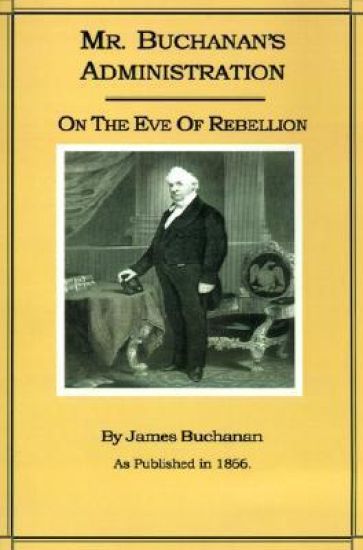
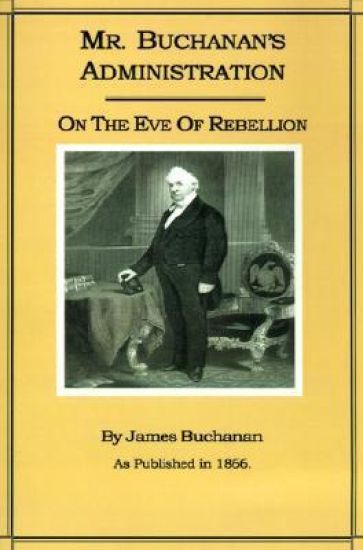
Mr. Buchanan's Administration on the Eve of the Rebellion
An autobiographical vindication of the policy of the Buchanan administration during the last months of his term, this book is an important source for understanding the political events leading to the secession and the Civil War. Throughout his administration, Buchanan was constantly plagued with the issues of slavery, even though the existence of domestic slavery in the South was recognized and protected by the Constitution of the United States. This book details the rising conflict within the nation as Southern slave holding states argued with Northern abolitionists and Anti-Slavery societies as to whether or not slavery should continue to flourish in the United States. Feeling the pressures of the unbearable tension between the North and the South, Buchanan tried desperately to compromise, pleading with both sides over this burning issue. He repeatedly warned his countrymen, at every opportunity, of the imminent danger they were putting the nation in and advised them of the means to avoid the certainty of a civil war. Despite these efforts, Congress rejected his recommendations. The result was the escalation of a conflict that led to the secession of the South and one of the bloodiest battles in our nation's history.
Power to Tax -- Analytical Foundations of a Fiscal Constitution
Commenting on his collaboration with Geoffrey Brennan on THE POWER TO TAX, James M. Buchanan says that the book is "demonstrable proof of the value of genuine research collaboration across national-cultural boundaries." Buchanan goes on to say that "THE POWER TO TAX is informed by a single idea -- the implications of a revenue-maximizing government." Originally published in 1980, THE POWER TO TAX was a much-needed answer to the tax revolts sweeping across the United States. It was a much-needed answer as well in the academic circles of tax theory, where orthodox public finance models were clearly inadequate to the needs at hand. The public-choice approach to taxation which Buchanan had earlier elaborated stood in direct opposition to public-finance orthodoxy. What Buchanan and Brennan constructed in THE POWER TO TAX was a middle ground between the two. As Brennan writes in the foreword, "The underlying motivating question was simple: Why not borrow the motivational assumptions standard in public-choice theory and put them together with assumptions about policy-maker discretion taken from public-finance orthodoxy?" The result was a controversial book -- and a much misunderstood one as well. Looking back twenty years later, Brennan feels confirmed in the rightness of the theories he and Buchanan espoused, particularly in their unity with the public-choice tradition: "The insistence on motivational symmetry is a characteristic feature of the public choice approach, and it is in this dimension that THE POWER TO TAX and the orthodox public- finance approach diverge."
Reason of Rules -- Constitutional Politics Economy
In his foreword, Robert D Tollison identifies the main objective of Geoffrey Brennan and James M Buchanan's THE REASON OF RULES: "...a book-length attempt to focus the energies of economists and other social analysts on the nature and function of the rules under which ordinary political life and market life function." In persuasive style, Brennan and Buchanan argue that too often economists become mired in explaining the obvious or constructing elaborate mathematical models to shed light on trivial phenomena. Their solution: economics as a discipline would be better focused on deriving normative procedures for establishing rules so that ordinary economic life can proceed unaffected as much as possible by social issues. In THE REASON OF RULES, Brennan and Buchanan sketch out a methodological and analytical framework for the establishment of rules. They point out that the consideration of rules has its roots in classical economics and has been hinted at in the work of some contemporary economists. But the enterprise of applying the analytical rigor of modern economics to the establishment of effective rules is the little-traveled road that bears the most promise. In fact, the basic idea of the importance of rules is a thread that runs through virtually the whole of Buchanan's distinguished career, and it is one of his signal contributions to the contemporary discipline of economics. THE REASON OF RULES is an elaboration of the potential for rules and the normative process by which they can best be devised.
Reason of Rules -- Consitiutional Political Economy
In his foreword, Robert D Tollison identifies the main objective of Geoffrey Brennan and James M Buchanan's THE REASON OF RULES: "...a book-length attempt to focus the energies of economists and other social analysts on the nature and function of the rules under which ordinary political life and market life function." In persuasive style, Brennan and Buchanan argue that too often economists become mired in explaining the obvious or constructing elaborate mathematical models to shed light on trivial phenomena. Their solution: economics as a discipline would be better focused on deriving normative procedures for establishing rules so that ordinary economic life can proceed unaffected as much as possible by social issues. In THE REASON OF RULES, Brennan and Buchanan sketch out a methodological and analytical framework for the establishment of rules. They point out that the consideration of rules has its roots in classical economics and has been hinted at in the work of some contemporary economists. But the enterprise of applying the analytical rigor of modern economics to the establishment of effective rules is the little-traveled road that bears the most promise. In fact, the basic idea of the importance of rules is a thread that runs through virtually the whole of Buchanan's distinguished career, and it is one of his signal contributions to the contemporary discipline of economics. THE REASON OF RULES is an elaboration of the potential for rules and the normative process by which they can best be devised.
Politics as Public Choice

Politics as Public Choice

James Buchanan

Liberty Fund Inc
2000
nidottu
This volume presents a collection of thirty-four essays and shorter works by James M. Buchanan that represent the brilliance of his founding work on public-choice theory. The work of James M. Buchanan is perhaps most often associated with his helping to found public-choice theory. Buchanan's book-length works such as 'The Calculus of Consent' or 'The Reason of Rules' (Volumes 3 and 10, respectively, in Liberty Fund's 'The Collected Works of James M Buchanan') are best known for their brilliant application of market behavioural models to government. But Buchanan's shorter works represented here all show originality and insight as well as clear articulation of important theoretical principles. What's more, these essays have all had a significant impact on the subsequent literature about public choice. In this volume, the works are broken down into these major categorical groupings: general approach; public choice and its critics; voters; voting models; rent seeking; regulation; public choice and public expenditures. As Robert D Tollison concludes his foreword to this volumes, "Read in conjunction with the other parts of the 'Collected Works', these papers offer the reader a fuller appreciation of the public-choice revolution and its impact and prospects."
Legacy of Friedrich von Hayek DVD, Volume 7
Each of the seven DVDs in this series, represents one of a series of seven lectures sponsored in 1999 by Liberty Fund and the Committee on Social Thought at the University of Chicago in celebration of the hundredth anniversary of Friedrich von Hayek's birth. Approximate running time: 80 minutes.
Economic Inquiry & Its Logic

Economic Inquiry & Its Logic

James Buchanan

Liberty Fund Inc
2000
nidottu
This volume presents a collection of Buchanan's most representative works in economic method and analysis. As Robert D Tollison points out in his foreword, "(Included) in this volume are some of (Buchanan's) most often cited works on methodology, including papers reflecting his emphasis on the subjective nature of opportunity costs and the implications of this subjectivity for economic analysis." The works collected in this volume also demonstrate Buchanan's interest throughout his career in the ideas and issues posed by economic theory. Buchanan shows throughout this volume that he believes economic theory can help explain the world around us. Spanning nearly his entire fifty-year career, Buchanan's writings in this volume exhibit a consistency of thought and belief as ideas recur from paper to paper, ever richer and more resonant. The thirty-six works represented here are grouped into the major categories: the practice and method of economic theory; competition and entrepreneurship; the theory of monopoly; input prices; opportunity cost and efficient prices; increasing returns and the work ethic; economic theory in a post-Socialist world. Clearly, these papers as a whole reflect a broad range of issues and provide us with countless insights. More than this, they give us a picture of the theorist in his workshop. They acquaint us with what interests him and how he deals with important issues. In his conclusion to the opening essay, 'Is Economics the Science of Choice?' Buchanan typifies the richness of thought available throughout this volume: "Modern economics, as practiced by professional scholars, embodies confusions that are fundamentally methodological. For myself, I advance no claim that my own thinking has yet fully rid itself of the paradigms of neoclassical orthodoxy."
Democracy in Deficit -- The Political Legacy of Lord Keynes
Democracy in Deficit opened the door for much of the current work on political business cycles and the incorporation of public-choice considerations into macroeconomic theory. Even in the area of monetarism, Buchanan's landmark work has greatly influenced the sway of contemporary theorists away from the nearly universally held belief of Keynesian theory. Democracy in Deficit contributes greatly to Buchanan's lifelong fiscal and monetary rules to guide long-term policy in macroeconomics. The book serves to bolster Buchanan's central beliefs in the necessity of a balanced-budget amendment to the US Constitution and in monetary rules rather than central bank discretion.
Limits of Liberty -- Between Anarchy & Leviathan
Published originally in 1975, "The Limits of Liberty" made James Buchanan's name more widely known than ever before among political philosophers and theorists and established Buchanan, along with John Rawls and Robert Nozick, as one of the three new contractarians, standing on the shoulders of Hobbes, Locke, and Kant. While "The Limits of Liberty" is strongly related to Buchanan's "Calculus of Consent", it is logically prior to the Calculus, according to Helmut Kliemt in the foreword, even though it was published later. Buchanan frames the central idea most cogently in the opening of his preface: "Precepts for living together are not going to be handed down from on high. Men must use their own intelligence in imposing order on chaos, intelligence not in scientific problem-solving but in the more difficult sense of finding and maintaining agreement among themselves. Anarchy is ideal for ideal men; passionate men must be reasonable. Like so many men have done before me, I examine the bases for a society of men and women who want to be free but who recognise the inherent limits that social interdependence places on them".