Kirjojen hintavertailu – 12 903 725 kirjaa ja 27 kauppaa

Kirjailija

James F. Miskel

Kirjat ja teokset yhdessä paikassa: 3 kirjaa, julkaisuja vuosilta 1993–2012, suosituimpiin kuuluu Buying Trouble. Vertaile teosten hintoja ja tarkista saatavuus suomalaisista kirjakaupoista.

3 kirjaa

Kirjojen julkaisuvuodet: 1993–2012.

The Real Population Bomb

The Real Population Bomb

P. H. Liotta; James F. Miskel

Potomac Books Inc
2012
sidottu
Shocking in description and crammed with detail, this book is about where and how geopolitics plays out in the twenty-first century. Drawing on the authors’ three decades of international field work and seasoned policy analysis, The Real Population Bomb hits like a pile driver. Its essential truths can no longer be ignored: we have never been here before in human history. The choices we make in this next decade will determine the fate of human societies. By 2025, twenty-seven cities will have populations greater than ten million and over six hundred cities will have populations greater than one million. Specific megacities, intimately connected to globalization, are posing huge security challenges—now. Liotta and Miskel focus intensely on effects these massive, underserved, and undergoverned cities have on international stability, human security, and environmental degradation, and offer strategies and solutions for mitigating those effects. Their stark, often stunning, portraits of major urban centers in Africa, Asia, the Middle East, and South America illuminate how megacity Leviathans are redrawing the map of the future—in ways that affect us all. You may not agree with this book’s message. But it will prove difficult to forget.
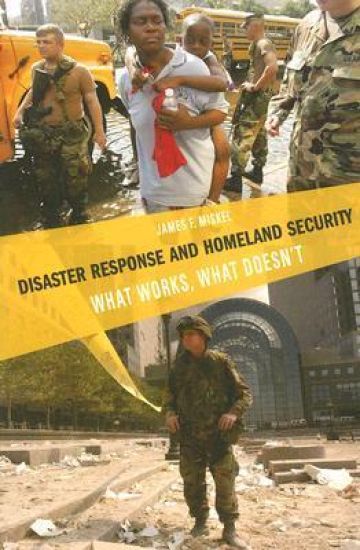
Disaster Response and Homeland Security

Disaster Response and Homeland Security

James F. Miskel

Stanford University Press
2008
pokkari
Hurricane Katrina is the latest in a series of major disasters that were not well managed, but it is not likely to be the last. Category 4 and category 5 hurricanes will, according to most predictions, become both more frequent and more intense in the future due to global warming and/or natural weather cycles. In addition, it is often said that another terrorist attack on the United States is inevitable; that it is a question of when, not whether. Add to that the scare over a possible avian flu pandemic. As a result, the United States should expect that disaster response—to natural and other types of disasters—will continue to be of vital concern to the American public and the policymakers and officials who deal with disaster response and relief, including the military. The U. S. disaster relief program reflects a basic division of responsibility between federal, state, and local governments that has generally stood the test of time. At the federal level, a single agency, FEMA—now under the Department of Homeland Security—has been charged with the responsibility for coordinating the activities of the various federal agencies that have a role in disaster relief. A successful disaster response requires three things: timely and effective coordination between state and federal governments; effective coordination among the federal agencies; and effective coordination between and among state and local government agencies. Miskel examines the effects that operational failures after Hurricanes Agnes, Hugo, Andrew, and Katrina have had on the organizational design and operating principles of the disaster response system program. He also discusses the impact of 9/11 and the evolving role of the military, and he identifies reforms that should be implemented to improve the nation's ability to respond in the future.
Buying Trouble

Buying Trouble

James F. Miskel

University Press of America
1993
nidottu
Recent economic trends have created strong incentives for foreign industry to serve as reliable suppliers of military-related products during crises. The formation of free trade zones and economic blocs also make anti-American trade embargoes virtually impossible to administer. In this book, the author advocates the positive effects of military research on science and explains how the defense acquisition process could be more efficient. He seeks to address whether the national security is jeopardized when the Pentagon and American defense industries rely upon imports of defense-related products and technologies. Contents: Defense Industries in the 1980s; Objectives and Definitions; Gulf War Lessons; Technological Superiority; Sustainability, Sea Lift and Air Lift; Other Sustainability Programs; Pacific Rim Imports; Investments, Trading Blocs, Other Factors; Conclusions; Bibliography; Index.