Kirjojen hintavertailu – 12 903 725 kirjaa ja 27 kauppaa

Kirjailija

James F. Peters

Kirjat ja teokset yhdessä paikassa: 12 kirjaa, julkaisuja vuosilta 2000–2020, suosituimpiin kuuluu Computational Proximity. Vertaile teosten hintoja ja tarkista saatavuus suomalaisista kirjakaupoista.

Nimi esiintyy myös muodoissa: James F Peters

12 kirjaa

Kirjojen julkaisuvuodet: 2000–2020.

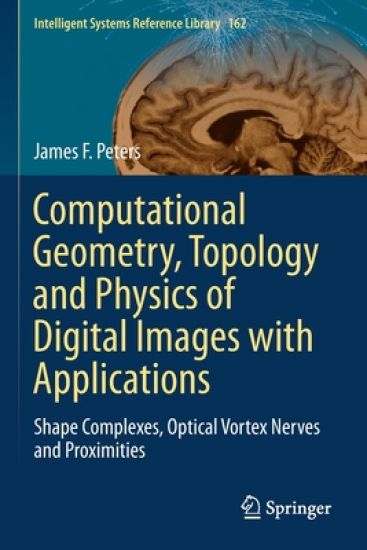
Computational Geometry, Topology and Physics of Digital Images with Applications
This book discusses the computational geometry, topology and physics of digital images and video frame sequences. This trio of computational approaches encompasses the study of shape complexes, optical vortex nerves and proximities embedded in triangulated video frames and single images, while computational geometry focuses on the geometric structures that infuse triangulated visual scenes. The book first addresses the topology of cellular complexes to provide a basis for an introductory study of the computational topology of visual scenes, exploring the fabric, shapes and structures typically found in visual scenes. The book then examines the inherent geometry and topology of visual scenes, and the fine structure of light and light caustics of visual scenes, which bring into play catastrophe theory and the appearance of light caustic folds and cusps. Following on from this, the book introduces optical vortex nerves in triangulated digital images. In this context, computationalphysics is synonymous with the study of the fine structure of light choreographed in video frames. This choreography appears as a sequence of snapshots of light reflected and refracted from surface shapes, providing a solid foundation for detecting, analyzing and classifying visual scene shapes.
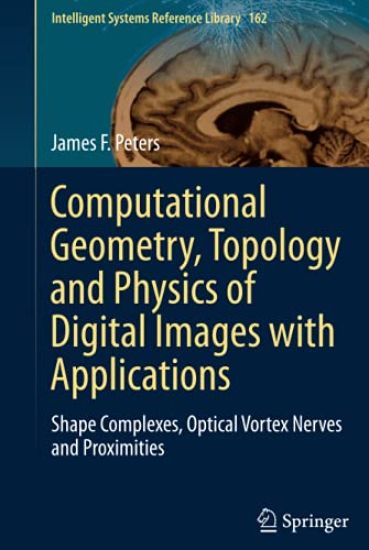
Computational Geometry, Topology and Physics of Digital Images with Applications
This book discusses the computational geometry, topology and physics of digital images and video frame sequences. This trio of computational approaches encompasses the study of shape complexes, optical vortex nerves and proximities embedded in triangulated video frames and single images, while computational geometry focuses on the geometric structures that infuse triangulated visual scenes. The book first addresses the topology of cellular complexes to provide a basis for an introductory study of the computational topology of visual scenes, exploring the fabric, shapes and structures typically found in visual scenes. The book then examines the inherent geometry and topology of visual scenes, and the fine structure of light and light caustics of visual scenes, which bring into play catastrophe theory and the appearance of light caustic folds and cusps. Following on from this, the book introduces optical vortex nerves in triangulated digital images. In this context, computationalphysics is synonymous with the study of the fine structure of light choreographed in video frames. This choreography appears as a sequence of snapshots of light reflected and refracted from surface shapes, providing a solid foundation for detecting, analyzing and classifying visual scene shapes.
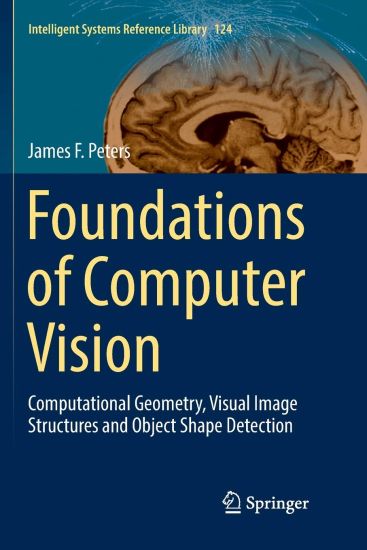
Foundations of Computer Vision

Foundations of Computer Vision

James F. Peters

Springer International Publishing AG
2018
nidottu
This book introduces the fundamentals of computer vision (CV), with a focus on extracting useful information from digital images and videos. Including a wealth of methods used in detecting and classifying image objects and their shapes, it is the first book to apply a trio of tools (computational geometry, topology and algorithms) in solving CV problems, shape tracking in image object recognition and detecting the repetition of shapes in single images and video frames. Computational geometry provides a visualization of topological structures such as neighborhoods of points embedded in images, while image topology supplies us with structures useful in the analysis and classi?cation of image regions. Algorithms provide a practical, step-by-step means of viewing image structures. The implementations of CV methods in Matlab and Mathematica, classi?cation of chapter problems with the symbols (easily solved) and (challenging) and its extensive glossary of key words, examples and connections with the fabric of CV make the book an invaluable resource for advanced undergraduate and ?rst year graduate students in Engineering, Computer Science or Applied Mathematics. It offers insights into the design of CV experiments, inclusion of image processing methods in CV projects, as well as the reconstruction and interpretation of recorded natural scenes.
Computational Proximity

Computational Proximity

James F. Peters

Springer International Publishing AG
2018
nidottu
This book introduces computational proximity (CP) as an algorithmic approach to finding nonempty sets of points that are either close to each other or far apart. Typically in computational proximity, the book starts with some form of proximity space (topological space equipped with a proximity relation) that has an inherent geometry. In CP, two types of near sets are considered, namely, spatially near sets and descriptivelynear sets. It is shown that connectedness, boundedness, mesh nerves, convexity, shapes and shape theory are principal topics in the study of nearness and separation of physical aswell as abstract sets. CP has a hefty visual content. Applications of CP in computer vision, multimedia, brain activity, biology, social networks, and cosmology are included. The book has been derived from the lectures of the author in a graduate course on the topology of digital images taught over the past several years. Many of the students have provided important insights and valuable suggestions. The topics in this monograph introduce many forms of proximities with a computational flavour (especially, what has become known as the strong contact relation), many nuances of topological spaces, and point-free geometry.
Foundations of Computer Vision

Foundations of Computer Vision

James F. Peters

Springer International Publishing AG
2017
sidottu
This book introduces the fundamentals of computer vision (CV), with a focus on extracting useful information from digital images and videos. Including a wealth of methods used in detecting and classifying image objects and their shapes, it is the first book to apply a trio of tools (computational geometry, topology and algorithms) in solving CV problems, shape tracking in image object recognition and detecting the repetition of shapes in single images and video frames. Computational geometry provides a visualization of topological structures such as neighborhoods of points embedded in images, while image topology supplies us with structures useful in the analysis and classi?cation of image regions. Algorithms provide a practical, step-by-step means of viewing image structures. The implementations of CV methods in Matlab and Mathematica, classi?cation of chapter problems with the symbols (easily solved) and (challenging) and its extensive glossary of key words, examples and connections with the fabric of CV make the book an invaluable resource for advanced undergraduate and ?rst year graduate students in Engineering, Computer Science or Applied Mathematics. It offers insights into the design of CV experiments, inclusion of image processing methods in CV projects, as well as the reconstruction and interpretation of recorded natural scenes.
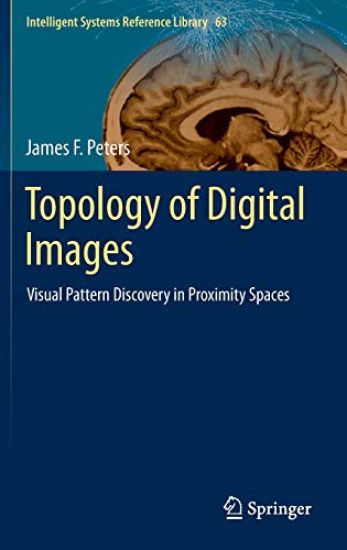
Topology of Digital Images

Topology of Digital Images

James F. Peters

Springer-Verlag Berlin and Heidelberg GmbH Co. K
2016
nidottu
This book carries forward recent work on visual patterns and structures in digital images and introduces a near set-based a topology of digital images. Visual patterns arise naturally in digital images viewed as sets of non-abstract points endowed with some form of proximity (nearness) relation. Proximity relations make it possible to construct uniform topologies on the sets of points that constitute a digital image. In keeping with an interest in gaining an understanding of digital images themselves as a rich source of patterns, this book introduces the basics of digital images from a computer vision perspective. In parallel with a computer vision perspective on digital images, this book also introduces the basics of proximity spaces. Not only the traditional view of spatial proximity relations but also the more recent descriptive proximity relations are considered. The beauty of the descriptive proximity approach is that it is possible to discover visual set patterns among sets that are non-overlapping and non-adjacent spatially. By combining the spatial proximity and descriptive proximity approaches, the search for salient visual patterns in digital images is enriched, deepened and broadened. A generous provision of Matlab and Mathematica scripts are used in this book to lay bare the fabric and essential features of digital images for those who are interested in finding visual patterns in images. The combination of computer vision techniques and topological methods lead to a deep understanding of images.
Computational Proximity

Computational Proximity

James F. Peters

Springer International Publishing AG
2016
sidottu
This book introduces computational proximity (CP) as an algorithmic approach to finding nonempty sets of points that are either close to each other or far apart. Typically in computational proximity, the book starts with some form of proximity space (topological space equipped with a proximity relation) that has an inherent geometry. In CP, two types of near sets are considered, namely, spatially near sets and descriptivelynear sets. It is shown that connectedness, boundedness, mesh nerves, convexity, shapes and shape theory are principal topics in the study of nearness and separation of physical aswell as abstract sets. CP has a hefty visual content. Applications of CP in computer vision, multimedia, brain activity, biology, social networks, and cosmology are included. The book has been derived from the lectures of the author in a graduate course on the topology of digital images taught over the past several years. Many of the students have provided important insights and valuable suggestions. The topics in this monograph introduce many forms of proximities with a computational flavour (especially, what has become known as the strong contact relation), many nuances of topological spaces, and point-free geometry.
Topology of Digital Images

Topology of Digital Images

James F. Peters

Springer-Verlag Berlin and Heidelberg GmbH Co. K
2014
sidottu
This book carries forward recent work on visual patterns and structures in digital images and introduces a near set-based a topology of digital images. Visual patterns arise naturally in digital images viewed as sets of non-abstract points endowed with some form of proximity (nearness) relation. Proximity relations make it possible to construct uniform topologies on the sets of points that constitute a digital image. In keeping with an interest in gaining an understanding of digital images themselves as a rich source of patterns, this book introduces the basics of digital images from a computer vision perspective. In parallel with a computer vision perspective on digital images, this book also introduces the basics of proximity spaces. Not only the traditional view of spatial proximity relations but also the more recent descriptive proximity relations are considered. The beauty of the descriptive proximity approach is that it is possible to discover visual set patterns among sets that are non-overlapping and non-adjacent spatially. By combining the spatial proximity and descriptive proximity approaches, the search for salient visual patterns in digital images is enriched, deepened and broadened. A generous provision of Matlab and Mathematica scripts are used in this book to lay bare the fabric and essential features of digital images for those who are interested in finding visual patterns in images. The combination of computer vision techniques and topological methods lead to a deep understanding of images.
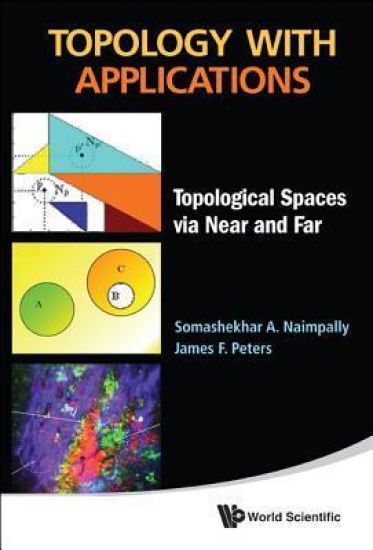
Topology With Applications: Topological Spaces Via Near And Far

Topology With Applications: Topological Spaces Via Near And Far

Somashekhar A Naimpally; James F Peters

World Scientific Publishing Co Pte Ltd
2013
sidottu
The principal aim of this book is to introduce topology and its many applications viewed within a framework that includes a consideration of compactness, completeness, continuity, filters, function spaces, grills, clusters and bunches, hyperspace topologies, initial and final structures, metric spaces, metrization, nets, proximal continuity, proximity spaces, separation axioms, and uniform spaces. This book provides a complete framework for the study of topology with a variety of applications in science and engineering that include camouflage filters, classification, digital image processing, forgery detection, Hausdorff raster spaces, image analysis, microscopy, paleontology, pattern recognition, population dynamics, stem cell biology, topological psychology, and visual merchandising. It is the first complete presentation on topology with applications considered in the context of proximity spaces, and the nearness and remoteness of sets of objects. A novel feature throughout this book is the use of near and far, discovered by F Riesz over 100 years ago. In addition, it is the first time that this form of topology is presented in the context of a number of new applications.
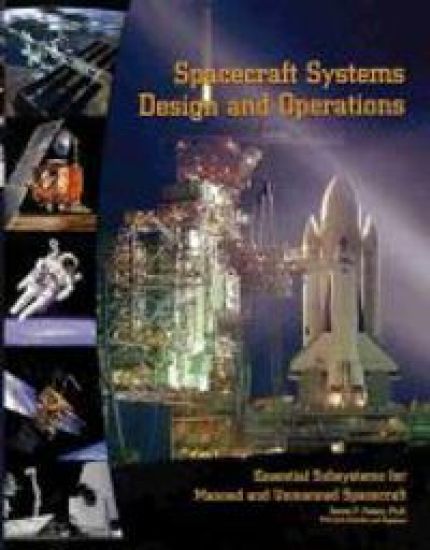
Spacecraft Systems Design and Operations

Spacecraft Systems Design and Operations

James F Peters

KENDALL/HUNT PUBLISHING CO ,U.S.
2004
nidottu
AcknowledgmentsThis text is dedicated to those who work in the space industry as well as the future generations who will follow. I would like to thank the many people and organizations that assisted me with collecting the research data and validating the technical content. Finally, special thanks goes to my wife, Brenda and daughter, Keirnan for allowing me the time needed to complete this project. AbstractThis textbook focuses on spacecraft operations and the design of the critical subsystems (Structures and Mechanisms, Guidance, Navigation and Control, Propulsion and Motion Control, Electrical Power, Thermal Control, Communication and Tracking, Command and Data Handling, and Environmental Control and Life Support) needed to develop a manned or unmanned spacecraft. A comprehensive overview of each critical subsystem is included for the Space Shuttle and International Space Station. In addition, photographic images illustrate many of the hardware components that comprise these systems. Previous space flight data provides a historical prospective on the importance of each critical subsystem and the consequence of a system failure. The major system requirements, operation functions and integration trades for each critical subsystem area are addressed with respect to performance, design margin, operations and cost. In addition, alternative design approaches for each essential subsystem are provided along with application examples from current space vehicles such as the International Space Station, Space Shuttle and various satellite systems. Understanding the major trades in each area, as well as the different design philosophies and alternatives, provides the knowledge needed to develop and evaluate a preliminary space vehicle design and operations concept.
Software Engineering

Software Engineering

James F. Peters; Witold Pedrycz

John Wiley Sons Inc
2000
sidottu
A clear-cut, practical approach to software development! Emphasizing both the design and analysis of the technology, Peters and Pedrycz have written a comprehensive and complete text on a quantitative approach to software engineering. As you read the text, you'll learn the software design practices that are standard practice in the industry today. Practical approaches to specifying, designing and testing software as well as the foundations of Software Engineering are also presented. And the latest information in the field, additional experiments, and solutions to selected problems are available at the authors's web site (httpp//www.ee.umanitoba.ca/~clib/main.html). Key Features * Thorough coverage is provided on the quantitative aspects of software Engineering including software measures, software quality, software costs and software reliability. * A complete case study allows students to trace the application of methods and practices in each chapter. * Examples found throughout the text are in C++ and Java. * A wide range of elementary and intermediate problems as well as more advanced research problems are available at the end of each chapter. * Students are given the opportunity to expand their horizons through frequent references to related web pages.