Kirjailija
James Fenimore Cooper
Kirjat ja teokset yhdessä paikassa: 1 777 kirjaa, julkaisuja vuosilta 1826–2026, suosituimpiin kuuluu Oeuvres de J. F. Cooper. T. 13 Le Bourreau de Berne. Vertaile teosten hintoja ja tarkista saatavuus suomalaisista kirjakaupoista.
1 777 kirjaa
Kirjojen julkaisuvuodet: 1826–2026.
Reprint of the original, first published in 1861.
The book "" Autobiography of a Pocket-Handkerchief "" has been considered important throughout the human history, and so that this work is never forgotten we have made efforts in its preservation by republishing this book in a modern format for present and future generations. This whole book has been reformatted, retyped and designed. These books are not made of scanned copies and hence the text is clear and readable.
... Your speculations concerning the influence of the late revolution, on the social habits of the French, are more ingenious than true. While the mass of this nation has obtained less than they had a right to expect by the severe political convulsions they have endured, during the last forty years, they have, notwithstanding, gained something in their rights; and, what is of far more importance, they have gained in a better appreciation of those rights, as well as in the knowledge of the means to turn them to a profitable and practical account. The end will show essential improvements in their condition, or rather the present time shows it already. The change in polite society has been less favourable, although even this is slowly gaining in morals, and in a healthier tone of thought. No error can be greater, than that of believing France has endured so much, without a beneficial return. ...
The story opens with Ishmael, his family, Ellen, and Abiram making across the virgin prairies of the Midwest searching for a homestead. They meet the trapper (Natty Bumppo), who has left his home in New York State to find where he can't hear the sound of individuals cutting down the timberlands. All that evening, a band of Teton warriors takes Ishmael's animal, stranding the immigrants. The doctor returns the following morning along with his donkey after a band of Teton warriors takes Ihmael's animals. He escapes with Inez, Paul, and Middleton, whom Abiram had been keeping hostage, and escapes with her and Ellen. The Indians endeavor to recapture the catcher by encompassing them with a prairie fire, yet he lights up a backfire to save everybody. They get together with Hard-heart, a Pawnee Indian who endures the fire enclosed by buffalo skin and endeavors to disappear to his town. Middleton, Inez, Paul, and Ellen return just in time to witness the Trapper's death. The Prairie (1827) is a novel by James Fenimore Cooper, the third novel composed by him featuring Natty Bumppo. It was published in two volumes in 1827, the third of five books published as The Leatherstocking Tales. Sequentially, The Prairie is the fifth and last portion of the Leatherstocking Stories, though it was distributed before The Pathfinder (1841) and The Deerslayer (1842). The book ends with the death of the octogenarian frontiersman Natty Bumppo, called Hawkeye.
The Prairie: A Tale (1827) is a novel by James Fenimore Cooper, the third novel written by him featuring Natty Bumppo. His fictitious frontier hero Bumppo is never called by his name, but is instead referred to as "the trapper" or "the old man." Chronologically The Prairie is the fifth and final installment of the Leatherstocking Tales, though it was published before The Pathfinder (1840) and The Deerslayer (1841). It depicts Natty in the final year of his life still proving helpful to people in distress on the American frontier. The book frequently references characters and events from the two books previously published in the Leatherstocking Tales as well as the two which Cooper wouldn't write for more than ten years. Continuity with The Last of the Mohicans is indicated by the appearance of the grandson of Duncan and Alice Heyward, as well as the noble Pawnee chief Hard Heart, whose name is English for the French nickname for the Delaware, le Coeur-dur. As with The Last of the Mohicans, one of Cooper's major themes in The Prairie is the idea of a noble savage. The book contrasts Hard-heart and the Pawnee tribe-who were at peace with the white settlers-to the warlike Tetons. The Tetons are categorically described as cunning, crafty, deceitful, loathsome and dirty. Hard-heart is brave, fierce, and fights to protect his honor. He refuses to abandon his tribe, even if he loses his life for it. In contrast, Le Balafre once abandoned his tribe to become a Teton, thus saving his own life. In the end, Hard-heart is alive while Weucha and Mahtoree are dead. The doctor, horrified at the possibility of being forced to marry an Indian wife, refers to them as a different species, not homo sapiens. The Tetons are frequently referred to as looking like snakes or with other snake symbolism, such as having "forked tongues". Although Cooper's Indians are frequently stereotypical, so are his white characters. Despite sometimes referring prejudicially to Indians as subhuman, he still presents them in a complex light, a mixture of human and devilish characteristics. Amidst what Cooper describes as primitive or dirty, he lauds their honor, hospitality, laws, etc. The Indians are more complex characters than most or any of the white characters in the book. In The Prairie, the Tetons are the most loathsome, evil characters aside from Abiram, and yet Hard-heart of the Pawnee is the most honorable and brave character after the trapper. (wikipedia.org)


James Fenimore Cooper (September 15, 1789 - September 14, 1851) was an American writer of the first half of the 19th century. His historical romances depicting colonist and Indigenous characters from the 17th to the 19th centuries created a unique form of American literature. He lived much of his boyhood and the last fifteen years of life in Cooperstown, New York, which was founded by his father William Cooper on property that he owned. Cooper became a member of the Episcopal Church shortly before his death and contributed generously to it. He attended Yale University for three years, where he was a member of the Linonian Society. After a stint on a commercial voyage, Cooper served in the U. S. Navy as a midshipman, where he learned the technology of managing sailing vessels which greatly influenced many of his novels and other writings. The novel that launched his career was The Spy, a tale about espionage set during the American Revolutionary War and published in 1821. He also created American sea stories. His best-known works are five historical novels of the frontier period, written between 1823 and 1841, known as the Leatherstocking Tales, which introduced the iconic American frontier scout, Natty Bumppo. Cooper's works on the U. S. Navy have been well received among naval historians, but they were sometimes criticized by his contemporaries. Among his more famous works is the romantic novel The Last of the Mohicans, often regarded as his masterpiece. Throughout his career, he published numerous social, political, and historical works of fiction and non-fiction with the objective of countering European prejudices and nurturing an original American art and culture. (wikipedia.org)
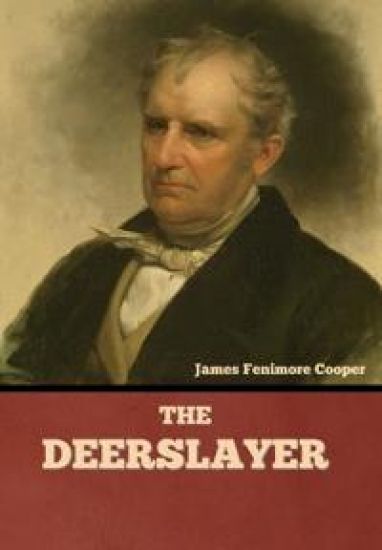
The Deerslayer, or The First War-Path (1841) was James Fenimore Cooper's last novel in his Leatherstocking Tales. Its 1740-1745 time period makes it the first installment chronologically and in the lifetime of the hero of the Leatherstocking tales, Natty Bumppo. The novel's setting on Otsego Lake in central, upstate New York, is the same as that of The Pioneers, the first of the Leatherstocking Tales to be published (1823). The Deerslayer is considered to be the prequel to the rest of the series. Fenimore Cooper begins his work by relating the astonishing advance of civilization in New York State, which is the setting of four of his five Leatherstocking Tales. This novel introduces Natty Bumppo as "Deerslayer" a young frontiersman in early 18th-century New York, who objects to the practice of taking scalps, on the grounds that every living thing should follow "the gifts" of its nature, which would keep European Americans from taking scalps. Two characters who actually seek to take scalps are Deerslayer's foil Henry March (alias "Hurry Harry") and the former pirate 'Floating Tom' Hutter, to whom Deerslayer is introduced en route to a rendezvous with the latter's lifelong friend Chingachgook (who first appeared as "Indian John" in The Pioneers). Shortly before the rendezvous, Hutter's residence is besieged by the indigenous Hurons, and Hutter and March sneak into the camp of the besiegers to kill and scalp as many as they can; but are captured in the act, and later ransomed by Bumppo, Chingachgook, and Hutter's daughters Judith and Hetty. Bumppo and Chingachgook thereafter plan to rescue Chingachgook's kidnapped betrothed Wah-ta-Wah (alias 'Hist') from the Hurons; but, in rescuing her, Bumppo is captured. In his absence, the Hurons invade Hutter's home, and Hutter is scalped alive. On his deathbed, he confesses that Judith and Hetty were not his daughters by birth, and Judith determines to discover her natural father's identity; but her search reveals only that her late mother had been of aristocratic descent, and had married 'Floating Tom' after the collapse of an illicit affair. Later, Judith attempts and fails to rescue Deerslayer; and they are all saved at last when March returns with English reinforcements, who massacre the Hurons and mortally wound Hetty. After Hetty's death, Judith proposes marriage to Deerslayer, but is refused, and is last described as the paramour of a soldier. Fifteen years later, Bumppo and Chingachgook return to the site to find Hutter's house in ruins. (wikipedia.org)