Kirjojen hintavertailu – 12 859 824 kirjaa ja 27 kauppaa

Kirjailija

James Fenimore Cooper

Kirjat ja teokset yhdessä paikassa: 1 777 kirjaa, julkaisuja vuosilta 1826–2026, suosituimpiin kuuluu Oeuvres de J. F. Cooper. T. 13 Le Bourreau de Berne. Vertaile teosten hintoja ja tarkista saatavuus suomalaisista kirjakaupoista.

1 777 kirjaa

Kirjojen julkaisuvuodet: 1826–2026.

Precaution: first novel written by American author James Fenimore Cooper.: James Fenimore Cooper

Precaution: first novel written by American author James Fenimore Cooper.: James Fenimore Cooper

James Fenimore Cooper

Createspace Independent Publishing Platform
2016
nidottu
Precaution (1820) is the first novel written by American author James Fenimore Cooper. It was written in imitation of contemporary English domestic novels like those of Jane Austen and Amelia Opie, and it did not meet with contemporary success. 1] Cooper went on to have great success with works such as The Pathfinder (1841) and The Deerslayer (1840). The American reading public responded most to The Last of the Mohicans (1826). Background--It is thought that the novel was written after a challenge made by his wife. His biographer Warren Walker records it this way: "... In the customary practice of the day he was reading aloud to his wife one evening from a current English novel, but found the story dull. Throwing it aside, he declared, "I could write a better book than that myself." And Susan's challenge to make good his boast resulted in his writing Precaution (1820). . ." When Cooper's work was published without a name it was anonymously accredited to an English woman. It was also published in England and was well received among the set that was fond of this style of writing. The publisher, A. T. Goodrich, later surprised the public when it revealed that Precaution was authored by a gentleman from New York. This is the work that made Cooper realize his potential as a writer. James Fenimore Cooper (September 15, 1789 - September 15, 1851) was a prolific and popular American writer of the early 19th century. His historical romances of frontier and Indian life in the early American days created a unique form of American literature. He lived most of his life in Cooperstown, New York, which was founded by his father William on property that he owned. Cooper was a lifelong member of the Episcopal Church and, in his later years, contributed generously to it. He attended Yale University for three years, where he was a member of the Linonian Society, but was expelled for misbehavior. Before embarking on his career as a writer, he served in the U. S. Navy as a Midshipman, which greatly influenced many of his novels and other writings. The novel that launched his career was The Spy, a tale about counterespionage set during the Revolutionary War and published in 1821. He also wrote numerous sea stories, and his best-known works are five historical novels of the frontier period known as the Leatherstocking Tales. Among naval historians, Cooper's works on the early U. S. Navy have been well received, but they were sometimes criticized by his contemporaries. Among his most famous works is the Romantic novel The Last of the Mohicans, often regarded as his masterpiece. James Fenimore Cooper was born in Burlington, New Jersey in 1789 to William Cooper and Elizabeth (Fenimore) Cooper, the eleventh of 12 children, most of whom died during infancy or childhood. He was descended from James Cooper of Stratford-upon-Avon, Warwickshire, England, who emigrated to the American colonies in 1679. James and his wife were Quakers who purchased plots of land in New Jersey and Pennsylvania. Seventy-five years after his arrival in America, his great-grandson William was born on December 2, 1754. Shortly after James' first birthday, his family moved to Cooperstown, New York, a community founded by his father on a large piece of land which he had bought for development. Later, his father was elected as a United States Congressman from Otsego County. Their town was in a central area of New York that had previously been occupied by the Iroquois of the Six Nations. The Iroquois were forced to cede their territory after British defeat in the Revolutionary War, as they had been allies. Shortly after the American Revolutionary War, the state opened up these former Iroquois lands for sale and development. ....
The Chainbearer; or The Littlepage Manuscripts, By J. Fenimore Cooper A NOVEL: ( complete in one volume ) New edition
The Chainbearer; or The Littlepage Manuscripts is a novel by the American novelist James Fenimore Cooper first published in 1845. The Chainbearer is the second book in a trilogy starting with Satanstoe and ending with The Redskins. The novel focuses mainly on issues of land ownership and the displacement of American Indians as the United States moves Westward. Themes Critical to the trilogy of these novels, is the sense of expansion through the measuring and acquisition of land by civilization. The title The Chainbearer represents "the man who carries the chains in measuring the land, the man who helps civilization to grow from the wilderness, but who at the same time continues the chain of evil, increases the potentiality for corruption." The central position of the "Chainbearer" allows Cooper to deal with the cultural lack of understanding Native Americans had of European concepts of land ownership. This in turn allows Cooper to critique ownership in general. Also, Cooper, like in many of his novels, focuses on the growing corruption of individuals in "civilization" as it expands. This Cooper attributes "an inherent principle in the corrupt nature of man to misuse all his privileges. . . . If history proves anything, it proves this." Two characters, in particular, represent this growing corruption of civilization, Andries Mordaunt, the chainbearer, and Aaron, known as "Thousandacres". The men represent different types of the civilization, Mordaunt as the usurper of old civilization and Thousandacres representing an older society which the new "civilization" means to usurp. Eventually this new civilization decides to embrace force in order to lay full claim on the land. This displacement of Native Americans by the ever expansionist Americans repeatedly becomes an issue for Cooper throughout the trilogy of novels. In so doing, Cooper presents a very strong critique of Americans and America. James Fenimore Cooper (September 15, 1789 - September 15, 1851) was a prolific and popular American writer of the early 19th century. His historical romances of frontier and Indian life in the early American days created a unique form of American literature. He lived most of his life in Cooperstown, New York, which was founded by his father William on property that he owned. Cooper was a lifelong member of the Episcopal Church and, in his later years, contributed generously to it. He attended Yale University for three years, where he was a member of the Linonian Society, but was expelled for misbehavior. Before embarking on his career as a writer, he served in the U. S. Navy as a Midshipman, which greatly influenced many of his novels and other writings. The novel that launched his career was The Spy, a tale about counterespionage set during the Revolutionary War and published in 1821. He also wrote numerous sea stories, and his best-known works are five historical novels of the frontier period known as the Leatherstocking Tales. Among naval historians, Cooper's works on the early U. S. Navy have been well received, but they were sometimes criticized by his contemporaries. Among his most famous works is the Romantic novel The Last of the Mohicans, often regarded as his masterpiece.
The Prairie: A Tale, By James Fenimore Cooper (Adventure and Historical novel )

The Prairie: A Tale, By James Fenimore Cooper (Adventure and Historical novel )

James Fenimore Cooper

Createspace Independent Publishing Platform
2016
nidottu
The Prairie: A Tale (1827) is a novel by James Fenimore Cooper, the third novel . Plot--The story opens with Ishmael, his family, Ellen and Abiram slowly making their way across the virgin prairies of the Midwest looking for a homestead, just two years after the Louisiana Purchase, and during the time of the Lewis and Clark Expedition. They meet the trapper (Natty Bumppo), who has left his home in New York state to find a place where he cannot hear the sound of people cutting down the forests. In the years between his other adventures and this novel, he tells us only that he has walked all the way to the Pacific Ocean and seen all the land between the coasts citation needed] (a heroic feat, considering Lewis and Clark hadn't yet completed the same trek). That night, a band of Teton warriors steal all of Ishmael's animals, stranding the immigrants. The doctor returns the next morning along with his donkey. The trapper helps the family relocate their wagons, including one with mysterious contents, to a nearby butte where they will be safer when the Tetons return. Middleton joins the group when he stumbles upon the trapper and Paul. Before they return to the butte, Ishmael and his family go looking for his eldest son, Asa, whom they find murdered. The trapper, Paul, and Middleton return to camp, find Inez whom Abiram and Ishmael had been keeping captive, and flee with her and Ellen. Ishmael chases them until the Tetons capture the Trapper and his crew. They escape the Tetons, and then Ishmael forms an alliance with the Indians. The Indians attempt to recapture the trapper by surrounding them with a prairie fire, but the trapper lights a backfire and saves everyone. They meet up with Hard-heart, a Pawnee Indian who survived the fire wrapped in a buffalo skin, and attempt to escape to his village. The Tetons capture them. Ishmael demands the trapper, Inez, and Ellen for helping the Tetons but is denied and turned away. Mahtoree intends to take Inez and Ellen for his new wives. Le Balafre attempts to spare Hard-heart's life by making Hard-heart his son. Hard-heart refuses, kills Weucha, and flees the village. When Hard-heart's Pawnee warriors attack the Teton village, the trapper and his friends escape, only to be captured by Ishmael. The trapper is accused of Asa's death until Abiram's guilt is discovered. Abiram is executed, and Ishmael's family returns east without Inez, Ellen, or the doctor. Middleton, Inez, Paul and Ellen travel back to Louisiana and Kentucky, respectively, while the trapper joins a Pawnee village located on a tributary of the Missouri River. Middleton and Paul return just in time to witness the trapper's noble death and bury him. Treatment of Indians As with The Last of the Mohicans, one of Cooper's major themes in The Prairie is the idea of a noble savage. The book contrasts Hard-heart and the Pawnee tribe-who were at peace with the white settlers-to the warlike Tetons. The Tetons are categorically described as cunning, crafty, deceitful, loathsome and dirty. Hard-heart is brave, fierce, and fights to protect his honor. He refuses to abandon his tribe, even if he loses his life for it. In contrast, Le Balafre once abandoned his tribe to become a Teton, thus saving his own life. In the end, Hard-heart is alive while Weucha and Mahtoree are dead. The doctor, horrified at the possibility of being forced to marry an Indian wife, refers to them as a different species, not homo sapiens. The Tetons are frequently referred to as looking like snakes or with other snake symbolism, such as having "forked tongues". Although Cooper's Indians are frequently stereotypical, so are his white characters. Despite sometimes referring prejudicially to Indians as subhuman, he still presents them in a complex light, a mixture of human and devilish characteristics. Amidst what Cooper describes as primitive or dirty, he lauds their honor, hospitality, laws, etc. ...
Satanstoe, The novel is a fictional autobiography ( A Tale of the Colony ): by James Fenimore Cooper
Satanstoe is a 1845 novel by the early American novelist James Fenimore Cooper. The novel is the first of a three novel cycle, followed by The Chainbearer and The Redskins. The novel is a fictional autobiography which explores the 18th century colony of New York. Though Satanstoe has been too much neglected by readers of Cooper s time and ours, it is one of his most interesting books, combining nostalgic autobiographical recollections, pictures of manners, action and adventure, and social philosophy in one of the author's happiest experiments in fiction. Ostensibly, it gives a comprehensive view of colonial life and society in New York State in the middle of the eighteenth century, blending all these elements with the narrative skill for which the author has always been famous. James Fenimore Cooper (September 15, 1789 - September 15, 1851) was a prolific and popular American writer of the early 19th century. His historical romances of frontier and Indian life in the early American days created a unique form of American literature. He lived most of his life in Cooperstown, New York, which was founded by his father William on property that he owned. Cooper was a lifelong member of the Episcopal Church and, in his later years, contributed generously to it. He attended Yale University for three years, where he was a member of the Linonian Society, but was expelled for misbehavior. Before embarking on his career as a writer, he served in the U. S. Navy as a Midshipman, which greatly influenced many of his novels and other writings. The novel that launched his career was The Spy, a tale about counterespionage set during the Revolutionary War and published in 1821. He also wrote numerous sea stories, and his best-known works are five historical novels of the frontier period known as the Leatherstocking Tales. Among naval historians, Cooper's works on the early U. S. Navy have been well received, but they were sometimes criticized by his contemporaries. Among his most famous works is the Romantic novel The Last of the Mohicans, often regarded as his masterpiece.
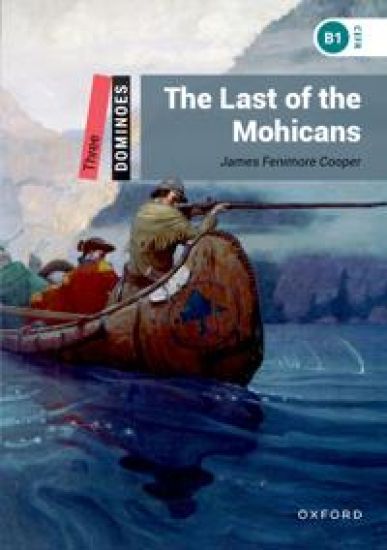
Dominoes: Level 3: The Last of the Mohicans Audio Pack

Dominoes: Level 3: The Last of the Mohicans Audio Pack

James Fenimore Cooper

Oxford University Press
2016
muu
Dominoes is a full-colour, interactive readers series that offers students a fun reading experience while building their language skills. With integrated activities, and exciting, fully dramatized audio for every story, the new edition of the series makes reading motivating for students while making it easy for you to develop their reading and language skills. Listen along with downloadable MP3 audio.
The Pioneers, or The Sources of the Susquehanna; a Descriptive Tale is a historical NOVEL by American writer James Fenimore Cooper.
The Pioneers, or The Sources of the Susquehanna; a Descriptive Tale is a historical novel by American writer James Fenimore Cooper. It was the first of five novels known as the Leatherstocking Tales. Published in 1823, the period it covers makes The Pioneers the fourth chronologically in terms of the novels' plots. The story takes place on the rapidly advancing frontier of New York State and features an elderly Leatherstocking (Natty Bumppo), Judge Marmaduke Temple of Templeton (whose life parallels that of the author's father Judge William Cooper), and Elizabeth Temple (based on the author's sister, Hannah Cooper), daughter of the fictional Templeton. The story begins with an argument between the judge and Leatherstocking over who killed a buck. Through their discussion, Cooper reviews many of the changes to New York's Lake Otsego, questions of environmental stewardship, conservation, and use prevail. Leatherstocking and his closest friend, the Mohican Indian Chingachgook, begin to compete with the Temples for the loyalties of a mysterious young visitor, a "young hunter" known as Oliver Edwards. He eventually marries Elizabeth. Chingachgook dies, representing fears of the race of "dying Indians", and Natty vanishes into the sunset.