Kirjailija
James Fitzjames Stephen
Kirjat ja teokset yhdessä paikassa: 67 kirjaa, julkaisuja vuosilta 1992–2025, suosituimpiin kuuluu A Digest of the Law of Evidence. Vertaile teosten hintoja ja tarkista saatavuus suomalaisista kirjakaupoista.
67 kirjaa
Kirjojen julkaisuvuodet: 1992–2025.

A Digest of the Law of Criminal Procedure in Indictable Offences
James Fitzjames Stephen
Hansebooks
2018
nidottu



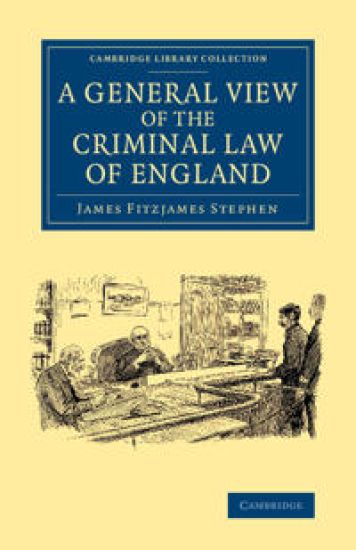
A General View of the Criminal Law of England
James Fitzjames Stephen
Cambridge University Press
2014
pokkari
The jurist Sir James Fitzjames Stephen (1829–94) published this work in 1863 to provide the intelligent layman with a general account of the workings and principles of English criminal law. He begins with a brief sketch of the development of that law from the Anglo-Saxon period onwards. He then covers the current law on criminal responsibility and the classification and definition of specific crimes, before turning to procedure and the rules of evidence. The book helped to establish Stephen's reputation and made possible his appointment as legal member of the Indian viceroy's council in succession to Henry Maine in 1869. Work on its revision for a second edition led Stephen into producing separate and authoritative digests of the law of evidence, criminal law, and criminal procedure, as well as his three-volume History of the Criminal Law of England, published in 1883 and also reissued in this series.
A History of the Criminal Law of England
James Fitzjames Stephen
Cambridge University Press
2014
pokkari
Sir James Fitzjames Stephen (1829–94) published this three-volume account of the English criminal law's historical development in 1883, four years after his appointment as a judge of the High Court. It is a revision and expansion of the second chapter in Stephen's 1863 General View (also reissued in this series). At first sight, it is ironic that the author of this classic of legal historical scholarship was himself a Benthamite who favoured and promoted the codification of the common law and worked on codes of criminal law and procedure for India and for England. Volume 3 covers the history of the criminal offences not covered in Volume 2 (murder and other offences against the person; theft and other property offences; and offences relating to trade and labour) and also covers the development of Indian criminal law and the main features of the Indian Penal Code of 1860 and Code of Criminal Procedure of 1882.
A History of the Criminal Law of England
James Fitzjames Stephen
Cambridge University Press
2014
pokkari
Sir James Fitzjames Stephen (1829–94) published this three-volume account of the English criminal law's historical development in 1883, four years after his appointment as a judge of the High Court. It is a revision and expansion of the second chapter in Stephen's 1863 General View (also reissued in this series). At first sight, it is ironic that the author of this classic of legal historical scholarship was himself a Benthamite who favoured and promoted the codification of the common law and worked on codes of criminal law and procedure for India and for England. Volume 2 contains a discussion of the limits on criminal jurisdiction in respect of time, person and place; of the history of criminal responsibility; of the different categories of criminal offence (treason, felony and misdemeanour); of inchoate offences (incitements, attempts and conspiracies); and of the history of the offences against the state (treason, seditious words, libels) and offences against religion.
A History of the Criminal Law of England
James Fitzjames Stephen
Cambridge University Press
2014
pokkari
Sir James Fitzjames Stephen (1829–94) published this three-volume account of the English criminal law's historical development in 1883, four years after his appointment as a judge of the High Court. It is a revision and expansion of the second chapter in Stephen's 1863 General View (also reissued in this series). At first sight, it is ironic that the author of this classic of legal historical scholarship was himself a Benthamite who favoured and promoted the codification of the common law and worked on codes of criminal law and procedure for India and for England. Volume 1 contains a short preliminary account of Roman criminal law and pre-Conquest English criminal law; a survey of courts exercising criminal jurisdiction; a historical account of the development of the main elements of criminal procedure; a history of criminal punishments; and a general comparative view of the differences between English and French criminal procedure.
R. J. White's edition, which was originally published in 1967, made Fitzjames Stephen's classic available for the first time since 1914. The editor made use of the 1874 second edition which included Stephen's notes in reply to his original critics. Stephen's work is written as a systematic denunciation of John Stuart Mill's political thought. It is thus of great importance in the history of Utilitarianism, and also as the most forthright and systematic of the Victorian attacks on democracy. Stephen's work is also important for its repudiation of the progressive attitudes to religion and morality characteristic of the Comptist philosophy which had attracted Mill. Stephen's aim was to show that 'no room is left for the order of ideas hinted at by the phrase 'Liberty, Equality, Fraternity''. He argues his case with legal precision and considerable rhetorical powers.

Liberty, Equality, Fraternity (LARGE PRINT EDITION)
James Fitzjames Stephen
KESSINGER PUBLISHING, LLC
2011
sidottu

A General View Of The Criminal Law Of England (1863)
James Fitzjames Stephen
KESSINGER PUBLISHING, LLC
2010
sidottu
A Modern Symposium
Frederic Harrison; James Fitzjames Stephen
KESSINGER PUBLISHING, LLC
2008
sidottu
General View Of The Criminal Law Of England (1863)
James Fitzjames Stephen
KESSINGER PUBLISHING CO
2008
pokkari