Kirjojen hintavertailu – 12 859 818 kirjaa ja 27 kauppaa

Kirjailija

James Jaccard

Kirjat ja teokset yhdessä paikassa: 7 kirjaa, julkaisuja vuosilta 1990–2020, suosituimpiin kuuluu Theory Construction and Model-Building Skills, Second Edition. Vertaile teosten hintoja ja tarkista saatavuus suomalaisista kirjakaupoista.

7 kirjaa

Kirjojen julkaisuvuodet: 1990–2020.

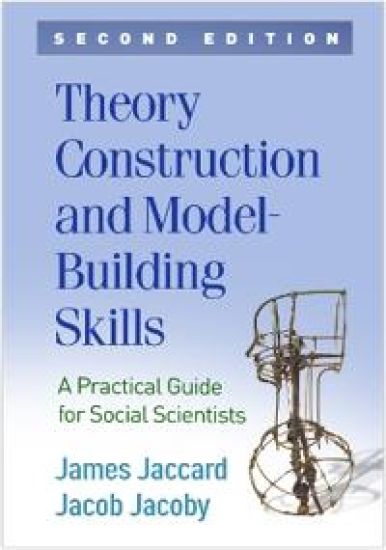
Theory Construction and Model-Building Skills, Second Edition

Theory Construction and Model-Building Skills, Second Edition

James Jaccard; Jacoby Jacob; Jacob Jacoby

Guilford Press
2020
nidottu
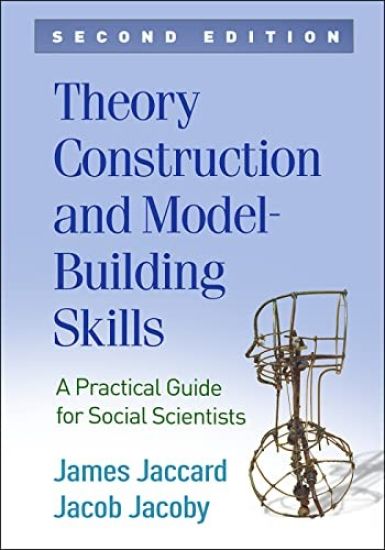
This accessible, hands-on text has now been revised and updated, with expanded coverage of topics including how theory may emerge from exploratory data analysis. The book prepares graduate students, new researchers, and even seasoned investigators to develop their own theories and build on existing ones. Concrete strategies are provided to help readers generate ideas, define constructs, and think through relationships and processes that link constructs. Compelling examples from multiple disciplines illustrate the use of quantitative, qualitative, and mixed methods orientations to theory construction. The text also offers practical advice for writing effectively about theories in papers and grant applications. Readers learn by doing via application and concept exercises, demonstration boxes, and practical guidelines. The extensive companion website (www.theory-construction.com) includes PowerPoint slides of all of the book’s figures, primers on advanced topics, video demonstrations, supplemental exercises, and other resources. New to This Edition *Emergent theory is now covered in mixed methods as well as qualitative approaches, plus in a new chapter on exploratory quantitative methods that can help generate new theory through data mining. *Chapter on whether and how to revise a theory when faced with disconfirmatory data. *Two chapters on the theoretical underpinnings of measurement practices. *New or expanded discussions of what constitutes a theoretical contribution, conceptual logic models, thought experiments, and more. Pedagogical Features *Application and concept exercises in every chapter. *Lists of key terms and engaging topical boxes. *Annotated suggestions for further reading. *New companion website with rich resources for students and instructors. *Chapters stand on their own and can be used in any order.
Theory Construction and Model-Building Skills, Second Edition

Theory Construction and Model-Building Skills, Second Edition

James Jaccard; Jacoby Jacob; Jacob Jacoby

Guilford Press
2020
sidottu
This accessible, hands-on text has now been revised and updated, with expanded coverage of topics including how theory may emerge from exploratory data analysis. The book prepares graduate students, new researchers, and even seasoned investigators to develop their own theories and build on existing ones. Concrete strategies are provided to help readers generate ideas, define constructs, and think through relationships and processes that link constructs. Compelling examples from multiple disciplines illustrate the use of quantitative, qualitative, and mixed methods orientations to theory construction. The text also offers practical advice for writing effectively about theories in papers and grant applications. Readers learn by doing via application and concept exercises, demonstration boxes, and practical guidelines. The extensive companion website (www.theory-construction.com) includes PowerPoint slides of all of the book’s figures, primers on advanced topics, video demonstrations, supplemental exercises, and other resources. New to This Edition *Emergent theory is now covered in mixed methods as well as qualitative approaches, plus in a new chapter on exploratory quantitative methods that can help generate new theory through data mining. *Chapter on whether and how to revise a theory when faced with disconfirmatory data. *Two chapters on the theoretical underpinnings of measurement practices. *New or expanded discussions of what constitutes a theoretical contribution, conceptual logic models, thought experiments, and more. Pedagogical Features *Application and concept exercises in every chapter. *Lists of key terms and engaging topical boxes. *Annotated suggestions for further reading. *New companion website with rich resources for students and instructors. *Chapters stand on their own and can be used in any order.
Interaction Effects in Multiple Regression

Interaction Effects in Multiple Regression

James Jaccard; Robert Turrisi

SAGE Publications Inc
2003
nidottu
Interaction Effects in Multiple Regression has provided students and researchers with a readable and practical introduction to conducting analyses of interaction effects in the context of multiple regression. The new addition will expand the coverage on the analysis of three way interactions in multiple regression analysis.
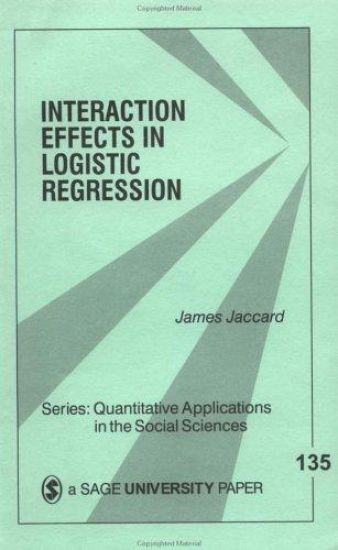
Interaction Effects in Logistic Regression

Interaction Effects in Logistic Regression

James Jaccard

SAGE Publications Inc
2001
nidottu
This book provides an introduction to the analysis of interaction effects in logistic regression by focusing on the interpretation of the coefficients of interactive logistic models for a wide range of situations encountered in the research literature. The volume is oriented toward the applied researcher with a rudimentary background in multiple regression and logistic regression and does not include complex formulas that could be intimidating to the applied researcher.
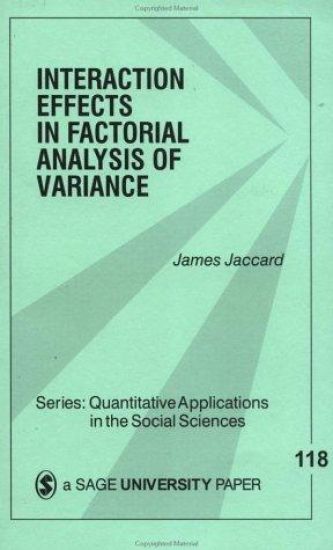
Interaction Effects in Factorial Analysis of Variance
Although factorial analysis is widely used in the social sciences, there is some confusion as to how to use the techniqueÆs most powerful featureùthe evaluation of interaction effects. Written to remedy this situation, author James Jaccard clearly describes the issues underlying the effective analysis of interaction in factorial designs. The book begins by describing different ways of characterizing interactions in ANOVA, elucidating both moderator conceptualizations of interactions as well as that of residualized means. After discussing interaction effects using traditional hypothesis testing approaches, he then covers alternative analytic frameworks that focus on effect size methodology and interval estimation. Jaccard summarizes criticisms of classical null hypothesis testing and offers practical guidelines for pursuing magnitude estimation and interval estimation approaches. In addition, Jaccard shows applications of all three approaches to the analysis of interactions using a complete numerical example; discusses strategies for effectively exploring interactions in higher order designs and designs with more than two levels per factor; highlights the central role of single degree of freedom contrasts and provides numerous illustrations for formulating such contrasts; considers simplified approaches to statistical power analysis; describes approaches to consider when statistical assumptions are not met; explicates the case of unequal sample sizes; considers the impact of measurement error; and demonstrates computer applications. Readers who have wanted a book that fully discusses different conceptualizations of interactions as well as one that provides practical guidelines for analyzing complex interactions will find this volume the one that they have been seeking.
LISREL Approaches to Interaction Effects in Multiple Regression

LISREL Approaches to Interaction Effects in Multiple Regression

James Jaccard; Choi K. Wan

SAGE Publications Inc
1996
nidottu
Through the use of engaging and detailed examples, the authors guide the reader through the use of the computer program LISREL to show how it can be applied to the analysis of interactions in regression framework. The authors consider a wide range of applications, including qualitative moderator variables, longitudinal designs, and product term analysis. They describe different types of measurement error, and follow this discussion with latent variable representations of measurement error that serve as the foundation for the analyses described in later chapters. They then offer a brief introduction to LISREL and show how it can be used to execute the analyses. Readers can use this book without any prior training in LISREL, and will find it an excellent introduction to analytic methods that deal with the problem of measurement error in the analyses of interactions.
Parent-Teen Communication

Parent-Teen Communication

James Jaccard; Patricia Dittus

Springer-Verlag New York Inc.
1990
nidottu
The problem of unintended pregnancies among adolescents is a serious one. Millions of dollars have been spent and hundreds of social science investigations have been conducted in the attempt to address the problem. The present book reports the results of a federally funded research project on parent-teenager communication about premarital sex and birth control. Both the role and potential of parents in influencing the sexual behavior of their teenagers has been questioned by many social scientists. The literature is characterized by studies that tend to observe little relationship between measures of parent-teen communication and teen sexual behavior. Many of our colleagues informally express the viewpoint that parents have little to do with the sexual behavior of their teens and that attempts to reduce unintended pregnancies through parental involvement will be futile. Indeed, when we first sought funding for the present research, several reviewers were skeptical for just this reason. It is our belief that parents can play an important role in preventing unintended pregnancies. In our opinion, past research has failed to make important conceptual distinctions which has resulted in an underestimation of the potential utility of parent-teen communication. We believe that the study reported here is consistent with this opinion. We have written the book with two goals. First, we wanted to identify important conceptual and methodological points that future researchers can consider in exploring this important area of inquiry. Second, we wanted to develop some of the applied implications of these points vis-a-vis our data.