Kirjojen hintavertailu – 12 859 828 kirjaa ja 27 kauppaa

Kirjailija

James Kraska

Kirjat ja teokset yhdessä paikassa: 10 kirjaa, julkaisuja vuosilta 2011–2026, suosituimpiin kuuluu International Maritime Security Law. Vertaile teosten hintoja ja tarkista saatavuus suomalaisista kirjakaupoista.

10 kirjaa

Kirjojen julkaisuvuodet: 2011–2026.

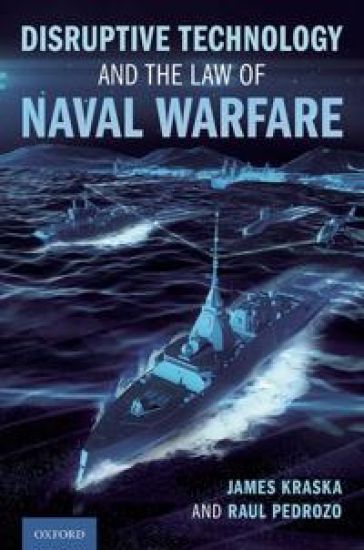
Disruptive Technology and the Law of Naval Warfare

Disruptive Technology and the Law of Naval Warfare

James Kraska; Raul Pedrozo

OXFORD UNIVERSITY PRESS INC
2022
sidottu
Conflict at sea has been transformed by disruptive technologies, creating a dynamic and distributed operational environment that extends from the oceans to encompass warfare on land, in the air, outer space, and cyberspace. This raises choice of law decisions that include the law of naval warfare and the law of armed conflict, neutrality law, and the peacetime regimes that apply to the oceans, airspace, outer space, and cyberspace. The international law in networked naval warfare must contend with autonomous vessels and aircraft, artificial intelligence, and long-range precision strike missiles that can close the kill chain at sea and beyond. The asymmetrical use of merchant ships and blockchain shipping in naval operations, opening of the seabed as a new dimension of undersea warfare, and sophisticated attacks against submarine cables and space satellites pose new operational and legal dilemmas. Navigating this broader conception of the international law of naval warfare requires an understanding of emerging operational capabilities and concepts throughout the spectrum of conflict and the selection and integration of distinct legal regimes. This book gives readers an understanding of the discrete but overlapping legal frameworks connected to the law of naval warfare and explores related concepts of seapower and naval technology.
The Free Sea

The Free Sea

James Kraska; Raul A Pedrozo

Naval Institute Press
2018
sidottu
The Free Sea offers a unique, single-volume analysis of incidents that challenged U. S. freedom of navigation at sea. The book spans more than two hundred years, from the Quasi-War with France in 1798 to contemporary freedom of navigation operations in the South China Sea. Since World War II, the struggle for freedom of navigation has pulled the United States to the brink of war with Vietnam during the Gulf of Tonkin incident, North Korea with the seizure of the USS Pueblo in 1968, and Cambodia with the capture of the SS Mayaguez. In the 1980s, Libya's "line of death" across the Gulf of Sidra and Iran's "tanker war" in the Persian Gulf drew the United States into conflicts. During the Cold War U. S. and Russian navies clashed over navigational rights in the Black Sea--and an incident that led to amicable agreement on the right of innocent passage. Today, China poses perhaps the greatest challenge to freedom of navigation since Germany's unrestricted U-boat campaigns as it seeks to regulate U. S. naval operations in the South China and East China Seas. Freedom of the seas is the foundation of all sea power and a bedrock principle of international law and global order. Separated from the centers of power in Europe and Asia by the Atlantic and Pacific Oceans, the United States has relied on the principles of freedom of navigation for economic prosperity and military security. James Kraska and Raul Pedrozo focus on the struggle to safeguard that freedom. Challenges to U. S. warships and maritime commerce have pushed, and continue to challenge, the United States to vindicate its rights through diplomatic, legal, and military means, underscoring the need for the strategic resolve to ensure freedom in the global maritime commons.
International Maritime Security Law

International Maritime Security Law

James Kraska; Raul Pedrozo

BRILL
2018
nidottu

Halvin toimitettuna 141,90 €

International Maritime Security Law by James Kraska and Raul Pedrozo defines an emerging interdisciplinary field of law and policy comprised of norms, legal regimes, and rules to address today's hybrid threats to the global order of the oceans. Worldwide shipping commerce, fishing fleets, pleasure craft, and coastal states are exposed to the menace of offshore terrorism, weapons of mass destruction, piracy, smuggling, robbery, marine insurgency and anti-access threats. Land-based institutions and maritime constabulary forces operate within an increasingly integrated network that blends elements of humanitarian law, human rights law, criminal law, and law of the sea, with inspection regimes, commercial enterprise, and marine safety and environmental stewardship. The new authorities fuse together a global maritime partnership among states, international organizations and commercial interests to protect the maritime commons from the most dangerous risks and hazards.
International Maritime Security Law

International Maritime Security Law

James Kraska; Raul Pedrozo

Martinus Nijhoff
2013
sidottu
International Maritime Security Law by James Kraska and Raul Pedrozo defines an emerging interdisciplinary field of law and policy comprised of norms, legal regimes, and rules to address today's hybrid threats to the global order of the oceans. Worldwide shipping commerce, fishing fleets, pleasure craft, and coastal states are exposed to the menace of offshore terrorism, weapons of mass destruction, piracy, smuggling, robbery, marine insurgency and anti-access threats. Land-based institutions and maritime constabulary forces operate within an increasingly integrated network that blends elements of humanitarian law, human rights law, criminal law, and law of the sea, with inspection regimes, commercial enterprise, and marine safety and environmental stewardship. The new authorities fuse together a global maritime partnership among states, international organizations and commercial interests to protect the maritime commons from the most dangerous risks and hazards.
Contemporary Maritime Piracy

Contemporary Maritime Piracy

James Kraska; Brian Wilson

Praeger Publishers Inc
2011
sidottu
This volume provides a concise introduction to the issues and debates regarding modern piracy, including naval operations, law, and diplomacy, and focuses on the recent surge of attacks off the coasts of Africa and Asia. In the past decade, the incidence of maritime piracy has exploded. The first three months of 2011 were the worst ever, with 18 ships hijacked, 344 crew taken hostage, and 7 crew members murdered. The four Americans on board the sailing vessel Quest were shot at point-blank range. The economic costs are also staggering, reaching $7 to $12 billion per year, as insurance costs skyrocket, ransoms double and then quadruple, and ships are forced to hire armed security for protection. Pirates operating off the Horn of Africa disrupt shipping traffic through the strategic Suez Canal, siphoning transit fees from an unstable Egypt, while the seizure of supertankers in the Indian Ocean underscores the vulnerability of the world's oil supply. Governments, private industry, and international organizations have mobilized to address the threat. This is the first volume to examine their work in developing naval strategy, international law and diplomacy, and industry guidelines to suppress contemporary maritime piracy. Contemporary Maritime Piracy: International Law, Strategy, and Diplomacy at Sea comprises three sections, the first of which contains chapters on historical and contemporary piracy, international law and diplomacy, and coalition strategies for combating future piracy. The second and third parts provide collections of historic profiles and relevant documents.

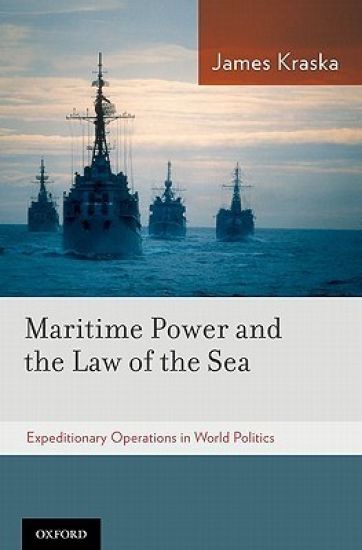
Maritime Power and the Law of the Sea:

Maritime Power and the Law of the Sea:

James Kraska

Oxford University Press Inc
2011
sidottu

Halvin toimitettuna 186,50 €

In Maritime Power and the Law of the Sea: Expeditionary Operations in World Politics, Commander James Kraska analyzes the evolving rules governing freedom of the seas and their impact on expeditionary operations in the littoral, near-shore coastal zone. Coastal state practice and international law are developing in ways that restrict naval access to the littorals and associated coastal communities and inshore regions that have become the fulcrum of world geopolitics. Consequently, the ability of naval forces to project expeditionary power throughout semi-enclosed seas, exclusive economic zones (EEZs) and along the important sea-shore interface is diminishing and, as a result, limiting strategic access and freedom of action where it is most needed. Commander Kraska describes how control of the global commons, coupled with new approaches to sea power and expeditionary force projection, has given the United States and its allies the ability to assert overwhelming sea power to nearly any area of the globe. But as the law of the sea gravitates away from a classic liberal order of the oceans, naval forces are finding it more challenging to accomplish the spectrum of maritime missions in the coastal littorals, including forward presence, power projection, deterrence, humanitarian assistance and sea control. The developing legal order of the oceans fuses diplomacy, strategy and international law to directly challenge unimpeded access to coastal areas, with profound implications for American grand strategy and world politics.