Kirjojen hintavertailu – 12 903 725 kirjaa ja 27 kauppaa

Kirjailija

James Kwak

Kirjat ja teokset yhdessä paikassa: 5 kirjaa, julkaisuja vuosilta 2011–2025, suosituimpiin kuuluu 13 Bankers. Vertaile teosten hintoja ja tarkista saatavuus suomalaisista kirjakaupoista.

5 kirjaa

Kirjojen julkaisuvuodet: 2011–2025.

The Fear of Too Much Justice

The Fear of Too Much Justice

Stephen B. Bright; James Kwak

THE NEW PRESS
2025
pokkari
The book John Grisham calls “a clear and poignant indictment of criminal injustice in America” Called “passionate and eye-opening” by Booklist, The Fear of Too Much Justice, by the legendary death penalty attorney Stephen B. Bright and legal scholar James Kwak, offers a heart-wrenching overview of how the criminal legal system fails to live up to the values of equality and justice. The book ranges from people convicted of crimes and condemned to death because of their race and poverty to poor people squeezed for cash by private probation companies because of trivial violations. Bright and Kwak also offer examples from places around the country that are making progress toward justice. With a foreword by Bryan Stevenson, and now in an accessible paperback format, this “urgent call to action . . . is an invaluable resource” (Publishers Weekly).

The Fear of Too Much Justice

The Fear of Too Much Justice

Stephen Bright; James Kwak

THE NEW PRESS
2023
sidottu
A legendary lawyer and a legal scholar reveal the structural failures that undermine justice in our criminal courts“An urgently needed analysis of our collective failure to confront and overcome racial bias and bigotry, the abuse of power, and the multiple ways in which the death penalty’s profound unfairness requires its abolition. You will discover Steve Bright’s passion, brilliance, dedication, and tenacity when you read these pages.” —from the foreword by Bryan StevensonGlenn Ford, a Black man, spent thirty years on Louisiana’s death row for a crime he did not commit. He was released in 2014—and given twenty dollars—when prosecutors admitted they did not have a case against him. Ford’s trial was a travesty. One of his court-appointed lawyers specialized in oil and gas law and had never tried a case. The other had been out of law school for only two years. They had no funds for investigation or experts. The prosecution struck all the Black prospective jurors to get the all-white jury that sentenced Ford to death. In The Fear of Too Much Justice, legendary death penalty lawyer Stephen B. Bright and legal scholar James Kwak offer a heart-wrenching overview of how the criminal legal system fails to live up to the values of equality and justice. The book ranges from poor people squeezed for cash by private probation companies because of trivial violations to people executed in violation of the Constitution despite overwhelming evidence of intellectual disability or mental illness. They also show examples from around the country of places that are making progress toward justice. With a foreword by Bryan Stevenson, who worked for Bright at the Southern Center for Human Rights and credits him for “[breaking] down the issues with the death penalty simply but persuasively,” The Fear of Too Much Justice offers a timely, trenchant, firsthand critique of our criminal courts and points the way toward a more just future.
Take Back Our Party

Take Back Our Party

James Kwak

Strong Arm Press
2020
pokkari
Once upon a time, the Democrats were the party of the people-of the New Deal, unions, and the War on Poverty. The New Democrats, Bill Clinton, and Barack Obama changed all that. Scarred by the Reagan Revolution, they abandoned their party's historical identity. They embraced the idea that markets are the source of prosperity and government's role is to nurture private sector growth, which would help both the 1% and the 99%. This idea has failed. Inequality has grown to historic proportions, and many families struggle with constant economic insecurity. In choosing markets over people, the party abandoned lower- and middle-income families-and by 2016, they no longer knew what the Democrats stood for. If we are to reverse the tide of inequality and to defend our country from President Trump and the Republicans, we must take back our party. It is time to restore the vision of Franklin Roosevelt: that a decent society takes care of all its citizens and ensures them the basic necessities of life. It is time for the Democratic Party to represent the people once again.
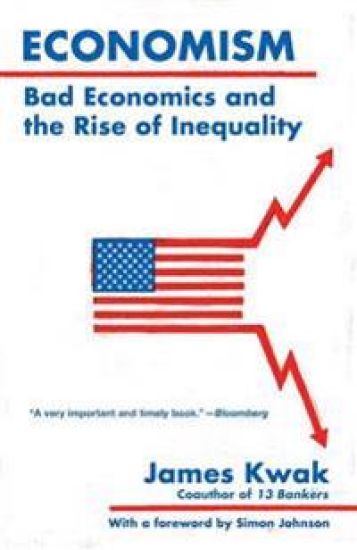
Economism: Bad Economics and the Rise of Inequality

Economism: Bad Economics and the Rise of Inequality

James Kwak

VINTAGE
2018
nidottu

Halvin toimitettuna 25,40 €

The coauthor of the best-selling 13 Bankers: The Wall Street Takeover and the Next Financial Meltdown now gives us a bracing deconstruction of the framework for understanding the world that is learned as gospel in Economics 101, regardless of its imaginary assumptions and misleading half-truths. Economism an ideology that distorts the valid principles and tools of Economics 101, propagated by self-styled experts, zealous lobbyists, clueless politicians, and ignorant pundits. In order to illuminate the fallacies of economism, James Kwak first offers a primer on supply and demand, market equilibrium, and social welfare: the underpinnings of most popular economic arguments. Then he provides a historical account of how economism became a prevalent mode of thought in the United States focusing on the people who packaged Econ 101 into sound bites they then repeated until they took on the aura of truth. He shows us how issues of the moment in contemporary American society labor markets, taxes, finance, health care, macroeconomic management, among others are shaped by economism, demonstrating in each case with clarity and elan how, because of its failure to reflect the complexities of our world, it has had a deleterious influence on policies that affect hundreds of millions of Americans.
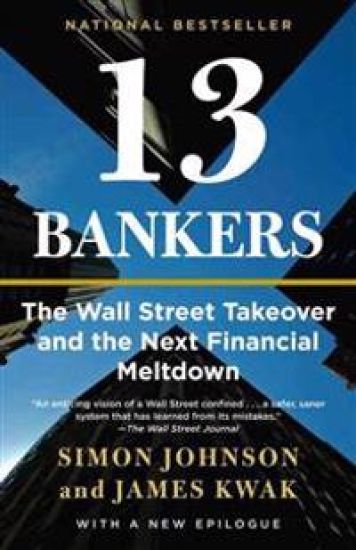
13 Bankers

13 Bankers

SIMON JOHNSON; James Kwak

Vintage Books
2011
pokkari

Halvin toimitettuna 21,50 €

In spite of its key role in creating the ruinous financial crisis of 2008, the American banking industry has grown bigger, more profitable, and more resistant to regulation than ever. Anchored by six megabanks whose assets amount to more than 60 percent of the country s gross domestic product, this oligarchy proved it could first hold the global economy hostage and then use its political muscle to fight off meaningful reform. 13 Bankers brilliantly charts the rise to power of the financial sector and forcefully argues that we must break up the big banks if we want to avoid future financial catastrophes. Updated, with additional analysis of the government s recent attempt to reform the banking industry, this is a timely and expert account of our troubled political economy."