Kirjojen hintavertailu – 12 903 735 kirjaa ja 27 kauppaa

Kirjailija

James L. Gibson

Kirjat ja teokset yhdessä paikassa: 14 kirjaa, julkaisuja vuosilta 1985–2024, suosituimpiin kuuluu Judging Inequality: State Supreme Courts and the Inequality Crisis. Vertaile teosten hintoja ja tarkista saatavuus suomalaisista kirjakaupoista.

Nimi esiintyy myös muodoissa: James L Gibson

14 kirjaa

Kirjojen julkaisuvuodet: 1985–2024.

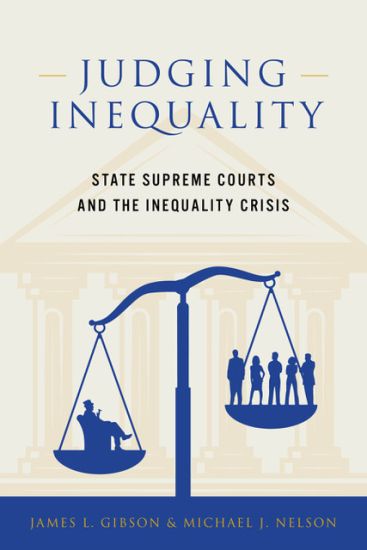
Judging Inequality: State Supreme Courts and the Inequality Crisis

Judging Inequality: State Supreme Courts and the Inequality Crisis

James L. Gibson; Michael J. Nelson

RUSSELL SAGE FOUNDATION
2021
nidottu
Social scientists have convincingly documented soaring levels of political, legal, economic, and social inequality in the United States. Missing from this picture of rampant inequality, however, is any attention to the significant role of state law and courts in establishing policies that either ameliorate or exacerbate inequality. In Judging Inequality, political scientists James L. Gibson and Michael J. Nelson demonstrate the influential role of the fifty state supreme courts in shaping the widespread inequalities that define America today, focusing on court-made public policy on issues ranging from educational equity and adequacy to LGBT rights to access to justice to worker's rights. Drawing on an analysis of an original database of nearly 6,000 decisions made by over 900 judges on 50 state supreme courts over a quarter century, Judging Inequality documents two ways that state high courts have crafted policies relevant to inequality: through substantive policy decisions that fail to advance equality and by rulings favoring more privileged litigants (typically known as "upperdogs"). The authors discover that whether court-sanctioned policies lead to greater or lesser inequality depends on the ideologies of the justices serving on these high benches, the policy preferences of their constituents (the people of their state), and the institutional structures that determine who becomes a judge as well as who decides whether those individuals remain in office. Gibson and Nelson decisively reject the conventional theory that state supreme courts tend to protect underdog litigants from the wrath of majorities. Instead, the authors demonstrate that the ideological compositions of state supreme courts most often mirror the dominant political coalition in their state at a given point in time. As a result, state supreme courts are unlikely to stand as an independent force against the rise of inequality in the United States, instead making decisions compatible with the preferences of political elites already in power. At least at the state high court level, the myth of judicial independence truly is a myth. Judging Inequality offers a comprehensive examination of the powerful role that state supreme courts play in shaping public policies pertinent to inequality. This volume is a landmark contribution to scholarly work on the intersection of American jurisprudence and inequality, one that essentially rewrites the "conventional wisdom" on the role of courts in America's democracy.
Black and Blue

Black and Blue

James L. Gibson; Michael Nelson

Oxford University Press Inc
2019
sidottu
The American legal system is experiencing a period of extreme stress, if not crisis, as it seems to be losing its legitimacy with at least some segments of its constituency. Nowhere is this legitimacy deficit more apparent than in a portion of the African American community in the U. S., as incidents of police killing black suspects - whether legally justified or not - have become almost routine. However, this legitimacy deficit has largely been documented through anecdotal evidence and a steady drumbeat of journalistic reports, not rigorous scientific research. This book offers an all-inclusive account of how and why African Americans differ in their willingness to ascribe legitimacy to legal institutions, as well as in their willingness to accept the policy decisions those institutions promulgate. Based on two nationally-representative samples of African Americans, this book ties together four dominant theories of public opinion: Legitimacy Theory, Social Identity Theory, theories of adulthood political socialization and learning through experience, and information processing theories. The findings reveal a gaping chasm in legal legitimacy between black and white Americans. More importantly, black people themselves differ in their perceptions of legal legitimacy. Group identities and experiences with legal authorities play a crucial role in shaping whether and how black people extend legitimacy to the legal institutions that so much affect them. This book is one of the most comprehensive analyses produced to date of legal legitimacy within the American black community, with many surprising and counter-intuitive results.
Black and Blue

Black and Blue

James L. Gibson; Michael Nelson

Oxford University Press Inc
2018
nidottu
The American legal system is experiencing a period of extreme stress, if not crisis, as it seems to be losing its legitimacy with at least some segments of its constituency. Nowhere is this legitimacy deficit more apparent than in a portion of the African American community in the U. S., as incidents of police killing black suspects - whether legally justified or not - have become almost routine. However, this legitimacy deficit has largely been documented through anecdotal evidence and a steady drumbeat of journalistic reports, not rigorous scientific research. This book offers an all-inclusive account of how and why African Americans differ in their willingness to ascribe legitimacy to legal institutions, as well as in their willingness to accept the policy decisions those institutions promulgate. Based on two nationally-representative samples of African Americans, this book ties together four dominant theories of public opinion: Legitimacy Theory, Social Identity Theory, theories of adulthood political socialization and learning through experience, and information processing theories. The findings reveal a gaping chasm in legal legitimacy between black and white Americans. More importantly, black people themselves differ in their perceptions of legal legitimacy. Group identities and experiences with legal authorities play a crucial role in shaping whether and how black people extend legitimacy to the legal institutions that so much affect them. This book is one of the most comprehensive analyses produced to date of legal legitimacy within the American black community, with many surprising and counter-intuitive results.
Electing Judges

Electing Judges

James L. Gibson

University of Chicago Press
2012
nidottu
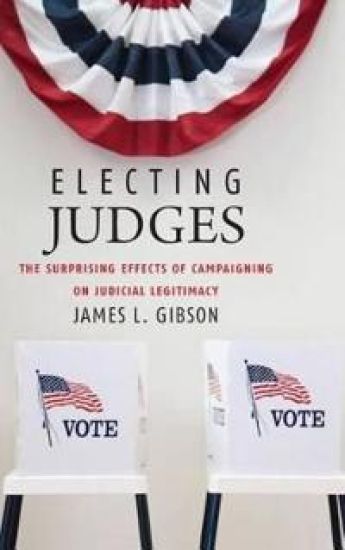
In "Electing Judges", leading judicial politics scholar James L. Gibson responds to the growing chorus of critics who fear that the politics of running for office undermine judicial independence. While many people have opinions on the topic, few have supported them with actual empirical evidence. Gibson rectifies this situation, offering the most systematic and comprehensive study to date of the impact of campaigns on public perceptions of fairness, impartiality, and the legitimacy of elected state courts - and his findings are both counterintuitive and controversial. Gibson finds that ordinary Americans do not conclude from campaign promises that judges are incapable of making impartial decisions. Instead, he shows, they understand the process of deciding cases to be an exercise in policymaking, rather than of simply applying laws to individual cases - and consequently think it's important for candidates to reveal where they stand on important issues. Negative advertising also turns out to have a limited effect on perceptions of judicial legitimacy, though the same cannot be said for widely hated campaign contributions. Taking both the good and bad into consideration, Gibson argues that elections are ultimately beneficial in boosting the legitimacy of courts, despite the slight negative effects of some campaign activities. "Electing Judges" will initiate a lively debate inside both the halls of justice and the academy.
Electing Judges

Electing Judges

James L. Gibson

University of Chicago Press
2012
sidottu
In "Electing Judges", leading judicial politics scholar James L. Gibson responds to the growing chorus of critics who fear that the politics of running for office undermine judicial independence. While many people have opinions on the topic, few have supported them with actual empirical evidence. Gibson rectifies this situation, offering the most systematic and comprehensive study to date of the impact of campaigns on public perceptions of fairness, impartiality, and the legitimacy of elected state courts - and his findings are both counterintuitive and controversial. Gibson finds that ordinary Americans do not conclude from campaign promises that judges are incapable of making impartial decisions. Instead, he shows, they understand the process of deciding cases to be an exercise in policymaking, rather than of simply applying laws to individual cases - and consequently think it's important for candidates to reveal where they stand on important issues. Negative advertising also turns out to have a limited effect on perceptions of judicial legitimacy, though the same cannot be said for widely hated campaign contributions. Taking both the good and bad into consideration, Gibson argues that elections are ultimately beneficial in boosting the legitimacy of courts, despite the slight negative effects of some campaign activities. "Electing Judges" will initiate a lively debate inside both the halls of justice and the academy.
Overcoming Historical Injustices

Overcoming Historical Injustices

James L. Gibson

Cambridge University Press
2009
sidottu
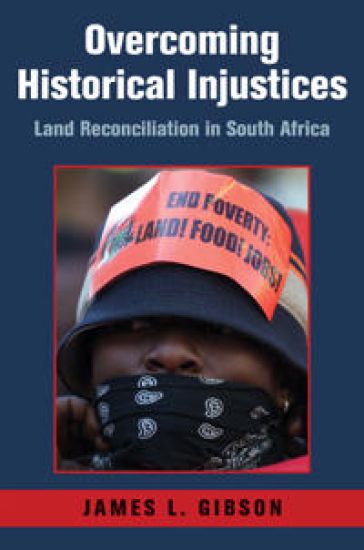
Overcoming Historical Injustices is the last entry in Gibson's 'overcoming trilogy' on South Africa's transformation from apartheid to democracy. Focusing on the issue of historical land dispossessions - the taking of African land under colonialism and apartheid - this book investigates the judgements South Africans make about the fairness of their country's past. Should, for instance, land seized under apartheid be returned today to its rightful owner? Gibson's research zeroes in on group identities and attachments as the thread that connects people to the past. Even when individuals have experienced no direct harm in the past, they care about the fairness of the treatment of their group to the extent that they identify with that group. Gibson's analysis shows that land issues in contemporary South Africa are salient, volatile, and enshrouded in symbols and, most important, that interracial differences in understandings of the past and preferences for the future are profound.
Citizens, Courts, and Confirmations

Citizens, Courts, and Confirmations

James L. Gibson; Gregory A. Caldeira

Princeton University Press
2009
pokkari
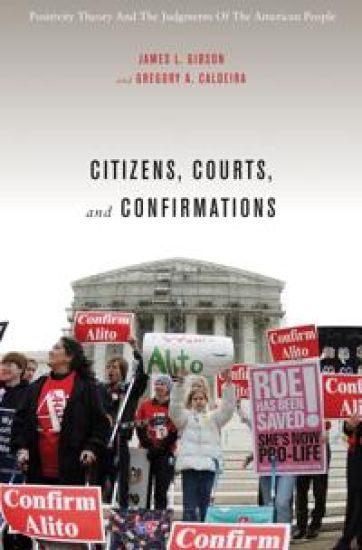
In recent years the American public has witnessed several hard-fought battles over nominees to the U. S. Supreme Court. In these heated confirmation fights, candidates' legal and political philosophies have been subject to intense scrutiny and debate. Citizens, Courts, and Confirmations examines one such fight--over the nomination of Samuel Alito--to discover how and why people formed opinions about the nominee, and to determine how the confirmation process shaped perceptions of the Supreme Court's legitimacy. Drawing on a nationally representative survey, James Gibson and Gregory Caldeira use the Alito confirmation fight as a window into public attitudes about the nation's highest court. They find that Americans know far more about the Supreme Court than many realize, that the Court enjoys a great deal of legitimacy among the American people, that attitudes toward the Court as an institution generally do not suffer from partisan or ideological polarization, and that public knowledge enhances the legitimacy accorded the Court. Yet the authors demonstrate that partisan and ideological infighting that treats the Court as just another political institution undermines the considerable public support the institution currently enjoys, and that politicized confirmation battles pose a grave threat to the basic legitimacy of the Supreme Court.
Cutting Propagation

Cutting Propagation

John M. Dole; James L. Gibson

Ball Publishing
2006
sidottu
The latest techniques for propagating crops with terminal, stem, and leaf/stem cuttings are the focus of this horticulture handbook. All the bases are covered—propagation basics, stock plant management, media, temperature, light, nutrition, plant growth regulators, insect and disease management, equipment, and postharvest handling. From these general subjects, the editors focus in on specifics for scores of specialty bedding plants, perennials, specialty cut flowers, and foliage plants. Then they zoom in even closer, covering more than 60 important floriculture crops in detail so propagators and growers can provide high-quality cuttings and young plants to the market.
Overcoming Apartheid

Overcoming Apartheid

James L Gibson

Russell Sage Foundation
2006
pokkari
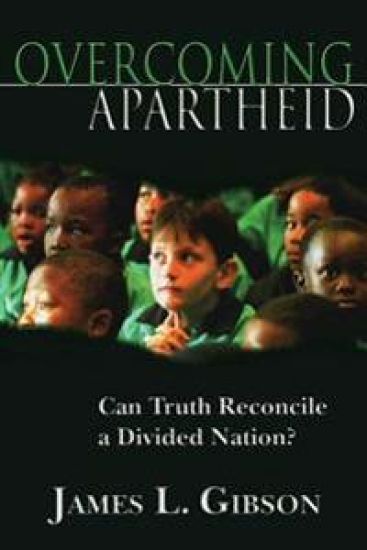
Perhaps no country in history has so directly and thoroughly confronted its past in an effort to shape its future as has South Africa. Working from the belief that understanding the past will help build a more peaceful and democratic future, South Africa has made a concerted, institutionalized effort to come to grips with its history of apartheid through its Truth and Reconciliation Commission. In Overcoming Apartheid, James L. Gibson provides the first systematic assessment of whether South Africa's truth and reconciliation process has been successful. Has the process allowed South Africa to let go of its painful past and move on? Or has it exacerbated racial tensions by revisiting painful human rights violations and granting amnesty to their perpetrators? Overcoming Apartheid reports on the largest and most comprehensive study of post-apartheid attitudes in South Africa to date, involving a representative sample of all major racial, ethnic, and linguistic groups. Grounding his analysis of truth in theories of collective memory, Gibson discovers that the process has been most successful in creating a common understanding of the nature of apartheid. His analysis then demonstrates how this common understanding is helping to foster reconciliation, as defined by the acceptance of basic principles of human rights and political tolerance, rejection of racial prejudice, and acceptance of the institutions of a new political order. Gibson identifies key elements in the process--such as acknowledging shared responsibility for atrocities of the past--that are essential if reconciliation is to move forward. He concludes that without the truth and reconciliation process, the prospects for a reconciled, democratic South Africa would diminish considerably. Gibson also speculates about whether the South African experience provides any lessons for other countries around the globe trying to overcome their repressive pasts. A groundbreaking work of social science research, Overcoming Apartheid is also a primer for utilizing innovative conceptual and methodological tools in analyzing truth processes throughout the world. It is sure to be a valuable resource for political scientists, social scientists, group relations theorists, and students of transitional justice and human rights.

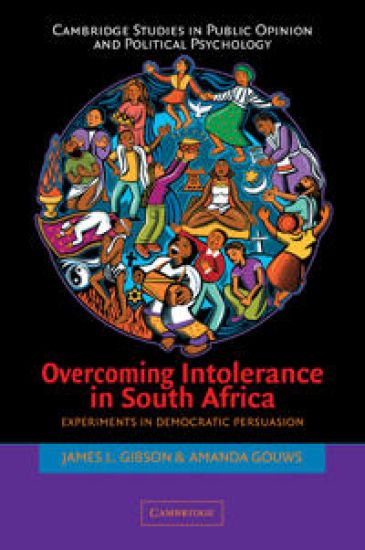
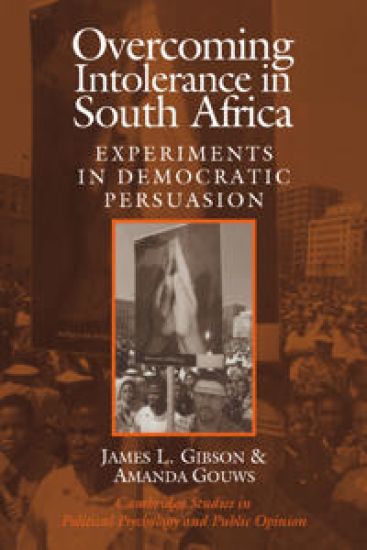
Overcoming Intolerance in South Africa

Overcoming Intolerance in South Africa

James L. Gibson; Amanda Gouws

Cambridge University Press
2005
pokkari
Overcoming Intolerance in South Africa investigates the degree to which the political culture of South Africa - the beliefs, values, and attitudes toward politics held by ordinary people - impedes or promotes the consolidation of democratic reform. One set of values is of particular concern in this study - political tolerance. The authors contend that political tolerance is a crucial element of democratic political cultures in general, but that in the South African case, tolerance is perhaps more important than any other democratic value. Since South Africa is one of the most polyglot countries in the world, the only viable strategy for survival is tolerance toward the political views of others. The overwhelming emphasis throughout this book is on finding ways to enhance the willingness of South Africans to 'put up with' their political enemies, to allow open and widespread political competition, and to coexist in their diversity.
Overcoming Intolerance in South Africa

Overcoming Intolerance in South Africa

James L. Gibson; Amanda Gouws

Cambridge University Press
2002
sidottu
Overcoming Intolerance in South Africa investigates the degree to which the political culture of South Africa - the beliefs, values, and attitudes toward politics held by ordinary people - impedes or promotes the consolidation of democratic reform. One set of values is of particular concern in this study - political tolerance. The authors contend that political tolerance is a crucial element of democratic political cultures in general, but that in the South African case, tolerance is perhaps more important than any other democratic value. Since South Africa is one of the most polyglot countries in the world, the only viable strategy for survival is tolerance toward the political views of others. The overwhelming emphasis throughout this book is on finding ways to enhance the willingness of South Africans to 'put up with' their political enemies, to allow open and widespread political competition, and to coexist in their diversity.
United States Supreme Court Judicial Data Base, Phase II

United States Supreme Court Judicial Data Base, Phase II

James L Gibson

Peter Lang Publishing Inc
1997
nidottu
For nearly a decade, a team of researchers was busily at work preparing a data base on the decisions of the United States Supreme Court. This book documents those efforts. Specifically, this book is a codebook and a user's guide to the data. In addition to documenting each of the codes in the data set, this book also provides specific details on how the variables were coded, as well as information about the reliability of the results. Three major aspects of these decisions are addressed: the values expressed in the opinions of the Court (including concurrences, dissents, etc.), the attributes of the litigants in each case, and the nature and extent of participation in the litigation by amicus curiae.
Civil Liberties and Nazis

Civil Liberties and Nazis

Richard D. Bingham; James L. Gibson

Praeger Publishers Inc
1985
sidottu
This study of civil liberties focuses on the American Civil Liberties Union (ACLU) and the dispute in Skokie, Illinois over the rights of members of the Nazi party to hold public demonstrations. Because this issue promoted at least one-fourth of the membership of the ACLU to take some form of action, ranging from objecting and reducing financial contributions to resigning, this conflict presents the opportunity for a case study of the conditions under which attitudes toward civil liberties are mobilized into behavior.