Kirjojen hintavertailu – 12 859 828 kirjaa ja 27 kauppaa

Kirjailija

James Lockhart

Kirjat ja teokset yhdessä paikassa: 18 kirjaa, julkaisuja vuosilta 1972–2022, suosituimpiin kuuluu Joshua & Noelle. Vertaile teosten hintoja ja tarkista saatavuus suomalaisista kirjakaupoista.

18 kirjaa

Kirjojen julkaisuvuodet: 1972–2022.

Chile, the CIA and the Cold War

Chile, the CIA and the Cold War

James Lockhart

Edinburgh University Press
2021
nidottu
James Lockhart blends Chilean, inter-American and transatlantic national, regional and world-historical trends into a century-long Cold War narrative. He argues that Chileans made their own history as highly engaged internationalists while reassessing American and other foreign-directed intelligence, surveillance and secret warfare operations in Chile and southern South America. The book transcends a well-known, US-centred historiography while offering a more equitable and global interpretation of Chile's Cold War experience than previously possible. This advances research that has progressively expanded the framework of Chile's Cold War experience since the arrest of General Augusto Pinochet in the UK for human rights violations more than 20 years ago.
Chile, the CIA and the Cold War

Chile, the CIA and the Cold War

James Lockhart

Edinburgh University Press
2019
sidottu
James Lockhart blends Chilean, inter-American and transatlantic national, regional and world-historical trends into a century-long Cold War narrative. He argues that Chileans made their own history as highly engaged internationalists while reassessing American and other foreign-directed intelligence, surveillance and secret warfare operations in Chile and southern South America. The book transcends a well-known, US-centred historiography while offering a more equitable and global interpretation of Chile's Cold War experience than previously possible. This advances research that has progressively expanded the framework of Chile's Cold War experience since the arrest of General Augusto Pinochet in the UK for human rights violations more than 20 years ago.
Venetia of the Roseate Dawn. [in Verse.]

Venetia of the Roseate Dawn. [in Verse.]

James Lockhart

British Library, Historical Print Editions
2011
pokkari
Title: Venetia of the Roseate Dawn. In verse.]Publisher: British Library, Historical Print EditionsThe British Library is the national library of the United Kingdom. It is one of the world's largest research libraries holding over 150 million items in all known languages and formats: books, journals, newspapers, sound recordings, patents, maps, stamps, prints and much more. Its collections include around 14 million books, along with substantial additional collections of manuscripts and historical items dating back as far as 300 BC. The POETRY & DRAMA collection includes books from the British Library digitised by Microsoft. The books reflect the complex and changing role of literature in society, ranging from Bardic poetry to Victorian verse. Containing many classic works from important dramatists and poets, this collection has something for every lover of the stage and verse. ++++The below data was compiled from various identification fields in the bibliographic record of this title. This data is provided as an additional tool in helping to insure edition identification: ++++ British Library Lockhart, James; 1866. 4 . 11645.g.55.(7.)
Jupiter the Balancer, Or, the Mysteries of Gold and Paper. a Legend of the Nineteenth Century. [in Verse.]
Title: Jupiter the Balancer, or, the Mysteries of Gold and Paper. A legend of the nineteenth century. In verse.]Publisher: British Library, Historical Print EditionsThe British Library is the national library of the United Kingdom. It is one of the world's largest research libraries holding over 150 million items in all known languages and formats: books, journals, newspapers, sound recordings, patents, maps, stamps, prints and much more. Its collections include around 14 million books, along with substantial additional collections of manuscripts and historical items dating back as far as 300 BC. The POETRY & DRAMA collection includes books from the British Library digitised by Microsoft. The books reflect the complex and changing role of literature in society, ranging from Bardic poetry to Victorian verse. Containing many classic works from important dramatists and poets, this collection has something for every lover of the stage and verse. ++++The below data was compiled from various identification fields in the bibliographic record of this title. This data is provided as an additional tool in helping to insure edition identification: ++++ British Library Lockhart, James; 1874. 4 . 11647.g.28.
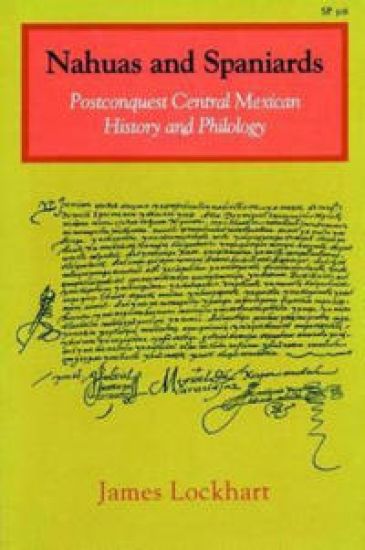
No. 6Nahuatl As Written

No. 6Nahuatl As Written

James Lockhart

Stanford University Press
2002
pokkari
Nahuatl was the primary native language of central Mexico both before and after the Spanish conquest. It is the Latin of the indigenous languages of the New World. Its tradition of alphabetic writing goes back to the middle years of the sixteenth century and embraces not only grammars, dictionaries, collections of preconquest lore, and works of religious instruction, but also, above all, a great mass of mundane writing by the Nahuas themselves for their own purposes. Though the past quarter century has seen a flourishing of ethnohistorical, philological, and grammatical studies based on this corpus, those interested in the world of Nahuatl texts still find access to it difficult. James Lockhart, an eminent historian of early Latin America, is also perhaps the leading interpreter of this large body of work. He has translated and edited a wide range of texts, analyzed their cultural and linguistic implications, and over the years trained a large number of students, several of whom have gone on to become well known scholars of Nahuatl and other indigenous languages. Lockhart's main tools of instruction were: (1) a gradually growing set of lessons consisting primarily of examples culled from many sources of the sixteenth through eighteenth centuries (or concocted in the spirit of that time), and (2) the grammar or Arte of Nahuatl published in Spanish by the Florentine Jesuit Horacio de Carochi in 1645. In small groups of students, with a maximum of personal instruction and discussion, these materials accomplished their purpose, but the lessons were only in skeletal form, and the Carochi grammar, too, in the Spanish editions available, needed extensive explanation. Now, Lockhart has organized and expanded these materials into volumes that can be understood by students working alone or used in organized Nahuatl classes. The two books together will allow any seriously interested person to master Nahuatl sufficiently to begin reading the texts, and they will provide essential reference works as one progresses. They are geared primarily to the older form of the language and its written texts, but they can also be extremely useful to those studying the spoken Nahuatl of later times. Nahuatl as Written presumes no previous knowledge of the language. Treating all essential features of Nahuatl, it is organized on purely pedagogical principles, using techniques developed over many years of practical teaching experience. The book is in large format, almost like a workbook, with a great abundance of examples that serve as exercises; the examples are also available separately for the student's convenience. The orthography and vocabulary are those found in texts of the time, and the last several of the twenty lessons give the student training in working with texts as they were actually written. Some of the lessons deal with syntax in a way not found elsewhere and develop notions of anticipation and crossreference that are basic to Nahuatl grammar. In line with Lockhart's wish to bring more people into the Nahuatl documentary world, an Epilogue surveys many of the published Nahuatl texts and an Appendix presents substantial selections from ten different texts. Carochi's 1645 Grammar is the most influential work ever published on Nahuatl grammar and remains an essential work of reference. The best recent grammars of Nahuatl are based on it, but they have not exhausted it. It includes an extensive discussion of adverbial expressions and particles that is found nowhere else, as well as an irreplaceable fund of authentic examples from the time, translated by a contemporary. Though a facsimile edition is available, the original is very difficult to read, and only a few experts can fully understand the seventeenth-century Spanish and Latinate grammatical terms. This new edition presents the original Spanish and an English translation on facing pages. Helpful footnotes provide explanatory commentary and more literal translations of some of Carochi's examples. The volume is at once an indispensable pedagogical tool and the first critical edition of the premier monument of the Nahuatl grammatical literature. The two books are published jointly with UCLA Latin American Center Publications.

No. 6Nahuatl As Written

No. 6Nahuatl As Written

James Lockhart

Stanford University Press
2002
sidottu
Nahuatl was the primary native language of central Mexico both before and after the Spanish conquest. It is the Latin of the indigenous languages of the New World. Its tradition of alphabetic writing goes back to the middle years of the sixteenth century and embraces not only grammars, dictionaries, collections of preconquest lore, and works of religious instruction, but also, above all, a great mass of mundane writing by the Nahuas themselves for their own purposes. Though the past quarter century has seen a flourishing of ethnohistorical, philological, and grammatical studies based on this corpus, those interested in the world of Nahuatl texts still find access to it difficult. James Lockhart, an eminent historian of early Latin America, is also perhaps the leading interpreter of this large body of work. He has translated and edited a wide range of texts, analyzed their cultural and linguistic implications, and over the years trained a large number of students, several of whom have gone on to become well known scholars of Nahuatl and other indigenous languages. Lockhart's main tools of instruction were: (1) a gradually growing set of lessons consisting primarily of examples culled from many sources of the sixteenth through eighteenth centuries (or concocted in the spirit of that time), and (2) the grammar or Arte of Nahuatl published in Spanish by the Florentine Jesuit Horacio de Carochi in 1645. In small groups of students, with a maximum of personal instruction and discussion, these materials accomplished their purpose, but the lessons were only in skeletal form, and the Carochi grammar, too, in the Spanish editions available, needed extensive explanation. Now, Lockhart has organized and expanded these materials into volumes that can be understood by students working alone or used in organized Nahuatl classes. The two books together will allow any seriously interested person to master Nahuatl sufficiently to begin reading the texts, and they will provide essential reference works as one progresses. They are geared primarily to the older form of the language and its written texts, but they can also be extremely useful to those studying the spoken Nahuatl of later times. Nahuatl as Written presumes no previous knowledge of the language. Treating all essential features of Nahuatl, it is organized on purely pedagogical principles, using techniques developed over many years of practical teaching experience. The book is in large format, almost like a workbook, with a great abundance of examples that serve as exercises; the examples are also available separately for the student's convenience. The orthography and vocabulary are those found in texts of the time, and the last several of the twenty lessons give the student training in working with texts as they were actually written. Some of the lessons deal with syntax in a way not found elsewhere and develop notions of anticipation and crossreference that are basic to Nahuatl grammar. In line with Lockhart's wish to bring more people into the Nahuatl documentary world, an Epilogue surveys many of the published Nahuatl texts and an Appendix presents substantial selections from ten different texts. Carochi's 1645 Grammar is the most influential work ever published on Nahuatl grammar and remains an essential work of reference. The best recent grammars of Nahuatl are based on it, but they have not exhausted it. It includes an extensive discussion of adverbial expressions and particles that is found nowhere else, as well as an irreplaceable fund of authentic examples from the time, translated by a contemporary. Though a facsimile edition is available, the original is very difficult to read, and only a few experts can fully understand the seventeenth-century Spanish and Latinate grammatical terms. This new edition presents the original Spanish and an English translation on facing pages. Helpful footnotes provide explanatory commentary and more literal translations of some of Carochi's examples. The volume is at once an indispensable pedagogical tool and the first critical edition of the premier monument of the Nahuatl grammatical literature. The two books are published jointly with UCLA Latin American Center Publications.

Of Things of the Indies

Of Things of the Indies

James Lockhart

Stanford University Press
2000
sidottu
This volume offers an illuminating overview of the work of a pioneering and highly distinguished scholar of early Latin American social and cultural history and philology. Known for the originality of his approach and the variety of his research interests, James Lockhart has gone from studying social history using career pattern methods to an ethnohistory emphasizing indigenous-language philology, all the while stressing general interpretation, synthesis, historiography, and the development of analytical concepts and categories. The present volume illustrates all these interests and activities within the covers of a single book; the reader can see not only common threads running through the individual essays, but also the close relationships between types of scholarship all too often seen as utterly distinct. The "old and new" of the subtitle is meant literally; the first piece was written in 1968, the last in 1998. Some are already well known, while others have appeared in quite obscure venues. Four of the twelve chapters are published here for the first time. They elucidate the reading of texts for social and cultural purposes, expound on aspects of Nahuatl historical linguistics, discuss the problematic nature of the concept of resistance in Western Hemisphere culture encounters, and review the author's experience with the scholarly disciplines, which involves a certain amount of intellectual autobiography. The tone of the volume is generally colloquial, for nine chapters originated as lectures and attempt to interpret for a wider audience the author's research as represented in his monographic books. Previously published pieces have been revised or expanded to a greater or lesser degree. Their subjects include the transition from encomienda to hacienda, the evolution of social history in Latin American studies, the economic rationality of Spanish procedures, the changing role of merchants in Spanish America, the editing of Nahuatl texts, the author's concept of Double Mistaken Identity, and the process of cultural contact in three major Latin American areas.
Of Things of the Indies

Of Things of the Indies

James Lockhart

Stanford University Press
2000
pokkari
This volume offers an illuminating overview of the work of a pioneering and highly distinguished scholar of early Latin American social and cultural history and philology. Known for the originality of his approach and the variety of his research interests, James Lockhart has gone from studying social history using career pattern methods to an ethnohistory emphasizing indigenous-language philology, all the while stressing general interpretation, synthesis, historiography, and the development of analytical concepts and categories. The present volume illustrates all these interests and activities within the covers of a single book; the reader can see not only common threads running through the individual essays, but also the close relationships between types of scholarship all too often seen as utterly distinct. The "old and new" of the subtitle is meant literally; the first piece was written in 1968, the last in 1998. Some are already well known, while others have appeared in quite obscure venues. Four of the twelve chapters are published here for the first time. They elucidate the reading of texts for social and cultural purposes, expound on aspects of Nahuatl historical linguistics, discuss the problematic nature of the concept of resistance in Western Hemisphere culture encounters, and review the author's experience with the scholarly disciplines, which involves a certain amount of intellectual autobiography. The tone of the volume is generally colloquial, for nine chapters originated as lectures and attempt to interpret for a wider audience the author's research as represented in his monographic books. Previously published pieces have been revised or expanded to a greater or lesser degree. Their subjects include the transition from encomienda to hacienda, the evolution of social history in Latin American studies, the economic rationality of Spanish procedures, the changing role of merchants in Spanish America, the editing of Nahuatl texts, the author's concept of Double Mistaken Identity, and the process of cultural contact in three major Latin American areas.
The Story of Guadalupe

The Story of Guadalupe

Lisa Sousa; Stafford Poole; James Lockhart

Stanford University Press
1998
pokkari
The devotion to Our Lady of Guadalupe is one of the most important elements in the development of a specifically Mexican tradition of religion and nationality over the centuries. The picture of the Virgen morena (Dark Virgin) is to be found everywhere throughout Mexico, and her iconography is varied almost beyond telling. Though innumerable books, both historical and devotional, have been published on the Guadalupan legend in this century alone, it is only recently that its textual sources have been closely studied. This volume makes available to the English-reading public an easily accessible translation from the original Nahuatl of the story itself and the entire book in which the story is embedded. The study also provides scholars with new perspectives on a text long at the center of Mexican intellectual currents. Through the use of technical philological methods, it indicates that the text may have been authored in the mid-seventeenth century by a Spanish-Mexican priest, based on an earlier text by a colleague of his, and that it was not the product of Nahuatl oral tradition. The story of the apparition of the Virgin of Guadalupe to a poor indigenous man less than fifteen years after the Spanish conquest of Mexico did not come into prominence until the mid-seventeeth century. The first known telling of the tale appeared in a book published in Spanish in 1648 by the priest Miguel Sánchez. On the heels of the Sánchez version, the story was included in the book Huei tlamahuiçoltica published in 1649 by Luis Laso de la Vega, the vicar of the Guadalupe chapel and a friend of Sánchez. It had little impact initially, but by the twentieth century, with indigenism triumphant, it had become the best known version. There have been a few translations of Laso de la Vega's apparition story into English but only on a popular or devotional level. The present edition offers a translation and transcription of the complete text of the 1649 edition, together with critical apparatus, including comparisons of the Sánchez and Laso de la Vega texts, and various linguistic, orthographic, and typographical matters that throw light on the date and manner of composition.
The Story of Guadalupe

The Story of Guadalupe

Lisa Sousa; Stafford Poole; James Lockhart

Stanford University Press
1998
sidottu
The devotion to Our Lady of Guadalupe is one of the most important elements in the development of a specifically Mexican tradition of religion and nationality over the centuries. The picture of the Virgen morena (Dark Virgin) is to be found everywhere throughout Mexico, and her iconography is varied almost beyond telling. Though innumerable books, both historical and devotional, have been published on the Guadalupan legend in this century alone, it is only recently that its textual sources have been closely studied. This volume makes available to the English-reading public an easily accessible translation from the original Nahuatl of the story itself and the entire book in which the story is embedded. The study also provides scholars with new perspectives on a text long at the center of Mexican intellectual currents. Through the use of technical philological methods, it indicates that the text may have been authored in the mid-seventeenth century by a Spanish-Mexican priest, based on an earlier text by a colleague of his, and that it was not the product of Nahuatl oral tradition. The story of the apparition of the Virgin of Guadalupe to a poor indigenous man less than fifteen years after the Spanish conquest of Mexico did not come into prominence until the mid-seventeeth century. The first known telling of the tale appeared in a book published in Spanish in 1648 by the priest Miguel Sánchez. On the heels of the Sánchez version, the story was included in the book Huei tlamahuiçoltica published in 1649 by Luis Laso de la Vega, the vicar of the Guadalupe chapel and a friend of Sánchez. It had little impact initially, but by the twentieth century, with indigenism triumphant, it had become the best known version. There have been a few translations of Laso de la Vega's apparition story into English but only on a popular or devotional level. The present edition offers a translation and transcription of the complete text of the 1649 edition, together with critical apparatus, including comparisons of the Sánchez and Laso de la Vega texts, and various linguistic, orthographic, and typographical matters that throw light on the date and manner of composition.
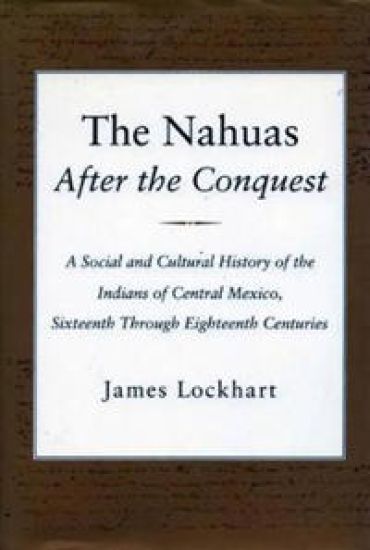
The Nahuas After the Conquest

The Nahuas After the Conquest

James Lockhart

Stanford University Press
1994
pokkari
A monumental achievement of scholarship, this volume on the Nahua Indians of Central Mexico (often called Aztecs) constitutes our best understanding of any New World indigenous society in the period following European contact. Simply put, the purpose of this book is to throw light on the history of Nahua society and culture through the use of records in Nahuatl, concentrating on the time when the bulk of the extant documents were written, between about 1540-50 and the late eighteenth century. At the same time, the earliest records are full of implications for the very first years after contact, and ultimately for the preconquest epoch as well, both of which are touched on here in ways that are more than introductory or ancillary.
The Nahuas After the Conquest

The Nahuas After the Conquest

James Lockhart

Stanford University Press
1992
sidottu
A monumental achievement of scholarship, this volume on the Nahua Indians of Central Mexico (often called Aztecs) constitutes our best understanding of any New World indigenous society in the period following European contact. Simply put, the purpose of this book is to throw light on the history of Nahua society and culture through the use of records in Nahuatl, concentrating on the time when the bulk of the extant documents were written, between about 1540-50 and the late eighteenth century. At the same time, the earliest records are full of implications for the very first years after contact, and ultimately for the preconquest epoch as well, both of which are touched on here in ways that are more than introductory or ancillary.
Early Latin America

Early Latin America

James Lockhart; Stuart B. Schwartz

Cambridge University Press
1983
sidottu
This book provides a general history of Latin America in the period between the European conquest and the gaining of independence by the Spanish American countries and Brazil (approximately 1492–1825). It is both an introduction for the student at the college level and a provisionally updated synthesis of the quickly changing field for the more experienced reader. The authors' aim is not only to treat colonial Brazil and colonial Spanish America in a single volume, something rarely done, but also to view early Latin America as one unit with a centre and peripheries, all parts of which were characterized by variants of the same kinds of change, regardless of national and imperial borders. The authors integrate both the older and the newer historical literature, seeing legal, institutional, and political phenomena within a social, economic, and cultural context. They incorporate insights from other disciplines and newer techniques of historical research, but eschew jargon or technical concepts. The approach of the book, with its emphasis on broad social and economic trends across large areas and long time periods, does much to throw light on Latin America in the nineteenth and twentieth centuries as well.
Early Latin America

Early Latin America

James Lockhart; Stuart B. Schwartz

Cambridge University Press
1983
pokkari
This book provides a general history of Latin America in the period between the European conquest and the gaining of independence by the Spanish American countries and Brazil (approximately 1492–1825). It is both an introduction for the student at the college level and a provisionally updated synthesis of the quickly changing field for the more experienced reader. The authors' aim is not only to treat colonial Brazil and colonial Spanish America in a single volume, something rarely done, but also to view early Latin America as one unit with a centre and peripheries, all parts of which were characterized by variants of the same kinds of change, regardless of national and imperial borders. The authors integrate both the older and the newer historical literature, seeing legal, institutional, and political phenomena within a social, economic, and cultural context. They incorporate insights from other disciplines and newer techniques of historical research, but eschew jargon or technical concepts. The approach of the book, with its emphasis on broad social and economic trends across large areas and long time periods, does much to throw light on Latin America in the nineteenth and twentieth centuries as well.
The Men of Cajamarca

The Men of Cajamarca

James Lockhart

University of Texas Press
1972
pokkari
In November 1532, a group of 168 Spaniards seized the Inca emperor Atahuallpa in the town of Cajamarca, in the northern Peruvian highlands. Their act, quickly taken as a symbol of the conquest of a vast empire, brought them unprecedented rewards in gold and silver; it made them celebrities, gave them first choice of positions of honor and power in the new Peru of the Spaniards, and opened up the possibility of a splendid life at home in Spain, if they so desired. Thus they became men of consequence, at the epicenter of a swift and irrevocable transformation of the Andean region. Yet before that memorable day in Cajamarca they had been quite unexceptional, a reasonable sampling of Spaniards on expeditions all over the Indies at the time of the great conquests. The Men of Cajamarca is perhaps the fullest treatment yet published of any group of early Spaniards in America. Part I examines general types, characteristics, and processes visible in the group as representative Spanish immigrants, central to the establishment of a Spanish presence in the New World’s richest land. The intention is to contribute to a changing image of the Spanish conqueror, a man motivated more by pragmatic self-interest than by any love of adventure, capable and versatile as often as illiterate and rough. Aiming at permanence more than new landfalls, these men created the governmental units and settlement distribution of much of Spanish America and set lasting patterns for a new society. Part II contains the men’s individual biographies, ranging from a few lines for the most obscure to many pages of analysis for the best-documented figures. The author traces the lives of the men to their beginnings in Spain and follows their careers after the episode in Cajamarca.