Kirjojen hintavertailu – 12 903 725 kirjaa ja 27 kauppaa

Kirjailija

James M. Buchanan

Kirjat ja teokset yhdessä paikassa: 34 kirjaa, julkaisuja vuosilta 1960–2021, suosituimpiin kuuluu Cost and Choice. Vertaile teosten hintoja ja tarkista saatavuus suomalaisista kirjakaupoista.

Nimi esiintyy myös muodoissa: James M Buchanan

34 kirjaa

Kirjojen julkaisuvuodet: 1960–2021.

Calculus of Consent -- Logical Foundations of Constitutional Democracy
THE CALCULUS OF CONSENT was co-authored by Buchanan with Gordon Tullock, with whom Buchanan collaborated on many books and academic enterprises throughout their careers. As Robert D Tollison states in the foreword: (this book) is a radical departure from the way democracies conduct their business. The 'Calculus' is already a book for the ages. This classic work analyses the political organisation of a free society through the lens of the economic organisation of society. The authors acknowledge their unease as economists in analysing the political organisation, but they take the risk of forging into unfamiliar territory because they believe the benefits of their perspective will bear much fruit. As the authors state, their objective in this book is "to analyze the calculus of the rational individual when he is faced with questions of constitutional choice... We examine the (choice) process extensively only with reference to the problem of decision-making rules." The authors describe their approach as 'economic individualism'. They believe that economists have explored individual choice extensively in the market sector while social scientists have largely ignored the dynamics of individual decision-making in the dynamics of forming group action in the public sector. Written in the early 1960s, THE CALCULUS OF CONSENT has become a bulwark of the public choice movement for which James M Buchanan is so justly famous.
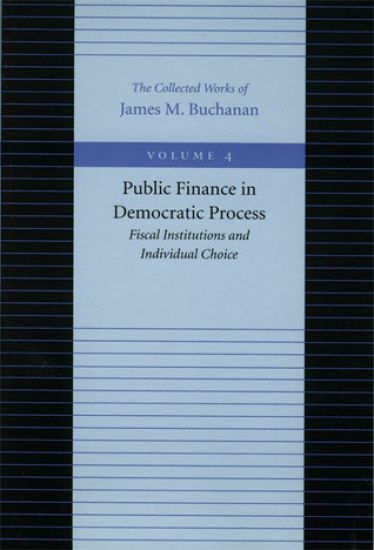
Public Finance in Democratic Process -- Fiscal Institutions & Individual Choice
A monumental work that outlines the dynamics of individual choice as it is displayed in the process of public finance. Buchanan is perhaps nowhere more clearly a disciple of the great Swedish economist Knut Wicksell than he is in the underlying principles of this seminal work. Specifically, he elaborates on these three central Wicksellian themes: analysis of market failure in the provision of public goods; the insistence on conceiving policy decisions as the outcome of political processes; and, the necessity of treating the tax and expense sides of the budget as interconnected. Echoing Wicksell's antipathy to the 'benevolent despot' model of government, Buchanan lays out in this book a starting point for modern public-choice analysis. Recognising the path breaking work he is about to begin, Buchanan opens his preface by stating, "Fiscal theory is normally discussed in a frame of reference wholly different from that adopted in this book. This dramatic shift of emphasis... requires that I consider the processes through which individual choices are transmitted, combined, and transformed into collective outcomes. Careful research in this area is in its infancy, and the necessary reliance on crude, unsophisticated models underscores the exploratory nature of the work." According to Geoffrey Brennan in the foreword, "PUBLIC FINANCE IN DEMOCRATIC PROCESS is a work more hospitable to public finance orthodoxy and could be treated as an extension (albeit an important one) of the conventional approach."
Public Finance in Democratic Process -- Fiscal Institutions & Individual Choice
A monumental work that outlines the dynamics of individual choice as it is displayed in the process of public finance. Buchanan is perhaps nowhere more clearly a disciple of the great Swedish economist Knut Wicksell than he is in the underlying principles of this seminal work. Specifically, he elaborates on these three central Wicksellian themes: analysis of market failure in the provision of public goods; the insistence on conceiving policy decisions as the outcome of political processes; and, the necessity of treating the tax and expense sides of the budget as interconnected. Echoing Wicksell's antipathy to the 'benevolent despot' model of government, Buchanan lays out in this book a starting point for modern public-choice analysis. Recognising the path breaking work he is about to begin, Buchanan opens his preface by stating, "Fiscal theory is normally discussed in a frame of reference wholly different from that adopted in this book. This dramatic shift of emphasis... requires that I consider the processes through which individual choices are transmitted, combined, and transformed into collective outcomes. Careful research in this area is in its infancy, and the necessary reliance on crude, unsophisticated models underscores the exploratory nature of the work." According to Geoffrey Brennan in the foreword, "PUBLIC FINANCE IN DEMOCRATIC PROCESS is a work more hospitable to public finance orthodoxy and could be treated as an extension (albeit an important one) of the conventional approach."
Public Principles of Public Debt -- A Defense & Restatement
One of Buchanan's most important and influential books. The radical idea he conceived was that: our reliance on public debt has amassed a sort of orthodoxy that is commonly -- and needlessly -- assumed by taxpayers, by politicians, and by economists themselves. Buchanan dismisses the nearly universal belief (which continues to this day) that the burden of debt is borne by the current generation, and he argues persuasively that public debt is shouldered in large part by generations still to come. Written in 1958, this book represents Buchanan's first published monograph, and its publication met with much controversy, confusion, and speculation in the economic community. But the book also added to Buchanan's rising stature in the early part of his career as a brilliant and original thinker. The arguments Buchanan lays out in this book had a considerable impact on much of his later work. Buchanan's object here is to establish a set of analytical claims about debt incidence. Current anxieties over implicit Social Security debt are clear indications of the rightness of Buchanan's then-revolutionary theory.
Politics by Principle, Not Interest

Politics by Principle, Not Interest

James M. Buchanan; Roger D. Congleton

Cambridge University Press
1998
sidottu
The very logic of majority rule implies unequal treatment or discrimination. If left unconstrained, majority coalitions will promote the interests of their own members at the expense of other persons. This book focuses on the effects of applying a generality constraint on the political process. Under this requirement, majorities would be constitutionally prohibited from treating different persons and groups differently. The generality principle is familiar in that all persons are to be treated equally. In summary, this book extends the generality norm to politics. Several defenses or equal treatment or generality are developed and applied. These include the familiar intuition that invokes fairness. But the primary argument here is centred on political efficiency, which is increased when governments are constrained to treat persons or groups generally rather than differentially. The political efficiency defense of the generality constraint is based on a public choice analysis of the implication of majoritarian discrimination.
post-socialist political economy

post-socialist political economy

James M. Buchanan

Edward Elgar Publishing Ltd
1997
sidottu
This book presents a critical assessment of the political and social order in the post-revolutionary decade of the 1990s in both the transitional economies and Western welfare states confronting fiscal crises. As we enter the new post-socialist century, James M. Buchanan argues that we need to think and act on the premise that the future is uncertain. James M. Buchanan examines the political economy of the post-socialist era, analysing the events of 1989-91 and some of their predicted consequences. In addition he reflects upon the influence of those revolutionary years and the reactions to the changes, as well as the role of economists in the new socio-political environment. The political economy of the post-socialist era will be determined by the forces of historical development, social and cultural evolution, directed political change and exogenous shocks. To a large extent, many of these forces cannot be planned for, except directed political change. This insightful new book will be welcomed by political economists, legal and political philosophers, political scientists and public choice economists.
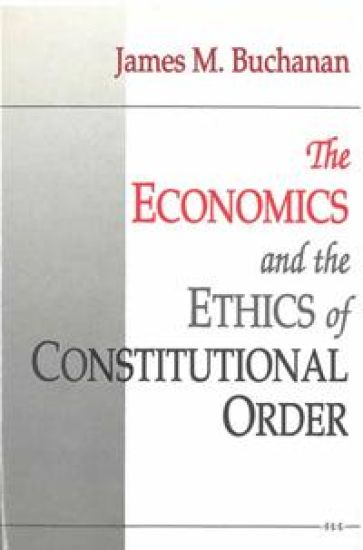
The Economics and the Ethics of Constitutional Order

The Economics and the Ethics of Constitutional Order

James M. Buchanan

The University of Michigan Press
1991
sidottu
How do persons live together in peace, prosperity, liberty, and justice? This ancient question requires continuing analysis, discussion, and attention – by economists, by philosophers, by political leaders, and by members of the body politic. Buchanan’s interests have always centered on the issues relevant to this question, and his most recent essays reflect a new broadening of perspective. In this collection of twenty distinctly but closely related essays, written over the period 1986-89 following the author’s receipt of the Nobel Prize in Economic Science, Professor Buchanan records his increasing interest in and developing ideas on the constitutional order of a free society, especially in its ethical foundations. The essays in this collection extend beyond the boundaries of economics into moral philosophy, political philosophy, methodology, and epistemology Many of the separate essays were initially delivered by special invitation as lectures to general audiences throughout the world. The linking theme of the essays in The Economics and the Ethics of Constitutional Order is the continuing relevance of Adam Smith’s ideas to issues emerging in the 1990s – issues that have gained a new immediacy since the revolutionary events of 1989. How can societies organize their economies so as to produce goods and services efficiently while at the same time allowing individuals the liberties to make their own choices? Buchanan’s contributions here are directly addressed to this question.
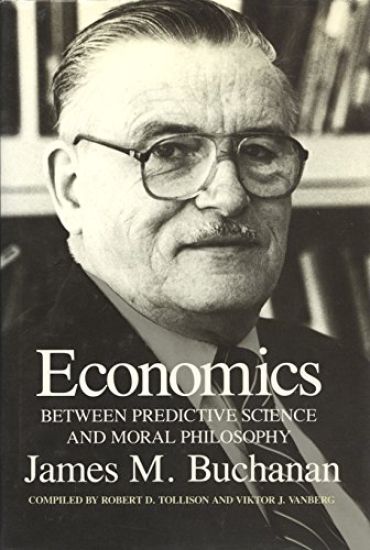
Economics

Economics

James M. Buchanan

Texas A M University Press
1988
sidottu
This book presents twenty-six of the major papers of 1986 Nobel Laureate James M. Buchanan, who played a key role in the development of "theoretical institutional economics" and was awarded the Nobel Prize in economic science for his contributions to a theory of political economy as well as his leadership of the public choice movement. These articles, written from the early 1950s to the mid-1980s and spanning various subfields of economics from public finance to methodology, form the core of Buchanan's work. In each paper the constitutional economics paradigm--viewed by the author as a modern revival of classical political economy--is modified, extended, and applied to particular issues. Contemporary economics grew out of the eighteenth century's moral philosophy--today's social science. Over years of disciplinary separation and specialization within the social sciences, economics has increasingly moved away from the issues about which its founders were concerned, issues that are central to the identity of the economic paradigm. A particular target of criticism has been the tendency to define and analyze economic processes as if they occur in an institutional vacuum. A number of new theoretical developments--among them public choice and the new political economy--have been initiated to refocus economists' attention to the institutional framework of economic activity. Buchanan is perhaps best known as a man who changed the ideas of a generation of scholars about the way the social and economic world works. Rather than working within a tradition, he created his own in the Virginia school of political economy. Aside from published works, his influence has been felt in lectures, conferences, and comments on his colleagues' work. This book will be valuable both to first-time readers of Buchanan's writings and to those already familiar with his contributions to economics.
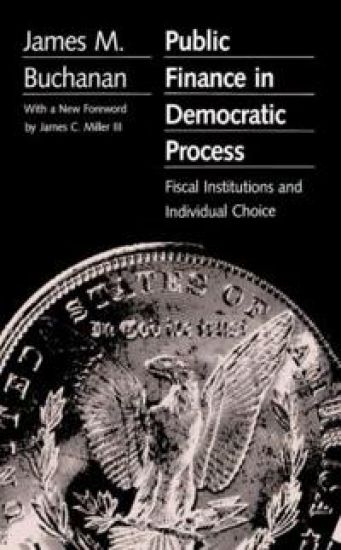
Public Finance in Democratic Process

Public Finance in Democratic Process

James M. Buchanan

The University of North Carolina Press
1987
nidottu
Studies of public finance, as traditionally developed, have analyzed the effects of fiscal institutions on the market-choice behavior of individuals and firms, but this book takes a different approach. It analyzes the effects of fiscal institutions on the political-choice behavior of individuals as they participate variously in the decision-making processes of democracies. What effect will the form of a new tax have on individuals' attitudes toward more or less public spending? To what extent does the private sector--public sector mix depend on the way in which tax payments are made? How do the various taxes affect the fiscal consciousness of individual citizens? These are questions that have been ignored for the most part. They are, nonetheless, important and worthy of examination. This book is an attempt to provide some provisional answers. By the use of simplified models of existing tax institutions, Buchanan predicts the effects that these exert on individual behavior in the area of political choice. The relative effects of direct and indirect taxes, the ""old tax--new tax"" distinction, the effects of fiscal earmarking, the effects of unbalanced budgets -- these are a few of the topics examined. Before these questions can be fully answered, research must be conducted to find out just how much individuals know about the taxes they pay and the benefits they receive. Comparatively little research of this kind has been completed, but the author devotes a chapter to a careful review of the present state of this sort of research. Individuals' choice among alternative fiscal institutions is examined in the second part of the book. If given the opportunity, how would the individual choose to pay his or her taxes? Progressive income taxes, excise taxes, and public debt are analyzed in terms of this question. Because of its interdisciplinary approach, this imaginative study will be of interest to both economists and political scientists. |Although much has been written about the ways in which Confederate politics affected the course of the Civil War, George Rable is the first historian to investigate Confederate political culture in its own right. Focusing on the assumptions, values, and b
Explorations Into Constit

Explorations Into Constit

James M. Buchanan

Texas A M University Press
1983
nidottu
These thirtyone essays form the foundation of 1986 Nobel Laureate James M. Buchanan's work on the constitutional economics paradigm he founded. Following the earlier collection, Economics: Between Predictive Science and Moral Philosophy, these essays include many that appeared in journals not easily accessible as well as some which have not previously been published. The volume is organized in two parts: theoretical foundations and applications. The latter part includes papers on aspects of voting, monetary and fiscal constitutions, public goods supply, taxation and public debt, and property rights and externalities. This edition provides easier access and gives a wider exposure to a set of arguments and ideas that mark important steps in Buchanan's building of the Constitutional Economics Paradigm. The vision of a new political economy developed and applied in the contributions of this volume will be of interest to scholars and students of economics as well as other disciplines from political science to philosophy, providing a valuable perspective and orientation to anyone who is concerned with the practical issues of policy making.
The Power to Tax

The Power to Tax

Geoffrey Brennan; James M. Buchanan

Cambridge University Press
1980
sidottu
Should government's power to tax be limited? The events of the late 1970s in the wake of California's Proposition 13 brought this question very sharply into popular focus. Whether the power to tax should be restricted, and if so how, are issues of immediate policy significance. Providing a serious analysis of these issues, the authors of this 1980 book offer an approach to the understanding and evaluation of the fiscal system, one that yields profound implications. The central question becomes: how much 'power to tax' would the citizen voluntarily grant to government as a party to some initial social contract devising a fiscal constitution? Those in office are assumed to exploit the power assigned to them to the maximum possible extent: government is modelled as 'revenue-maximizing Leviathan'. Armed with such a model, the authors proceed to trace out the restrictions on the power to tax that might be expected to emerge from the citizen's constitutional deliberations.
The Limits of Liberty

The Limits of Liberty

James M. Buchanan

University of Chicago Press
1977
nidottu
"The Limits of Liberty is concerned mainly with two topics. One is an attempt to construct a new contractarian theory of the state, and the other deals with its legitimate limits. The latter is a matter of great practical importance and is of no small significance from the standpoint of political philosophy."—Scott Gordon, Journal of Political EconomyJames Buchanan offers a strikingly innovative approach to a pervasive problem of social philosophy. The problem is one of the classic paradoxes concerning man's freedom in society: in order to protect individual freedom, the state must restrict each person's right to act. Employing the techniques of modern economic analysis, Professor Buchanan reveals the conceptual basis of an individual's social rights by examining the evolution and development of these rights out of presocial conditions.