

Kirjailija
James Matthew Barrie
Kirjat ja teokset yhdessä paikassa: 577 kirjaa, julkaisuja vuosilta 1900–2026, suosituimpiin kuuluu The Novels, Tales, and Sketches of J.M. Barrie. Vertaile teosten hintoja ja tarkista saatavuus suomalaisista kirjakaupoista.
577 kirjaa
Kirjojen julkaisuvuodet: 1900–2026.


The Novels, Tales and Sketches; The Little Minister, Part I
James Matthew Barrie
Trieste Publishing
2018
nidottu








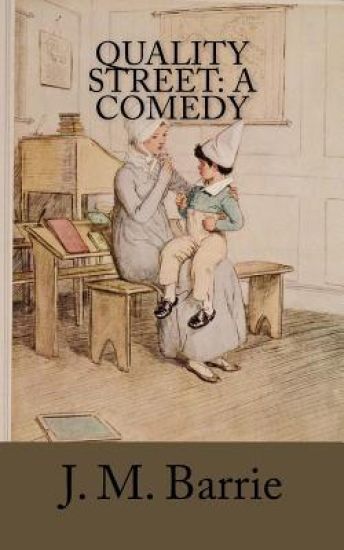
Quality Street: A Comedy
James Matthew Barrie
Createspace Independent Publishing Platform
2018
nidottu
1918. Barrie, Scottish journalist, playwright, and children's book writer, became world famous with his play and story about Peter Pan. Along with The Admirable Crichton, Quality Street is considered one of Barrie's two best plays. Quality Street is about two sisters who start a school for genteel children. Due to the age and scarcity of the original we reproduced, some pages may be spotty or faded.

Peter Pan in Kensington Gardens
James Matthew Barrie
Createspace Independent Publishing Platform
2018
nidottu
Voted Top 100 in Books for Children. Peter and Wendy. J. M. Barrie. Illustrated by F. D. Bedford. Peter Pan; or, the Boy Who Wouldn't Grow Up or Peter and Wendy is J. M. Barrie's most famous work, in the form of a 1904 play and a 1911 novel. Both versions tell the story of Peter Pan, a mischievous little boy who can fly, and his adventures on the island of Neverland with Wendy Darling and her brothers, the fairy Tinker Bell, the Lost Boys, the Indian princess Tiger Lily, and the pirate Captain Hook. The play and novel were inspired by Barrie's friendship with the Llewelyn Davies family. Barrie continued to revise the play for years after its debut; the novel reflects one version of the story. The play debuted in London on 27 December 1904 with Nina Boucicault, daughter of playwright Dion Boucicault, in the title role. A Broadway production was mounted in 1905 starring Maude Adams. It was later revived with such actresses as Marilyn Miller and Eva Le Gallienne. The play has since seen adaptation as a pantomime, stage musical, a television special, and several films, including a 1924 silent film, a 1953 animated Disney full-length feature, and a 2003 live action production. The play is now rarely performed in its original form on stage in the United Kingdom, whereas pantomime adaptations are frequently staged around Christmas. In the U. S., the original version has also been supplanted in popularity by the 1954 musical version, which became popular on television. The novel was first published in 1911 by Hodder & Stoughton in the United Kingdom and Charles Scribner's Sons in the United States. The original book contains a frontispiece and 11 half-tone plates by artist F. D. Bedford (whose illustrations are still in copyright in the EU). The novel was first abridged by May Byron in 1915, with Barrie's permission, and published under the title Peter Pan and Wendy, the first time this form was used. This version was later illustrated by Mabel Lucie Attwell in 1921. The novel is now usually published under that title or simply Peter Pan. The script of the play, which Barrie had continued to revise since its first performance, was published in 1928. In 1929, Barrie gave the copyright of the Peter Pan works to Great Ormond Street Hospital, a children's hospital in London.
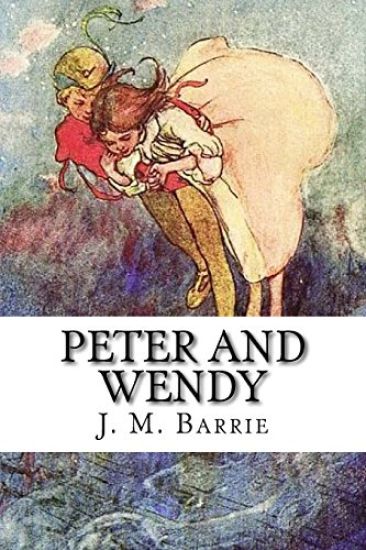
This play, Barrie's most successful, is the story of the boy who wouldn't grow up. It will never grow old. Peter Pan drops in on the Darling children. In spite of the efforts of their nurse, the dog Nana, he teaches Wendy and her brothers to fly. They soar with him to Never-Never Land, where Wendy becomes the mother of the lost children who live underground and in the hollow trunks of trees. Adventures with Indians and pirates follow. The pirate chief, Captain Hook, is followed by a crocodile that, having devoured the Captain's hand, seeks the remainder of his meal; but the ticking of a clock the crocodile has swallowed always warns the Captain. There is desperate war between the children and the pirates. Peter's friend, the fairy Tinker Bell -- visible only as a dancing light -- swallows the poison Hook has prepared for Peter. To save her life, Peter appeals to the audience: Do you believe in fairies?, and as the audience applauds Tinker Bell's light grows bright again. Peter leads his forces onto the pirate ship, and the desperados walk the plank. Wendy goes home, promising always to return, for the spring cleaning, to Peter's house in the tree-top in Never-Never Land. When Barrie wrote Peter Pan in 1904, he took it to Beerbohm Tree, whom he visualized as Captain Hook. Tree at once warned Frohman: "Barrie has gone out of his mind. I am sorry to say it; but you ought to know it. He's just read me a play. He's going to read it to you, so I am warning you. I know I have not gone woozy in my mind, because I have tested myself since hearing the play. But Barrie must be mad. He has written four acts all about fairies, children, and Indians running through the most incoherent story you ever listened to; and what do you suppose? The last act is to be set on top of trees " Later, Tree said he'd probably be known to posterity as the man that had refused Peter Pan. Young and old alike respond to the appeal of Peter Pan. Those who maintain -- as many do -- that it is a children's play, the Boston Transcript chided ( May 8, 1929): "Fools and slow of heart It is middle age's own tragicomedy -- the faint, far memories of boyhood and girlhood blown back in the bright breeze of Barrie's imagination." Percy Hammond made the same point on November 7, 1927: "Peter Pan is as young as it was eighteen years ago -- but I am not." The New York Times ( January 2, 1916) made the point more precisely: "Peter Pan is not children at play, but an old man smiling -- and smiling a little sadly -- as he watches children at play." "And if there be anybody," said the reviewer of London's King ( January 14, 1905) "who can sit through the performance without an occasional tear, I can only wish for him that he may some day have children of his own, and will then understand why in the first and last scenes so many eyes around him were moist and so many throats felt in them the lump that a tender emotion brings."
Though today he is best remembered for his work for younger audiences, including the beloved classic Peter Pan, J. M. Barrie was a writer of remarkable breadth and versatility who didn't shy away from tough subjects. This volume of plays showcases an array of British families and their very different methods of coping with the aftermath of World War I.

When a Man's Single A Tale of Literary Life
James Matthew Barrie
Createspace Independent Publishing Platform
2018
nidottu
Leopold is delighted to publish this classic book as part of our extensive Classic Library collection. Many of the books in our collection have been out of print for decades, and therefore have not been accessible to the general public. The aim of our publishing program is to facilitate rapid access to this vast reservoir of literature, and our view is that this is a significant literary work, which deserves to be brought back into print after many decades. The contents of the vast majority of titles in the Classic Library have been scanned from the original works. To ensure a high quality product, each title has been meticulously hand curated by our staff. This means that we have checked every single page in every title, making it highly unlikely that any material imperfections - such as poor picture quality, blurred or missing text - remain. When our staff observed such imperfections in the original work, these have either been repaired, or the title has been excluded from the Leopold Classic Library catalogue. As part of our on-going commitment to delivering value to the reader, within the book we have also provided you with a link to a website, where you may download a digital version of this work for free. Our philosophy has been guided by a desire to provide the reader with a book that is as close as possible to ownership of the original work. We hope that you will enjoy this wonderful classic work, and that for you it becomes an enriching experience. If you would like to learn more about the Leopold Classic Library collection please visit our website at www.leopoldclassiclibrary.com

The Admirable Crichton
James Matthew Barrie
Createspace Independent Publishing Platform
2018
nidottu
Lord Loam, a British peer, considers class divisions to be artificial. He promotes his views during tea-parties where servants mingle with his aristocratic guests, to the embarrassment of all. Crichton, his butler, particularly disapproves of this. Loam, his family, a maid, and Crichton are shipwrecked on a deserted tropical island. The resourceful Crichton is the only one of the party with any practical knowledge. Eventually, social roles are reversed, and Crichton becomes the governor.