

Kirjailija
James Matthew Wilson
Kirjat ja teokset yhdessä paikassa: 10 kirjaa, julkaisuja vuosilta 2017–2024, suosituimpiin kuuluu The Hanging God. Vertaile teosten hintoja ja tarkista saatavuus suomalaisista kirjakaupoista.
10 kirjaa
Kirjojen julkaisuvuodet: 2017–2024.

In James Matthew Wilson's fourth full-length collection of poems, the writer joins the great saint and theologian Thomas Aquinas to pause before "the thought of earthly sorrows" and to pray for "such a world that had so much to say." These poems stand in wonder before the tumult and beauty of created things and the capacity of the soul to rise above it. We move from encounters with the world as revelation, mystery, and promise, to great scenes of sin and fracture such as the bombing of Dresden, the execution of the Roman philosopher Cicero, and scandals in the Church. The volume begins with the prospects for an unborn child soon to enter our stormy world and concludes with a "Farewell" to the place, home, and setting of many of these poems. Saint Thomas and the Forbidden Birds is a story and pilgrimage through the troubles of our age and beyond them to the reason for our hope, "for all things turn about the love of God."
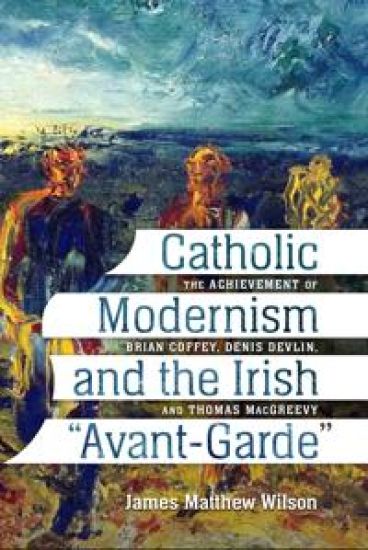
Catholic Modernism and the Irish "Avant-Garde
James Matthew Wilson
THE CATHOLIC UNIVERSITY OF AMERICA PRESS
2024
nidottu
This study constitutes the first-ever definitive account of the life and work of Irish modernist poets Thomas MacGreevy, Brian Coffey, and Denis Devlin. Apprenticed to the likes of W. B. Yeats, T. S. Eliot, James Joyce, and Samuel Beckett, all three writers worked at the center of modernist letters in England, France, and the United States, but did so from a distinctive perspective. All three writers wrote with a deep commitment to the intellectual life of Catholicism and saw the new movement in the arts as making possible for the first time a rich sacramental expression of the divine beauty in aesthetic form. MacGreevy spent his life trying to voice the Augustinian vision he found in The City of God. Coffey, a student of neo-Thomist philosopher Jacques Maritain, married scholastic thought and a densely wrought poetics to give form and solution to the alienation of modern life. Devlin contemplated the world with the eyes of Montaigne and the heart of Pascal as he searched for a poetry that could realize the divine presence in the experience of the modern person. Taken together, MacGreevy, Coffey, and Devlin exemplify the modern Catholic intellectual seeking to engage the modern world on its own terms while drawing the age toward fulfillment within the mystery and splendor of the Church. They stand apart from their Irish contemporaries for their religious seriousness and cosmopolitan openness of European modernism. They lay bare the theological potencies of modern art and do so with a sophistication and insight distinctive to themselves. Although MacGreevy, Coffey, and Devlin have received considerable critical attention in the past, this is the first book to study their work comprehensively, from MacGreevy's early poems and essays on Joyce and Eliot to Coffey's essays in the neo-scholastic philosophy of science, and on to Devlin's late poetic attempts to realize Dante's divine vision in a Europe shattered by war and modern doubt.

The Fortunes of Poetry in an Age of Unmaking
James Matthew Wilson
Wiseblood Books
2022
sidottu
Halvin toimitettuna 30,20 €
This brilliant new book powerfully demonstrates how the evolution of Modern and Post-Modern criticism and theory, free verse, and political ideology have greatly diminished contemporary poetry. The final chapter is a tour de force that compellingly argues for meter as the catalyst that joins syllables, accents, and (often) rhyme to create the deeply subtle artistry of our language's poetry." What is poetry and what is poetry for? To ask the first question is to ask the second. To answer both in light of the western tradition stretching back to Homer, and against much modernist and postmodernist poetic theory and practice, is the goal of this remarkable book. Poetry's final end is nothing less than to arouse in us a profound sense of wonder in coming to know that 'Reality as a whole is formed as the good-world-order, the intelligible beauty showing forth from the] cosmic circle of procession and return.'"-David Middleton, author of The Fiddler of Driskill Hill, in The American Conservative

The Strangeness of the Good, Including Quarantine Notebook
James Matthew Wilson
Angelico Press
2020
sidottu
The Strangeness of the Good, Including Quarantine Notebook
James Matthew Wilson
Angelico Press
2020
pokkari
Ours is an age full of desires but impoverished in its understanding of where those desires lead—an age that claims mastery over the world but also claims to find the world as a whole absurd or unintelligible. In The Vision of the Soul, James Matthew Wilson seeks to conserve the great insights of the western tradition by giving us a new account of them responsive to modern discontents. The western— or Christian Platonist— tradition, he argues, tells us that man is an intellectual animal, born to pursue the good, to know the true, and to contemplate all things in beauty. Wilson begins by reconceiving the intellectual conservatism born of Edmund Burke’s jeremiad against the French Revolution as an effort to preserve the West’s vision of man and the cosmos as ordered by and to beauty. After defining the achievement of that vision and its tradition, Wilson offers an extended study of the nature of beauty and the role of the fine arts in shaping a culture but above all in opening the human intellect to the perception of the form of reality. Through close studies of Theodor W. Adorno and Jacques Maritain, he recovers the classical vision of beauty as a revelation of truth and being. Finally, he revisits the ancient distinction between reason and story-telling, between mythos and logos, in order to rejoin the two. Story-telling is foundational to the forms of the fine arts, but it is no less foundational to human reason. Human life in turn constitutes a specific kind of form—a story form. The ancient conception of human life as a pilgrimage to beauty itself is one that we can fully embrace only if we see the essential correlation between reason and story and the essential convertibility of truth, goodness and beauty in beauty. By turns a study in fundamental ontology, aesthetics, and political philosophy, Wilson’s book invites its readers to a renewal of the West’s intellectual tradition.