

Kirjailija
James Mumford
Kirjat ja teokset yhdessä paikassa: 12 kirjaa, julkaisuja vuosilta 2007–2027, suosituimpiin kuuluu The Case Against Therapy. Vertaile teosten hintoja ja tarkista saatavuus suomalaisista kirjakaupoista.
12 kirjaa
Kirjojen julkaisuvuodet: 2007–2027.

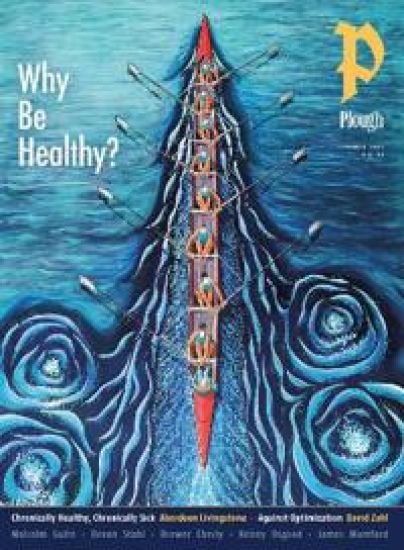
Plough Quarterly No. 44 – Why Be Healthy?
David Zahl; Malcolm Guite; Kelsey Osgood; Abraham Nussbaum; A. E. Stallings; Narine Abgaryan; John Swinton; Devan Stahl; James Mumford; Jessica T. Miskelly; Brewer Eberly; Aberdeen Livingstone; Terence Sweeney; Sam Tomlin; Hazel Thomson
PLOUGH PUBLISHING HOUSE
2025
nidottu
In an age of health care and wellness industries and near-religious pursuit of fitness and self-optimization, what does “health” mean for the chronically ill? For people with disabilities or mental health challenges or neurodiversity? For the aging and dying? This issue asks what it means to live well despite the limitations and frailties of our bodies, and what, beyond the scope of medicine, is needed for our flourishing. On this theme: Aberdeen Livingstone learns when to battle, and when to accept, chronic illness. Malcolm Guite defends the responsible use of pipe and pint. David Zahl calls out the wellness industry’s false promise of optimization. Abraham Nussbaum learns the limits of psychotherapy from his first patient. Cristiano Dennani photographs survivors of the Bhopal chemical spill in India. Heather M. Surls visits a tuberculosis hospital in Mafraq, Jordan. Brewer Eberly considers direct primary care, an attempt to reset the doctor-patient relationship. Devan Stahl considers what the wounds of the resurrected Christ mean for people with disabled bodies. Sam Tomlin wishes church and school weren’t such hurdles for children with autism. James Mumford finds the twelve steps of AA work when other approaches to addiction fail. Other articles in this issue: Jessica T. Miskelly, monitoring ocean currents on an icebreaker off Antarctica, feels the planet breathe. Kelsey Osgood visits a Jewish-Christian-Muslim interfaith center after October 7. Terence Sweeney profiles a repentant slaveholder, Bartolomé de las Casas. Plus: new poems by A. E. Stallings, short fiction by Narine Abgaryan, book reviews, and more. Plough Quarterly features stories, ideas, and culture for people eager to apply their faith to the challenges we face. Each issue includes in-depth articles, interviews, poetry, book reviews, and art.


Across the democratic West, politics has become deeply polarised and profoundly personal. Challenge someone’s political views and increasingly you challenge their very being. And yet, do our political tribes even make sense? Look carefully, and on the most important ethical issues of the age – assisted dying, social welfare, sexual liberation, abortion, gun control, the environment, technology, justice – the instinctive positions of both the Left and the Right are riven with contradictions. In this refreshing and eye-opening book, James Mumford, a public thinker and independent commentator, questions the basic assumptions of our political groups. His challenge is simple: ‘Why should believing strongly about one topic mean the automatic adoption of so many others?’ Vexed is an essential and provocative account that will appeal to anyone of independent thought, and a welcome call for new reflection on the moral issues most relevant to our modern way of life.



Many of the most controversial moral decisions we face hinge upon competing descriptions of life, and never is this truer than at the beginning of life. James Mumford draws upon phenomenology (a branch of continental philosophy) to question the descriptive adequacy, the essential 'purchase upon reality', of many of the approaches, attitudes and arguments which make up beginning of life ethics today. He argues that many of the most prevalent positions and practices in our late modern culture have simply failed to take into account the reality of human emergence, the particular way that new members of our species first appear in the world. Historically, phenomenologists have been far more interested in death than in birth. Mumford therefore first develops his own phenomenological investigation of human emergence, taking leads and developing approaches from phenomenologists both French and German, both living and dead. In the second half of the book phenomenology is finally applied to ethics, and acute moral questions are divided into two kinds: first those concerning 'what' it is that we are dealing; and, secondly, the more contextual 'where' questions relating to the situation in which the subject is found. Finally, although this book primarily constitutes a philosophical rather than a religious critique of contemporary ethics, with the findings from continental philosophy being brought to bear upon core convictions of English-speaking 'liberal' moral and political philosophers, Mumford concludes by exploring an alternative theological basis for human rights which might fill the vacuum created.
A Remembrance for the Living to Pray for the Dead
John Morris; James Mumford
Createspace Independent Publishing Platform
2014
nidottu

Many of the most controversial moral decisions we face hinge upon competing descriptions of life, and never is this truer than at the beginning of life. James Mumford draws upon phenomenology (a branch of continental philosophy) to question the descriptive adequacy, the essential 'purchase upon reality', of many of the approaches, attitudes and arguments which make up beginning of life ethics today. He argues that many of the most prevalent positions and practices in our late modern culture have simply failed to take into account the reality of human emergence, the particular way that new members of our species first appear in the world. Historically, phenomenologists have been far more interested in death than in birth. Mumford therefore first develops his own phenomenological investigation of human emergence, taking leads and developing approaches from phenomenologists both French and German, both living and dead. In the second half of the book phenomenology is finally applied to ethics, and acute moral questions are divided into two kinds: first those concerning 'what' it is that we are dealing; and, secondly, the more contextual 'where' questions relating to the situation in which the subject is found. Finally, although this book primarily constitutes a philosophical rather than a religious critique of contemporary ethics, with the findings from continental philosophy being brought to bear upon core convictions of English-speaking 'liberal' moral and political philosophers, Mumford concludes by exploring an alternative theological basis for human rights which might fill the vacuum created.
A Remembrance For The Living To Pray For The Dead (1871)
James Mumford
KESSINGER PUBLISHING, LLC
2008
sidottu

A Remembrance For The Living To Pray For The Dead
James Mumford; John (CON) Morris
Kessinger Pub
2007
pokkari