Kirjojen hintavertailu – 12 903 725 kirjaa ja 27 kauppaa
Kirjailija
James Murdock
Kirjat ja teokset yhdessä paikassa: 21 kirjaa, julkaisuja vuosilta 2001–2025, suosituimpiin kuuluu The History of Christianity. From the Birth of Christ to the Abolition of Paganism in the Roman Empire. Vertaile teosten hintoja ja tarkista saatavuus suomalaisista kirjakaupoista.
Reprint of the original, first published in 1871. The publishing house Anatiposi publishes historical books as reprints. Due to their age, these books may have missing pages or inferior quality. Our aim is to preserve these books and make them available to the public so that they do not get lost.
Reprint of the original, first published in 1871. The publishing house Anatiposi publishes historical books as reprints. Due to their age, these books may have missing pages or inferior quality. Our aim is to preserve these books and make them available to the public so that they do not get lost.
This work has been selected by scholars as being culturally important and is part of the knowledge base of civilization as we know it. This work is in the public domain in the United States of America, and possibly other nations. Within the United States, you may freely copy and distribute this work, as no entity (individual or corporate) has a copyright on the body of the work. Scholars believe, and we concur, that this work is important enough to be preserved, reproduced, and made generally available to the public. To ensure a quality reading experience, this work has been proofread and republished using a format that seamlessly blends the original graphical elements with text in an easy-to-read typeface. We appreciate your support of the preservation process, and thank you for being an important part of keeping this knowledge alive and relevant.
The Definitive, Comprehensive Guide to Cutting-Edge Millimeter Wave Wireless Design “This is a great book on mmWave systems that covers many aspects of the technology targeted for beginners all the way to the advanced users. The authors are some of the most credible scholars I know of who are well respected by the industry. I highly recommend studying this book in detail.”—Ali Sadri, Ph. D., Sr. Director, Intel Corporation, MCG mmWave Standards and Advanced Technologies Millimeter wave (mmWave) is today’s breakthrough frontier for emerging wireless mobile cellular networks, wireless local area networks, personal area networks, and vehicular communications. In the near future, mmWave applications, devices, and networks will change our world. In Millimeter Wave Wireless Communications, four of the field’s pioneers, including Theodore S. Rappaport, Robert W. Heath, Robert C. Daniels, and James N. Murdock, draw on their vast experience to empower engineers at all levels to succeed with mmWave. They deliver fundamental, end-to-end coverage of all aspects of future mmWave wireless communications systems. The authors explain new multi-Gigabit per second products and applications, mmWave signal propagation, analog and digital circuit design, mmWave antenna designs, and current and emerging wireless standards. They cover comprehensive mmWave wireless design issues for 60 GHz and other mmWave bands, from channel to antenna to receiver, introducing emerging design techniques that will be invaluable for research engineers in both industry and academia. Topics include Digital communication: baseband signal/channel models, modulation, equalization, error control coding, multiple input multiple output (MIMO) principles, and hardware architectures Radio wave propagation characteristics: indoor and outdoor channel models and beam combining Antennas/antenna arrays, including on-chip and in-package antennas, fabrication, and packaging Analog circuit design: mmWave transistors, fabrication, and transceiver design approaches Baseband circuit design: multi–gigabit-per-second, high-fidelity DAC and ADC converters Physical layer: algorithmic choices, design considerations, and impairment solutions; and how to overcome clipping, quantization, and nonlinearity Higher-layer design: beam adaptation protocols, relaying, multimedia transmission, and multiband considerations 60 GHz standardization: IEEE 802.15.3c for WPAN, Wireless HD, ECMA-387, IEEE 802.11ad, Wireless Gigabit Alliance (WiGig)
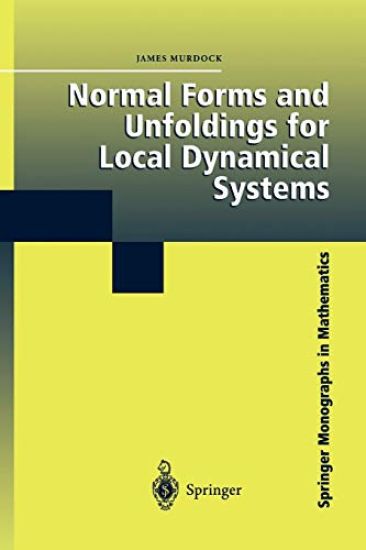
The subject of local dynamical systems is concerned with the following two questions: 1. Given an n×n matrix A, describe the behavior, in a neighborhood of the origin, of the solutions of all systems of di?erential equations having a rest point at the origin with linear part Ax, that is, all systems of the form x ? = Ax+··· , n where x? R and the dots denote terms of quadratic and higher order. 2. Describethebehavior(neartheorigin)ofallsystemsclosetoasystem of the type just described. To answer these questions, the following steps are employed: 1. A normal form is obtained for the general system with linear part Ax. The normal form is intended to be the simplest form into which any system of the intended type can be transformed by changing the coordinates in a prescribed manner. 2. An unfolding of the normal form is obtained. This is intended to be the simplest form into which all systems close to the original s- tem can be transformed. It will contain parameters, called unfolding parameters, that are not present in the normal form found in step 1. vi Preface 3. The normal form, or its unfolding, is truncated at some degree k, and the behavior of the truncated system is studied.
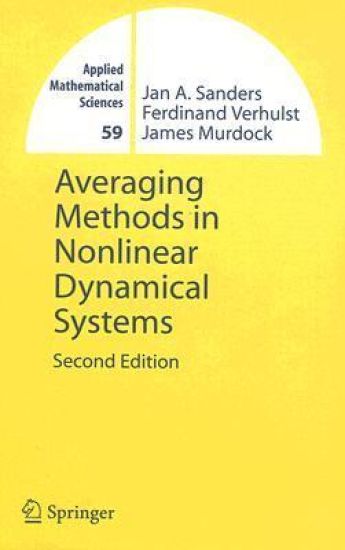
Perturbation theory and in particular normal form theory has shown strong growth during the last decades. So it is not surprising that the authors have presented an extensive revision of the first edition of the Averaging Methods in Nonlinear Dynamical Systems book. There are many changes, corrections and updates in chapters on Basic Material and Asymptotics, Averaging, and Attraction. Chapters on Periodic Averaging and Hyperbolicity, Classical (first level) Normal Form Theory, Nilpotent (classical) Normal Form, and Higher Level Normal Form Theory are entirely new and represent new insights in averaging, in particular its relation with dynamical systems and the theory of normal forms. Also new are surveys on invariant manifolds in Appendix C and averaging for PDEs in Appendix E. Since the first edition, the book has expanded in length and the third author, James Murdock has been added. Review of First Edition "One of the most striking features of the book is the nice collection of examples, which range from the very simple to some that are elaborate, realistic, and of considerable practical importance. Most of them are presented in careful detail and are illustrated with profuse, illuminating diagrams." - Mathematical Reviews
Perturbation theory and in particular normal form theory has shown strong growth during the last decades. So it is not surprising that the authors have presented an extensive revision of the first edition of the Averaging Methods in Nonlinear Dynamical Systems book. There are many changes, corrections and updates in chapters on Basic Material and Asymptotics, Averaging, and Attraction. Chapters on Periodic Averaging and Hyperbolicity, Classical (first level) Normal Form Theory, Nilpotent (classical) Normal Form, and Higher Level Normal Form Theory are entirely new and represent new insights in averaging, in particular its relation with dynamical systems and the theory of normal forms. Also new are surveys on invariant manifolds in Appendix C and averaging for PDEs in Appendix E. Since the first edition, the book has expanded in length and the third author, James Murdock has been added. Review of First Edition "One of the most striking features of the book is the nice collection of examples, which range from the very simple to some that are elaborate, realistic, and of considerable practical importance. Most of them are presented in careful detail and are illustrated with profuse, illuminating diagrams." - Mathematical Reviews
The subject of local dynamical systems is concerned with the following two questions: 1. Given an n×n matrix A, describe the behavior, in a neighborhood of the origin, of the solutions of all systems of di?erential equations having a rest point at the origin with linear part Ax, that is, all systems of the form x ? = Ax+··· , n where x? R and the dots denote terms of quadratic and higher order. 2. Describethebehavior(neartheorigin)ofallsystemsclosetoasystem of the type just described. To answer these questions, the following steps are employed: 1. A normal form is obtained for the general system with linear part Ax. The normal form is intended to be the simplest form into which any system of the intended type can be transformed by changing the coordinates in a prescribed manner. 2. An unfolding of the normal form is obtained. This is intended to be the simplest form into which all systems close to the original s- tem can be transformed. It will contain parameters, called unfolding parameters, that are not present in the normal form found in step 1. vi Preface 3. The normal form, or its unfolding, is truncated at some degree k, and the behavior of the truncated system is studied.