Kirjojen hintavertailu – 12 903 735 kirjaa ja 27 kauppaa

Kirjailija

James P. Barber

Kirjat ja teokset yhdessä paikassa: 10 kirjaa, julkaisuja vuosilta 2015–2024, suosituimpiin kuuluu Facilitating the Integration of Learning. Vertaile teosten hintoja ja tarkista saatavuus suomalaisista kirjakaupoista.

10 kirjaa

Kirjojen julkaisuvuodet: 2015–2024.

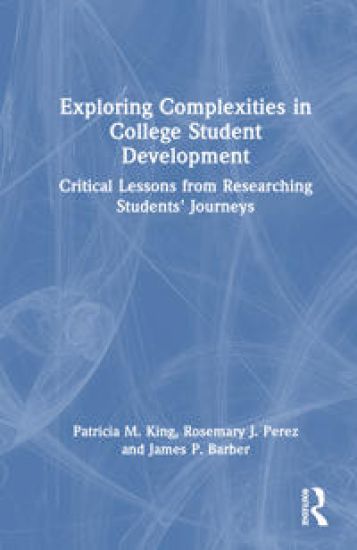
Exploring Complexities in College Student Development

Exploring Complexities in College Student Development

Patricia M. King; Rosemary J. Perez; James P. Barber

TAYLOR FRANCIS INC
2024
sidottu
This book explores how college students address life challenges and develop the self-authoring capacities needed to deal with the ambiguities and complexities of life after graduation. Based on the in-depth interview portion of the Wabash National Study of Liberal Arts Education, this book draws on almost 1,000 interviews with a diverse cohort of 315 students from six institutions over 4 years. It traces these students’ journeys, documenting the wide variety of pathways they followed, the range of contexts in which their experiences took place, the liberal education outcomes associated with these experiences, and the factors that affected quality and impact. The authors critique current student development theory and offer a new interactionist model to guide future study in the field, inviting readers to adopt five habits of mind to guide their praxis and practice to promote student development. This valuable resource is written for educators working in higher education institutions – both faculty and student affairs professionals – who want to help students get the most out of their college experience.
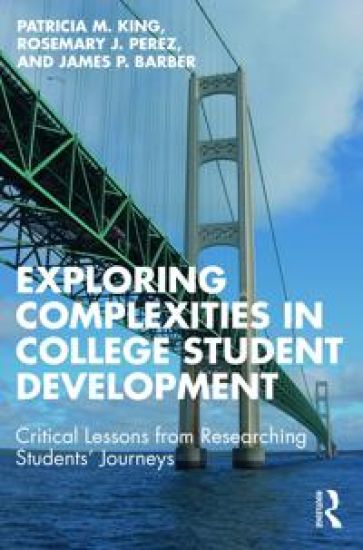
Exploring Complexities in College Student Development

Exploring Complexities in College Student Development

Patricia M. King; Rosemary J. Perez; James P. Barber

TAYLOR FRANCIS INC
2024
nidottu
This book explores how college students address life challenges and develop the self-authoring capacities needed to deal with the ambiguities and complexities of life after graduation. Based on the in-depth interview portion of the Wabash National Study of Liberal Arts Education, this book draws on almost 1,000 interviews with a diverse cohort of 315 students from six institutions over 4 years. It traces these students’ journeys, documenting the wide variety of pathways they followed, the range of contexts in which their experiences took place, the liberal education outcomes associated with these experiences, and the factors that affected quality and impact. The authors critique current student development theory and offer a new interactionist model to guide future study in the field, inviting readers to adopt five habits of mind to guide their praxis and practice to promote student development. This valuable resource is written for educators working in higher education institutions – both faculty and student affairs professionals – who want to help students get the most out of their college experience.

The Blacksmith

The Blacksmith

James P. Barber

Other Road Publishing
2020
nidottu
A ten-year-old German immigrant comes of age in the town of La Porte, Indiana, in the early years of the 20th century. In his youth, Carl develops his talents as a blacksmith. His ability to visualize solutions leads him to become part of key development teams at the Rumely Company and, later, at Allis-Chalmers. Regrettably, his expertise at work is weighed against alcoholism and some bad choices. Looming over his weakness for drink is a German spy ring specifically targeting Carl to obtain plans for a secret project under development for the impending war. Unfortunately, Carl becomes embroiled in a situation which makes him appear to be a Nazi spy to his co-workers. In the events that follow, Carl is placed in grave danger while his past comes flashing back to him. The setting in La Porte treats the reader to some historical background of the town, including the Rumely Company and the Allis-Chalmers Corporation. With the backdrop of the imminent outbreak of World War II, the reader is given a glimpse into the actual German Duquense Spy Ring that infiltrated the United States at that time.
Facilitating the Integration of Learning

Facilitating the Integration of Learning

James P. Barber

Stylus Publishing
2020
sidottu
Students’ ability to integrate learning across contexts is a critical outcome for higher education. Often the most powerful learning experiences that students report from their college years are those that prompt integration of learning, yet it remains an outcome that few educators explicitly work towards or specify as a course objective. Given that students will be more successful in college (and in life) if they can integrate their learning, James Barber offers a guide for college educators on how to promote students’ integration of learning, and help them connect knowledge and insights across contexts, whether in-class or out-of-class, in co-curricular activities, or across courses and disciplinary boundaries. The opening chapters lay the foundation for the book, defining what integration of learning is, how to promote it and students’ capacities for reflection; and introduce the author’s research-based Integration of Learning (IOL) model. The second section of the book provides practical, real-world strategies for facilitating integration of learning that college educators can use right away in multiple learning contexts. James Barber describes practices that readers can integrate as appropriate in their classes or activities, under chapters respectively devoted to Mentoring, Writing as Praxis, Juxtaposition, Hands-On Experiences, and Diversity and Identity. The author concludes by outlining how to apply IOL to a multiplicity of settings, such as a major, a single course, programming for a student organization, or other co-curricular experience; as well as offering guidance on assessing and documenting students’ mastery of this outcome. This book is addressed to a wide range of educators engaged with college student learning, from faculty to student affairs administrators, athletic coaches, internship supervisors, or anyone concerned with student development.
Facilitating the Integration of Learning

Facilitating the Integration of Learning

James P. Barber

Stylus Publishing
2020
nidottu
Students’ ability to integrate learning across contexts is a critical outcome for higher education. Often the most powerful learning experiences that students report from their college years are those that prompt integration of learning, yet it remains an outcome that few educators explicitly work towards or specify as a course objective. Given that students will be more successful in college (and in life) if they can integrate their learning, James Barber offers a guide for college educators on how to promote students’ integration of learning, and help them connect knowledge and insights across contexts, whether in-class or out-of-class, in co-curricular activities, or across courses and disciplinary boundaries. The opening chapters lay the foundation for the book, defining what integration of learning is, how to promote it and students’ capacities for reflection; and introduce the author’s research-based Integration of Learning (IOL) model. The second section of the book provides practical, real-world strategies for facilitating integration of learning that college educators can use right away in multiple learning contexts. James Barber describes practices that readers can integrate as appropriate in their classes or activities, under chapters respectively devoted to Mentoring, Writing as Praxis, Juxtaposition, Hands-On Experiences, and Diversity and Identity. The author concludes by outlining how to apply IOL to a multiplicity of settings, such as a major, a single course, programming for a student organization, or other co-curricular experience; as well as offering guidance on assessing and documenting students’ mastery of this outcome. This book is addressed to a wide range of educators engaged with college student learning, from faculty to student affairs administrators, athletic coaches, internship supervisors, or anyone concerned with student development.
Hill of the Bear

Hill of the Bear

James P. Barber

Other Road Publishing
2019
nidottu
Fourteen-year-old Clay Beckley comes of age in the Great American West in the 1890s. Leaving his home in La Porte, Indiana, Clay hops trains heading west to join in an expedition to study the flora and fauna of the San Francisco Peaks of Arizona. This undertaking is headed by Dr. C. Hart Merriam, recently appointed head of what would become the Bureau of Biological Survey, the forerunner of today's U. S. Fish and Wildlife Service. These rugged naturalists and scientists would battle . . . . . . THE ELEMENTS . . . "Suddenly, from around the bend to the west came a wall of muddy water that was well over ten feet high. The two braced themselves as best as they could as they were pounded into the river by the powerful wall of murky water. Thrown under the water, Clay was not sure which way was up. He swirled in a mass of confusion trying to right himself.". . . NATURE . . . "As the bear reared to come down again on him, Carlos managed to roll away from under the bear. The bear's right front paw tore a bit of Carlos' back as he rolled away. Carlos screamed, 'Clay '". . . DISEASE . . . "'Clay, I think you have consumption.' Another momentary pause to let his diagnosis sink in. 'Do you know what consumption is, Clay' Dr. Merriam's tone was caring and sympathetic. Do I know? Yes, it's a death sentence Clay tried to hide the thoughts that were filling him with fear.". . . AND MAN HIMSELF . . . "Clay did not see the nod from Black Jack Ketchum, but once again Ben delivered a severe blow to Clay's stomach. This time, however, before Clay could hit the ground, Ben delivered a second blow from underneath that caught Clay's chin and sent him lurching backwards."
The Hilgendorf-Haag Connection

The Hilgendorf-Haag Connection

James P. Barber

Other Road Publishing
2018
nidottu
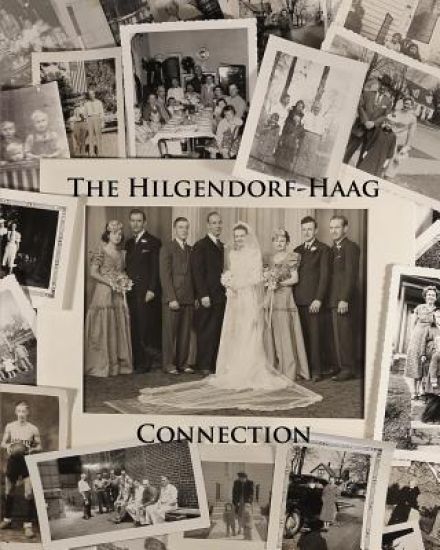
Both the Hilgendorf and the Haag families arrived in the United States from Germany. They were, however, from very different areas. The Hilgendorfs immigrated from northeast Germany, while the Haags came from southwestern Germany. Until 1871, however, Germany as a nation did not exist. In 1871, German states united to create the German Empire under Prussian leadership. Prior to that time, the area that contains today's Germany was known as the Kingdom of Prussia. The Hilgendorfs appear to have come to America about 1856, while the Haags arrived a bit earlier, about 1841. Exact points of entry into the United States are not known; however, most Germans immigrating at the time the Hilgendorfs did would have come to the Midwest with many going to Ohio, Wisconsin, Indiana and Missouri. By 1880, Wisconsin had more German Americans than any other state. And, in fact, the research finds many Hilgendorfs in these areas in the 1850-1880 time-frame. The Hilgendorf family comes from an area of Germany known today as Mecklenburg, or Mecklenburg-Vorpommern. Nearly every Hilgendorf located during the research was from this area of Germany. Mecklenburg is located in northeast Germany on the Baltic Sea. Traditionally, Mecklenburg has always been one of the poorer German areas. The ancestry of the Haag family begins with Hans Martin Hag born in 1647 in Durlach, Stadt Karlsruhe, Baden-Wuerttemberg, Germany. The western part of this territory bounced back and forth between Germany and France, eventually ending up in Germany. The Haags moved just a bit west from Wuerttemberg to the state of Saarland. This area is contiguous to Alsace-Lorraine, France. The Hilgendorf and Haag families are followed in this genealogy until they come together in 1940 with the marriage of Clarence "Dutch" Hilgendorf and Leatha Haag in La Porte, Indiana. The family history is told with documents, stories and photos following the direct line of descent leading to the union of Clarence and Leatha.