Kirjojen hintavertailu – 12 859 829 kirjaa ja 27 kauppaa

Kirjailija

James Penner

Kirjat ja teokset yhdessä paikassa: 8 kirjaa, julkaisuja vuosilta 1997–2012, suosituimpiin kuuluu Introduction to Jurisprudence and Legal Theory. Vertaile teosten hintoja ja tarkista saatavuus suomalaisista kirjakaupoista.

8 kirjaa

Kirjojen julkaisuvuodet: 1997–2012.

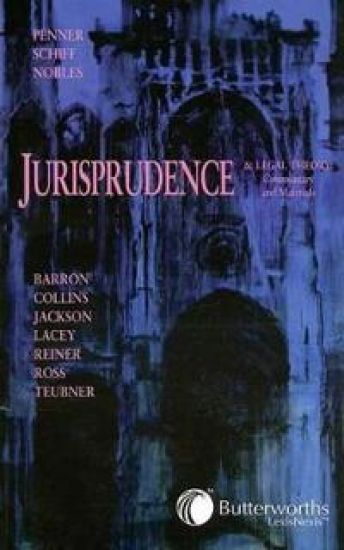
Introduction to Jurisprudence and Legal Theory

Introduction to Jurisprudence and Legal Theory

Anne Barron; Hugh Collins; Emily Jackson; Nicola Lacey; Robert Reiner; Hamish Ross; Gunther Teubner; James Penner

LexisNexis UK
2002
nidottu
This text lays out a course of study combining the traditional subject matter of jurisprudence with a series of introductions to a variety of other theoretical perspectives. It is designed for those taking jurisprudence/legal theory courses, and political science, philosophy and sociology students.

McCoubrey & White's Textbook on Jurisprudence

McCoubrey & White's Textbook on Jurisprudence

James Penner; Emmanuel Melissaris

Oxford University Press
2012
nidottu

Halvin toimitettuna 93,60 €

Fully updated and revised by James Penner and Emmanuel Melissaris, McCoubrey & White's Textbook on Jurisprudence clearly breaks down the complexities of this often daunting yet fascinating subject. Sophisticated ideas are explained concisely and with clarity, ensuring the reader is aware of the subtleties of the subject yet not overwhelmed. With chapters dedicated to both key concepts and leading theorists, this text takes a wide-ranging look at jurisprudence and places central ideas in context. In particular this text centres around one of the leading theorists, H. L. A Hart, and considers the landscape of jurisprudence in relation to his seminal The Concept of Law, looking at the key ideas which influenced him and considering the response to his work. Coverage of post-modern and feminist legal theory is also included, alongside discussion of key theorists such as Hobbes, Kant, and Rawls. Logically organised to support the topics commonly taught on jurisprudence and legal theory courses, this text provides an easy-to-follow and digestible account of this wide-ranging subject, making it the ideal companion text for further reading and research throughout your course.
Pinks, Pansies, and Punks

Pinks, Pansies, and Punks

James Penner

Indiana University Press
2010
pokkari
Pinks, Pansies, and Punks charts the construction of masculinity within American literary culture from the 1930s to the 1970s. Penner documents the emergence of "macho criticism," and explores how debates about "hard" and "soft" masculinity influenced the class struggles of the 1930s, anti-communism in the 1940s and 1950s, and the clash between the Old Left and the New Left in the 1960s. By extending literary culture to include not just novels, plays, and poetry, but diaries, journals, manifestos, screenplays, and essays on psychology and sociology, Penner unveils the multiplicity of gender attitudes that emerge in each of the decades he addresses.
Consuming Youth

Consuming Youth

John Berard; James Penner; Rick Bartlett

Zondervan
2010
nidottu
Today’s relentless, consumer culture—dominated by popular media’s emphasis on bigger, better, and more, and catering to teenagers’ every want and desire—is leaving our youth adrift in a sea of conflicting messages. Messages that youth workers and faith communities need to decode and redirect from consumption as the primary purpose of youth. Consuming Youth explores the shifts needed to move from the fragmented, isolated and consumer driven story for youth and towards a more compelling story of meaning, purpose and a life lived differently than the one served up by consumer culture. If you’re involved in the lives of teenagers, whether as a youth pastor, youth worker, volunteer, church leader, parent, or students of youth ministry, you’ll want to read this book to discover how a culturally invented and socially accepted version of adolescence, sustained by consumer culture, has shaped youth work and through the suggestions offered work together to discover ways in which you can re-imagine youth ministry and what it means to be a teenager.
The Law Student's Dictionary

The Law Student's Dictionary

James Penner

Oxford University Press
2008
nidottu
The Law Student's Dictionary is an invaluable reference work for all law students. The terms have been chosen with the specific needs of the undergraduate student in mind, providing a full insight into legal terminology and ensuring students are familiar with terms they will encounter during their studies. The dictionary includes substantial entries on core student topics which outline the conceptual importance of key areas, to give students an idea of how these terms have been shaped by, and in turn shape, how lawyers think. Some older terms are also included, as although they are not used to frame the current law, students will come across them in the course of their studies and they are of historical significance. The text features cross-referencing of terms and definitions, giving students the opportunity to expand and contextualise their knowledge, and the material is presented in a new two-colour page design, which allows for quick and easy navigation.
The Idea of Property in Law

The Idea of Property in Law

James Penner

Oxford University Press
2000
nidottu
Of importance for both philosophers and legal theorists interested in the nature of property, this book vindicates the commonsense idea that the right to property is a right to things. Distinguishing between the `practice' of property and the `practice' of contract is essential for a proper understanding, but the failure to do so is common. As the author shows, it mars both Locke's and Hegel's philosophies of property, and continues to contribute to confusion. It also obscures the central element of sharing and giving in the ownership of property, the important of which has been generally neglected. Perhaps most controversially, the author argues that the justification of the right to property is not dependent on the justice of the reigning distribution of property–that is a question which concerns the justice of the economy–gift, command, market, or mixed–that distributes all values, not just rights in property. The important `distributional' question about property is this: to what values does the property practice apply? Why does it apply to castles and cars, books and bank balances, but not to our body parts and our labour, nor to our employment contracts and our sexuality? In answer the author develops a distinction between persons and our personality-rich relationships which cannot be objects of property, and `things', both land and objects and personality-poor relationships like debts, which can.
The Idea of Property in Law

The Idea of Property in Law

James Penner

Clarendon Press
1997
sidottu
In The Idea of Property in Law, Penner considers the concept of property and its place in the legal environment. Penner proposes that the idea of property as a "bundle of rights" - the right to possess, the right to use, the right to destroy etc. - is deficient as a concept, failing to effectively characterise any particular sort of legal relation, and evading attempts to decide which rights are critical to the "bundle". Through a thorough exploration of property rules, property rights, and the interests which property serves and protects, Penner develops an alternative interpretation and goes on to consider how property interacts with the broader legal system.