Kirjailija
James Petras
Kirjat ja teokset yhdessä paikassa: 28 kirjaa, julkaisuja vuosilta 1973–2026, suosituimpiin kuuluu System In Crisis. Vertaile teosten hintoja ja tarkista saatavuus suomalaisista kirjakaupoista.
28 kirjaa
Kirjojen julkaisuvuodet: 1973–2026.
First published in 1992, Latin America in the Time of Cholera questions many ideas regarding the advent of a new era of democracy, peace, and north-south cooperation for development in the post-Cold War period by challenging several myths that shape United States policy toward Latin America. James Petras and Morris Morley trenchantly argue that electoral regimes and free markets in the hemisphere have not improved people’s lives, that Washington’s neo-conservative allies do not have a viable future, and that the end of the Cold War has not lessened U. S. interventionist behavior in Latin America. This book utilizes empirical and historical analyses and provides a unique interpretive framework that focuses on U. S. involvement in the so-called democraticization of Latin America. It also presents a lively combination of both case studies and critiques of contemporary power relations. This compelling account of Latin America will be an invaluable resource for academics, policymakers, journalists, and anyone who wishes to make sense of tumultuous events in this region.
Politics and Social Forces in Chilean Development
James Petras
University of California Press
2021
sidottu
Chile, which suffering from many of the same social and economic problems that afflict other Latin American countries, has enjoyed remarkable political stability. With the exception of one brief interlude, Chile has been governed by elected rules for half a century. The feature of Chilean development that explains its exceptional nature in contrast to the rest of Latin America is the special role of the bureaucracy, which functions as a broker for the conflicting demands of both the new and the traditional groups. Yet a strong dichotomy is evident between the entrepreneurial and bureaucratic elites, which have benefited and participated in the dominant society, and the peasantry, which has been largely exploited and excluded from the polity. Petras finds that the attempts to develop a dynamic industrial society in Chile have so far ailed. Chronic problems of slow economic growth and a rigid social system have been managed through a delicate system of political balances involving established parties and interest groups. While this arrangement has contributed to Chile's stability, it has also served to delay the entry of the peasantry and urban lower class into the polity, and as these groups do enter the political arena, they do so as radicals, increasingly hostile to established leaders and institutions. Working with fresh data, Petras considers virtually every aspect of Chile's social, political, and economic development, including industrialization and the roles of the right wing, the middle class, the peasantry, and the bureaucracy; and he gives detailed consideration to the programs and behavior of the Popular Action Front (FRAP) and the Christian Democratic party. In his final chapter,the author hazards a number of predictions concerning the future course of Chilean politics. He anticipates that the present trend toward basic social change will continue and that this will include limitation of the powers and prerogatives of the rich, a greater role for the government in planning and directing the economy, and some outright expropriation. In the long run, a realignment of major politcal forces is probably, with the likely result that opposition to reform will increase. The heavy involvement of North American firms in the Chilean copper-mining industry could lead to a conflict between a national-popular government in the United States. This title is part of UC Press's Voices Revived program, which commemorates University of California Press's mission to seek out and cultivate the brightest minds and give them voice, reach, and impact. Drawing on a backlist dating to 1893, Voices Revived makes high-quality, peer-reviewed scholarship accessible once again using print-on-demand technology. This title was originally published in 1969.

This book explores the dynamics of the recent ‘progressive cycle’ in Latin American politics, associated with a red and pink tide of regime change. With this cycle of centre-left regimes oriented towards an alternative post-neoliberal form of development now coming to an end, coinciding with the end of a ‘primary commodities boom’ (the demand for natural resources exported in primary form on the world market), the authors seek to explore the dynamics of the transition from a progressive cycle of regimes oriented towards the search for a more inclusive form of development towards what appears to be another swing in the pendulum of electoral politics towards the far right and a return to neoliberal orthodoxy. Within the vortex of forces of change pushing towards both the Left and the Right, Latin America lies at the centre of ongoing heated theoretical and political debates as to how to bring about a more inclusive and sustainable form of post-neoliberal and post-capitalist development. Latin America in the Vortex of Social Change crucially aims to cut through these debates and explore the dynamics of the forces of change at work in the current conjuncture of capitalist development. With reference to a theoretical framework based on the interaction of three different forms of capitalism (capitalism as usual, extractive capitalism, narco-capitalism), the authors proceed to an analysis of the development and resistance dynamics of the development process that is unfolding on the Latin American political landscape. The book will appeal to scholars of political sociology and political theory with an interest in the political economy of development and Latin American affairs.
This book helps readers to understand the relationship between democracy and poverty in Chile. It suggests that a comprehensive understanding of Chile's history requires a critical reassessment of the relationship between the export-oriented economic model and electoral politics. .
Politics and Social Forces in Chilean Development
James Petras
University of California Press
2020
pokkari
Chile, which suffering from many of the same social and economic problems that afflict other Latin American countries, has enjoyed remarkable political stability. With the exception of one brief interlude, Chile has been governed by elected rules for half a century. The feature of Chilean development that explains its exceptional nature in contrast to the rest of Latin America is the special role of the bureaucracy, which functions as a broker for the conflicting demands of both the new and the traditional groups. Yet a strong dichotomy is evident between the entrepreneurial and bureaucratic elites, which have benefited and participated in the dominant society, and the peasantry, which has been largely exploited and excluded from the polity. Petras finds that the attempts to develop a dynamic industrial society in Chile have so far ailed. Chronic problems of slow economic growth and a rigid social system have been managed through a delicate system of political balances involving established parties and interest groups. While this arrangement has contributed to Chile's stability, it has also served to delay the entry of the peasantry and urban lower class into the polity, and as these groups do enter the political arena, they do so as radicals, increasingly hostile to established leaders and institutions. Working with fresh data, Petras considers virtually every aspect of Chile's social, political, and economic development, including industrialization and the roles of the right wing, the middle class, the peasantry, and the bureaucracy; and he gives detailed consideration to the programs and behavior of the Popular Action Front (FRAP) and the Christian Democratic party. In his final chapter,the author hazards a number of predictions concerning the future course of Chilean politics. He anticipates that the present trend toward basic social change will continue and that this will include limitation of the powers and prerogatives of the rich, a greater role for the government in planning and directing the economy, and some outright expropriation. In the long run, a realignment of major politcal forces is probably, with the likely result that opposition to reform will increase. The heavy involvement of North American firms in the Chilean copper-mining industry could lead to a conflict between a national-popular government in the United States. This title is part of UC Press's Voices Revived program, which commemorates University of California Press's mission to seek out and cultivate the brightest minds and give them voice, reach, and impact. Drawing on a backlist dating to 1893, Voices Revived makes high-quality, peer-reviewed scholarship accessible once again using print-on-demand technology. This title was originally published in 1969.

The Left Strikes Back addresses the neglected topic of popular resistance to capital globalization and neoliberal polices, and considers the future of the revolutionary left in this region. James Petras shows that the current stage of capital globalization and the weakening of the ability of established popular groups to defend themselves have gene
This book offers a broad and deep examination of the dynamics of US imperialism. Petras analyzes imperialism not only as economic domination, showing that its impact in the world takes many forms, including cultural, political and historical. He points to the disruptive effects it has on other world regional economies and cultures. Capitalism and imperialism take diverse forms but both are intimately tied to the projection of state power in the service of capital—a strategy designed to advance the geopolitical and economic interests of the US economic elite and ruling class—interests that are equated with the 'US national interest'.
The critical issues concerning the development of a substantial and enduring democracy in Chile are those of strengthening civil society, democratizing the permanent institutions of the state, and building an economy geared to effectively satisfy human needs. In this book, the authors offer a critique of the Chilean transition and of the Aylwin electoral regime, analyzing the linkage between political compromises made prior to the civilians’ assumption of power and the choice of socioeconomic policy in the post-electoral period. They argue that the decisive factor underlying the Chilean transition is the contrast between the legal-political changes and socioeconomic and institutional continuities, a contrast that perpetuates the vast inequalities of wealth and power generated under Pinochet’s sixteen-year-old military dictatorship. They also challenge the myth of the “Chilean miracle‗the purported success of neoliberal policies in promoting sustained growth and social justice—and therefore in laying the basis for long-term social harmony and enduring political stability.
This book explores the dynamics of the recent ‘progressive cycle’ in Latin American politics, associated with a red and pink tide of regime change. With this cycle of centre-left regimes oriented towards an alternative post-neoliberal form of development now coming to an end, coinciding with the end of a ‘primary commodities boom’ (the demand for natural resources exported in primary form on the world market), the authors seek to explore the dynamics of the transition from a progressive cycle of regimes oriented towards the search for a more inclusive form of development towards what appears to be another swing in the pendulum of electoral politics towards the far right and a return to neoliberal orthodoxy. Within the vortex of forces of change pushing towards both the Left and the Right, Latin America lies at the centre of ongoing heated theoretical and political debates as to how to bring about a more inclusive and sustainable form of post-neoliberal and post-capitalist development. Latin America in the Vortex of Social Change crucially aims to cut through these debates and explore the dynamics of the forces of change at work in the current conjuncture of capitalist development. With reference to a theoretical framework based on the interaction of three different forms of capitalism (capitalism as usual, extractive capitalism, narco-capitalism), the authors proceed to an analysis of the development and resistance dynamics of the development process that is unfolding on the Latin American political landscape. The book will appeal to scholars of political sociology and political theory with an interest in the political economy of development and Latin American affairs.
Imperialism and Capitalism in the Twenty-First Century
James Petras; Henry Veltmeyer; Humberto Márquez
Routledge
2018
nidottu
We live in a time of dynamic, but generally regressive regime change-a period in which major political transformations and a rollback of a half-century of legislation are accelerated under conditions of a prolonged and deepening economic crisis and a worldwide offensive against the citizenry and the working class. Written by two of the world’s leading left-wing thinkers, Imperialism and Capitalism in the Twenty-First Century takes the form of a number of analytical probes into some of the dynamics of capitalist development and imperialism in contemporary conditions of a system in crisis. It is too early to be definitive about the form that capitalism and imperialism -and socialism-might be or is taking, as we are in but the early stages of a new developmental dynamic, the conditions of which are too complex to anticipate or grasp in thought; they require a closer look and much further study from a critical development and Marxist perspective. The purpose of this book is to advance this process and give some form to this perspective.
Power And Resistance: US Imperialism In Latin America
James Petras; Henry Veltmeyer
Haymarket Books
2017
nidottu
This book concerns the form taken today by US imperialism in Latin America, with reference to the projection of US state power as a means of both advancing the economic interests of the US capitalist class in the region and maintaining its hegemony over the world capitalist system.
The Class Struggle in Latin America: Making History Today analyses the political and economic dynamics of development in Latin America through the lens of class struggle. Focusing in particular on Peru, Paraguay, Chile, Colombia, Argentina, Brazil and Venezuela, the book identifies how the shifts and changing dynamics of the class struggle have impacted on the rise, demise and resurgence of neo-liberal regimes in Latin America. This innovative book offers a unique perspective on the evolving dynamics of class struggle, engaging both the destructive forces of capitalist development and those seeking to consolidate the system and preserve the status quo, alongside the efforts of popular resistance concerned with the destructive ravages of capitalism on humankind, society and the global environment. Using theoretical observations based on empirical and historical case studies, this book argues that the class struggle remains intrinsically linked to the march of capitalist development. At a time when post-neo-liberal regimes in Latin America are faltering, this supplementary text provides a guide to the economic and political dynamics of capitalist development in the region, which will be invaluable to students and researchers of international development, anthropology and sociology, as well as those with an interest in Latin American politics and development.
Imperialism and Capitalism in the Twenty-First Century
James Petras; Henry Veltmeyer; Humberto Márquez
Ashgate Publishing Limited
2013
sidottu
We live in a time of dynamic, but generally regressive regime change-a period in which major political transformations and a rollback of a half-century of legislation are accelerated under conditions of a prolonged and deepening economic crisis and a worldwide offensive against the citizenry and the working class. Written by two of the world’s leading left-wing thinkers, Imperialism and Capitalism in the Twenty-First Century takes the form of a number of analytical probes into some of the dynamics of capitalist development and imperialism in contemporary conditions of a system in crisis. It is too early to be definitive about the form that capitalism and imperialism -and socialism-might be or is taking, as we are in but the early stages of a new developmental dynamic, the conditions of which are too complex to anticipate or grasp in thought; they require a closer look and much further study from a critical development and Marxist perspective. The purpose of this book is to advance this process and give some form to this perspective.
The world is at the crossroads of social change, in the vortex of forces that are bringing about a different world, a post-neoliberal state. This groundbreaking book lays out an analysis of the dynamics and contradictions of capitalism in the twenty-first century. These dynamics of forces are traced out in developments across the world - in the Arab Spring of North Africa and the Middle East, in Cuba and elsewhere in Latin America, in the United States, and in Asia. The forces released by a system in crisis can be mobilized in different ways and directions. The focus of the book is on the strategic responses to the systemic crisis. As the authors tell it, these dynamics concern three worldviews and strategic responses. The Davos Consensus focuses on the virtues of the free market and deregulated capitalism as it represents the interests of the global ruling class. The post-Washington Consensus concerns the need to give capital a human face and establish a more inclusive form of development and global governance. In addition to these two visions of the future and projects, the authors identify an emerging radical consensus on the need to move beyond capitalism as well as neoliberalism.
This book concerns recent and current political developments in Latin America related to the emergence of left-leaning regimes riding the waves of anti-neoliberalism and a primary commodities boom. Based on five years of field research and a critical engagement with social movements in the region, the book documents the short-term advances and strategic weaknesses of these left-leaning regimes, highlighting their failure to take advantage of favourable economic and political conditions. The authors profile four cases of recent and current political developments, and the prospects for socialism, in Argentina, Bolivia, Cuba and Venezuela.
The role and economic power of corporations that dominate the world economy has generated considerable controversy. The most heated debate and the most critical questions surrounding the role of multinational corporations relate to foreign direct investment (FDI). This key volume offers an entirely fresh perspective of the role of multinationals and the development impact of FDI. Contrary to prevailing opinion, it examines whether imperialism is a much more useful concept for describing and explaining the dynamics of world development than globalization. FDI is a mechanism for empire-centred capital accumulation, a powerful lever for political control and for re-ordering the world economy. This is a much needed analysis of global capitalism and its impact around the world, resulting in an excellent resource for students, academics and activists.
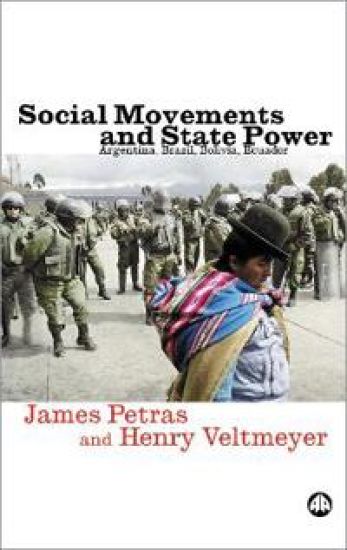
The 2003 electoral victory of Lucio Gutiérrez in Ecuador was met with the same sense of optimism that greeted the election of Ignacio 'Lula' da Silva in Brazil, and Hugo Chavez in Venezuela. Gutierrez's victory was viewed as a major advance for the country in its 500 year-long struggle for freedom and democracy. In Bolivia, Evo Morales similarly came within an electoral whisker of achieving state power in 2002, and in 2003 Nestor Kirchner became President of Argentina. Many journalists , academics and politicians speak of a "left-turn" in Latin America, characterizing these regimes as "center -left". They came to power on the promise of delivering a fundamental change of direction that would steer their countries away from neo-liberal economic policies, and towards greater social equity. Their success awakened major hopes on the Left for a new dawn in Latin American politics. This book challenges these assumptions. It critically examines their agreements with the IMF, their social and economic policies, and the economic ties of leading policy makers, as well as the beneficiaries and losers under these regimes. Latin America is unique in that it has experienced two decades of popular resistance to neo-liberal policies: each of the four countries examined here has a rich history of diverse indigenous and working class movements coming together to promote radical political change. The authors examine the political dynamics between the state and its agenda, and the strategy of mass mobilisation taken by the mass movements. They explore the intensifying conflicts between the movements and their former allies in the state.