Kirjojen hintavertailu – 12 903 725 kirjaa ja 27 kauppaa

Kirjailija

James R. Barth

Kirjat ja teokset yhdessä paikassa: 7 kirjaa, julkaisuja vuosilta 1991–2014, suosituimpiin kuuluu The Future of American Banking. Vertaile teosten hintoja ja tarkista saatavuus suomalaisista kirjakaupoista.

Nimi esiintyy myös muodoissa: James R Barth

7 kirjaa

Kirjojen julkaisuvuodet: 1991–2014.

The Future of American Banking

The Future of American Banking

James R. Barth; Robert E. Litan; R.Dan Brumbaugh

M.E. Sharpe
1992
sidottu
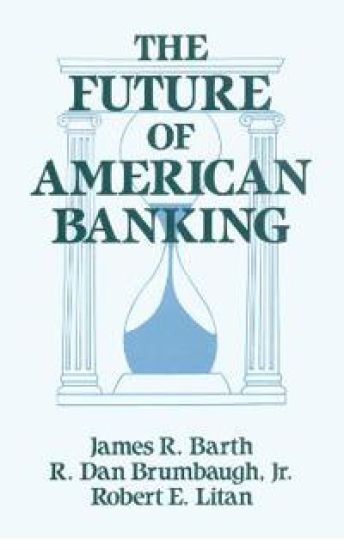
The future of American banking is in doubt and the industry and the federal insurance fund that helps support it are in turmoil. The ingredients of the turmoil have been simmering in public view since at least the early 1980s when commercial bank loans to lesser developed countries (LDCs) began to default. The difficulties began to boil at the end of the decade when the prospect first arose that the banks' deposit insurer, the Bank Insurance Fund (BIF) that is administered by the Federal Deposit Insurance Corporation (FDIC), might require dollars to resolve bank failure as occurred in the savings and loan debacle. This book frames the major economic and policy issues raised by the banking crisis whose resolution largely determines the future of American banking. It focuses on the current reported condition of the banking industry, concentrating on large banks in particular. A longer-run economic prognosis for the banking industry is presented and the implications of future bank failures for the financial services sector and federal regulatory policy are discussed. Most importantly the book contains suggestions for changes in the nation's deposit-insurance system and accompanying banking laws. These changes would reduce the federal government's deposit insurance liability and would provide banks with potentially profitable opportunities. The study includes a wealth of data on the financial condition of American banks and the system as a whole, some of it not easily obtainable from any other source. The authors are internationally recognized as knowledgeable experts on the state of the American banking system and the options and prospects for US banking reform.
The Future of American Banking

The Future of American Banking

James R. Barth; Robert E. Litan; R.Dan Brumbaugh

M.E. Sharpe
1992
nidottu
The future of American banking is in doubt and the industry and the federal insurance fund that helps support it are in turmoil. The ingredients of the turmoil have been simmering in public view since at least the early 1980s when commercial bank loans to lesser developed countries (LDCs) began to default. The difficulties began to boil at the end of the decade when the prospect first arose that the banks' deposit insurer, the Bank Insurance Fund (BIF) that is administered by the Federal Deposit Insurance Corporation (FDIC), might require dollars to resolve bank failure as occurred in the savings and loan debacle. This book frames the major economic and policy issues raised by the banking crisis whose resolution largely determines the future of American banking. It focuses on the current reported condition of the banking industry, concentrating on large banks in particular. A longer-run economic prognosis for the banking industry is presented and the implications of future bank failures for the financial services sector and federal regulatory policy are discussed. Most importantly the book contains suggestions for changes in the nation's deposit-insurance system and accompanying banking laws. These changes would reduce the federal government's deposit insurance liability and would provide banks with potentially profitable opportunities. The study includes a wealth of data on the financial condition of American banks and the system as a whole, some of it not easily obtainable from any other source. The authors are internationally recognized as knowledgeable experts on the state of the American banking system and the options and prospects for US banking reform.
Guardians of Finance

Guardians of Finance

James R. Barth; Gerard Caprio; Ross Levine

MIT Press
2014
pokkari
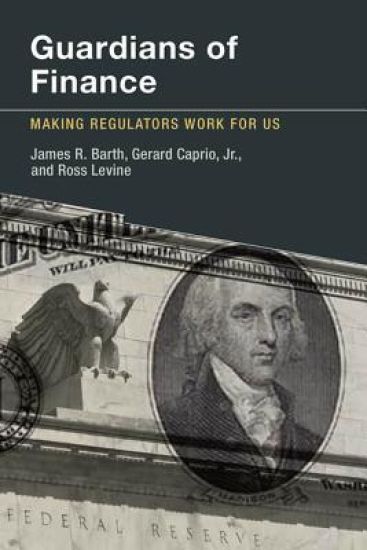
How the unaccountable, unmonitorable, and unchecked actions of regulators precipitated the global financial crisis; and how to reform the system. The recent financial crisis was an accident, a "perfect storm" fueled by an unforeseeable confluence of events that unfortunately combined to bring down the global financial systems. Or at least this is the story told and retold by a chorus of luminaries that includes Timothy Geithner, Henry Paulson, Robert Rubin, Ben Bernanke, and Alan Greenspan. In Guardians of Finance, economists James Barth, Gerard Caprio, and Ross Levine argue that the financial meltdown of 2007 to 2009 was no accident; it was negligent homicide. They show that senior regulatory officials around the world knew or should have known that their policies were destabilizing the global financial system and yet chose not to act until the crisis had fully emerged. Barth, Caprio, and Levine propose a reform to counter this systemic failure: the establishment of a "Sentinel" to provide an informed, expert, and independent assessment of financial regulation. Its sole power would be to demand information and to evaluate it from the perspective of the public-rather than that of the financial industry, the regulators, or politicians.
Rethinking Bank Regulation

Rethinking Bank Regulation

James R. Barth; Gerard Caprio; Ross Levine

Cambridge University Press
2008
pokkari
This volume assembles and presents a database on bank regulation in over 150 countries (included also on CD). It offered the first comprehensive cross-country assessment of the impact of bank regulation on the operation of banks, and assesses the validity of the Basel Committee's influential approach to bank regulation. The treatment also provides an empirical evaluation of the historic debate about the proper role of government in the economy by studying bank regulation and analyzes the role of politics in determining regulatory approaches to banking. The data also indicate that restrictions on the entry of banks, government ownership of banks, and restrictions on bank activities hurt banking system performance. The authors find that domestic political factors shape both regulations and their effectiveness.
Rethinking Bank Regulation

Rethinking Bank Regulation

James R. Barth; Gerard Caprio; Ross Levine

Cambridge University Press
2005
sidottu
This volume assembles and presents a database on bank regulation in over 150 countries (included also on CD). It offered the first comprehensive cross-country assessment of the impact of bank regulation on the operation of banks, and assesses the validity of the Basel Committee's influential approach to bank regulation. The treatment also provides an empirical evaluation of the historic debate about the proper role of government in the economy by studying bank regulation and analyzes the role of politics in determining regulatory approaches to banking. The data also indicate that restrictions on the entry of banks, government ownership of banks, and restrictions on bank activities hurt banking system performance. The authors find that domestic political factors shape both regulations and their effectiveness.
The Great Savings and Loan Debacle

The Great Savings and Loan Debacle

James R. Barth

AEI Press
1991
nidottu
During the 1980s, 525 insolvent savings and loans were liquidated or sold at an enormous cost. Resolving the remaining troubled S&Ls could cost American taxpayers hundreds of billions. What went wrong with the industry? Are fraud and deregulation solely responsible for this financial disaster? In this volume the author argues that federal deposit insurance itself is largely to blame: by permitting institutions to operate with inadequate capital, the system subsidizes weak institutions while increasing the risk to taxpayers. In addition, regulation and supervision prevent S&Ls from adapting to changing market forces. Congress, the Administration and the regulatory agencies, the author says, have created a flawed deposit insurance system and a rigid, outdated supervisory and regulatory structure. He recommends a re-examination and restructuring that would protect both depositors and taxpayers and would allow the industry to respond to changes in the marketplace.