Kirjojen hintavertailu – 12 859 828 kirjaa ja 27 kauppaa
Kirjailija
James Ralph
Kirjat ja teokset yhdessä paikassa: 29 kirjaa, julkaisuja vuosilta 2007–2025, suosituimpiin kuuluu The Fall of the Earl of Essex ... Alter'd [By James Ralph] from the Unhappy Favourite of Mr. Banks. [In Verse.]. Vertaile teosten hintoja ja tarkista saatavuus suomalaisista kirjakaupoista.
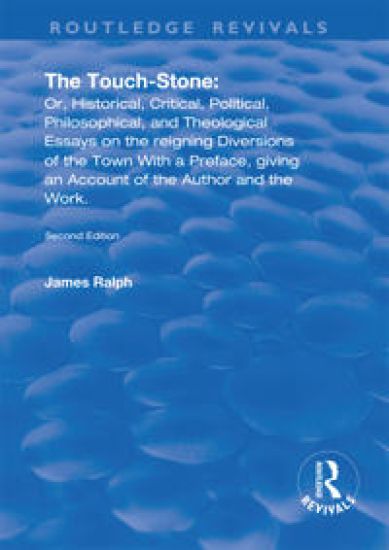
Previoulsy published in 1970. This volume, The Touch-Stone, contains a selection of essays from author James Ralph on a selection of topics, including Of Musick, Of Poetry, and Of Dancing.
Previoulsy published in 1970. This volume, The Touch-Stone, contains a selection of essays from author James Ralph on a selection of topics, including Of Musick, Of Poetry, and Of Dancing.
The 18th century was a wealth of knowledge, exploration and rapidly growing technology and expanding record-keeping made possible by advances in the printing press. In its determination to preserve the century of revolution, Gale initiated a revolution of its own: digitization of epic proportions to preserve these invaluable works in the largest archive of its kind. Now for the first time these high-quality digital copies of original 18th century manuscripts are available in print, making them highly accessible to libraries, undergraduate students, and independent scholars. Delve into what it was like to live during the eighteenth century by reading the first-hand accounts of everyday people, including city dwellers and farmers, businessmen and bankers, artisans and merchants, artists and their patrons, politicians and their constituents. Original texts make the American, French, and Industrial revolutions vividly contemporary.++++The below data was compiled from various identification fields in the bibliographic record of this title. This data is provided as an additional tool in helping to insure edition identification: ++++Huntington LibraryN045850Anonymous. By James Ralph. With a half-title. London: printed for J. Crokatt, 1729. 2], xxviii,237, 1]p.; 12
The 18th century was a wealth of knowledge, exploration and rapidly growing technology and expanding record-keeping made possible by advances in the printing press. In its determination to preserve the century of revolution, Gale initiated a revolution of its own: digitization of epic proportions to preserve these invaluable works in the largest archive of its kind. Now for the first time these high-quality digital copies of original 18th century manuscripts are available in print, making them highly accessible to libraries, undergraduate students, and independent scholars. Delve into what it was like to live during the eighteenth century by reading the first-hand accounts of everyday people, including city dwellers and farmers, businessmen and bankers, artisans and merchants, artists and their patrons, politicians and their constituents. Original texts make the American, French, and Industrial revolutions vividly contemporary.++++The below data was compiled from various identification fields in the bibliographic record of this title. This data is provided as an additional tool in helping to insure edition identification: ++++British LibraryT019997Anonymous. By James Ralph. Pp.73-76 misnumbered 65-68. The date in the imprint is in Roman numerals. There is no price at the foot of the titlepage. London: printed for R. Griffiths, 1758. 4],68 i.e.76]p.; 8
The 18th century was a wealth of knowledge, exploration and rapidly growing technology and expanding record-keeping made possible by advances in the printing press. In its determination to preserve the century of revolution, Gale initiated a revolution of its own: digitization of epic proportions to preserve these invaluable works in the largest archive of its kind. Now for the first time these high-quality digital copies of original 18th century manuscripts are available in print, making them highly accessible to libraries, undergraduate students, and independent scholars. Delve into what it was like to live during the eighteenth century by reading the first-hand accounts of everyday people, including city dwellers and farmers, businessmen and bankers, artisans and merchants, artists and their patrons, politicians and their constituents. Original texts make the American, French, and Industrial revolutions vividly contemporary.++++The below data was compiled from various identification fields in the bibliographic record of this title. This data is provided as an additional tool in helping to insure edition identification: ++++British LibraryT019998A re-issue of the 1758 edition, with the preliminary leaves reset. Pp. 73-76 misnumbered 65-68. London: printed for R. Griffiths, 1762. 4],68 i.e.76]p.; 8
The 18th century was a wealth of knowledge, exploration and rapidly growing technology and expanding record-keeping made possible by advances in the printing press. In its determination to preserve the century of revolution, Gale initiated a revolution of its own: digitization of epic proportions to preserve these invaluable works in the largest archive of its kind. Now for the first time these high-quality digital copies of original 18th century manuscripts are available in print, making them highly accessible to libraries, undergraduate students, and independent scholars. Western literary study flows out of eighteenth-century works by Alexander Pope, Daniel Defoe, Henry Fielding, Frances Burney, Denis Diderot, Johann Gottfried Herder, Johann Wolfgang von Goethe, and others. Experience the birth of the modern novel, or compare the development of language using dictionaries and grammar discourses. ++++The below data was compiled from various identification fields in the bibliographic record of this title. This data is provided as an additional tool in helping to insure edition identification: ++++British LibraryT027354With a final leaf of advertisements. London: printed for J. Watts, 1730. 8],94, 2]p.: ill., music; 8
This work has been selected by scholars as being culturally important, and is part of the knowledge base of civilization as we know it. This work was reproduced from the original artifact, and remains as true to the original work as possible. Therefore, you will see the original copyright references, library stamps (as most of these works have been housed in our most important libraries around the world), and other notations in the work. This work is in the public domain in the United States of America, and possibly other nations. Within the United States, you may freely copy and distribute this work, as no entity (individual or corporate) has a copyright on the body of the work. As a reproduction of a historical artifact, this work may contain missing or blurred pages, poor pictures, errant marks, etc. Scholars believe, and we concur, that this work is important enough to be preserved, reproduced, and made generally available to the public. We appreciate your support of the preservation process, and thank you for being an important part of keeping this knowledge alive and relevant.
This is the first full history of Operation Breadbasket, the interfaith economic justice program that transformed into Jesse Jackson’s Operation PUSH (now the Rainbow PUSH Coalition). Begun by Martin Luther King Jr. during the 1966 Chicago Freedom Movement, Breadbasket was directed by Jackson. Author Martin L. Deppe was one of Breadbasket’s founding pastors. He digs deeply into the program’s past to update the meager narrative about Breadbasket, add details to King’s and Jackson’s roles, and tell Breadbasket’s little-known story. Under the motto “Your Ministers Fight for Jobs and Rights,” the program put bread on the tables of the city’s African American families in the form of steady jobs. Deppe details how Breadbasket used the power of the pulpit to persuade businesses that sought black dollars to also employ a fair share of blacks. Though they favored negotiations, Breadbasket pastors also organized effective boycotts, as they did after one manager declared that he was “not about to let Negro preachers tell him what to do.” Over six years, Breadbasket’s efforts netted forty-five hundred jobs and sharply increased commerce involving black-owned businesses. Economic gains on Chicago’s South Side amounted to $57.5 million annually by 1971. Deppe traces Breadbasket’s history from its early “Don’t Buy” campaigns through a string of achievements related to black employment and black-owned products, services, and businesses. To the emerging call for black power, Breadbasket offered a program that actually empowered the black community, helping it engage the mainstream economic powers on an equal footing. Deppe recounts plans for Breadbasket’s national expansion; its sponsored business expos; and the Saturday Breadbasket gatherings, a hugely popular black-pride forum. Deppe shows how the program evolved in response to growing pains, changing alliances, and the King assassination. Breadbasket’s rich history, as told here, offers a still-viable model for attaining economic justice today.
This is the first full history of Operation Breadbasket, the interfaith economic justice program that transformed into Jesse Jackson’s Operation PUSH (now the Rainbow PUSH Coalition). Begun by Martin Luther King Jr. during the 1966 Chicago Freedom Movement, Breadbasket was directed by Jackson. Author Martin L. Deppe was one of Breadbasket’s founding pastors. He digs deeply into the program’s past to update the meager narrative about Breadbasket, add details to King’s and Jackson’s roles, and tell Breadbasket’s little-known story. Under the motto “Your Ministers Fight for Jobs and Rights,” the program put bread on the tables of the city’s African American families in the form of steady jobs. Deppe details how Breadbasket used the power of the pulpit to persuade businesses that sought black dollars to also employ a fair share of blacks. Though they favored negotiations, Breadbasket pastors also organized effective boycotts, as they did after one manager declared that he was “not about to let Negro preachers tell him what to do.” Over six years, Breadbasket’s efforts netted forty-five hundred jobs and sharply increased commerce involving black-owned businesses. Economic gains on Chicago’s South Side amounted to $57.5 million annually by 1971. Deppe traces Breadbasket’s history from its early “Don’t Buy” campaigns through a string of achievements related to black employment and black-owned products, services, and businesses. To the emerging call for black power, Breadbasket offered a program that actually empowered the black community, helping it engage the mainstream economic powers on an equal footing. Deppe recounts plans for Breadbasket’s national expansion; its sponsored business expos; and the Saturday Breadbasket gatherings, a hugely popular black-pride forum. Deppe shows how the program evolved in response to growing pains, changing alliances, and the King assassination. Breadbasket’s rich history, as told here, offers a still-viable model for attaining economic justice today.
Title: Miscellaneous Poems, viz.: Night; in 4 books: Zeuma, or the Love of Liberty; in 3 books: Clarinda, or the Fair Libertine: The Muses' Address. Publisher: British Library, Historical Print EditionsThe British Library is the national library of the United Kingdom. It is one of the world's largest research libraries holding over 150 million items in all known languages and formats: books, journals, newspapers, sound recordings, patents, maps, stamps, prints and much more. Its collections include around 14 million books, along with substantial additional collections of manuscripts and historical items dating back as far as 300 BC. The POETRY & DRAMA collection includes books from the British Library digitised by Microsoft. The books reflect the complex and changing role of literature in society, ranging from Bardic poetry to Victorian verse. Containing many classic works from important dramatists and poets, this collection has something for every lover of the stage and verse. ++++The below data was compiled from various identification fields in the bibliographic record of this title. This data is provided as an additional tool in helping to insure edition identification: ++++ British Library Ralph, James; 1729, 28. 4 pt.; 8 . 992.k.15.(1-4.)