Kirjojen hintavertailu – 12 903 725 kirjaa ja 27 kauppaa

Kirjailija

James Wright

Kirjat ja teokset yhdessä paikassa: 72 kirjaa, julkaisuja vuosilta 1959–2026, suosituimpiin kuuluu Pharafaneelya Gretchen's Story. Vertaile teosten hintoja ja tarkista saatavuus suomalaisista kirjakaupoista.

72 kirjaa

Kirjojen julkaisuvuodet: 1959–2026.

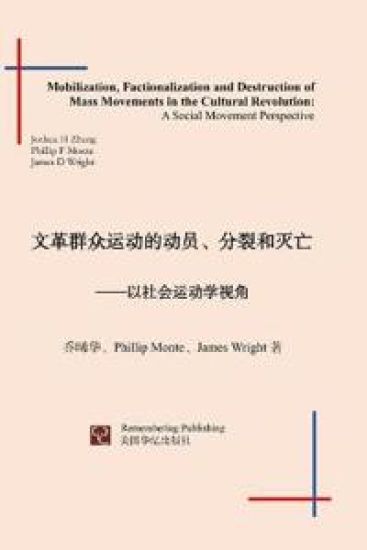
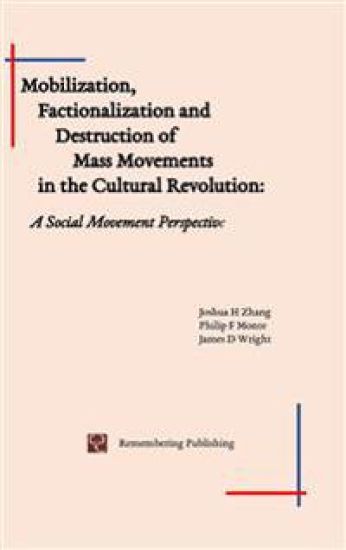
Mobilization, Factionalization and Destruction of Mass Movements in the Cultural Revolution

Mobilization, Factionalization and Destruction of Mass Movements in the Cultural Revolution

Joshua Zhang; Philip Monte; James Wright

Remembering Publishing, LLC
2020
sidottu
Based on a unique survey of Chinese respondents, the authors find that participation in social movements during the Cultural Revolution was motivated by the desire to improve social status or maintain existing positions in the social hierarchy. A strong relationship is noted between factional alignment and family background in provinces immersed in class-based struggle; however, the association becomes nil in provinces where sectarian struggle was grounded in class. The authors assert that the social conflict school has failed to adequately examine sectarian internecine fights among rebels in attempts to explain the mass movements, while the political process school has ignored fundamental social conflicts embedded in Chinese society. Potential pitfalls likely to confront future mass movements are identified.
Mobilization, Factionalization and Destruction of Mass Movements in the Cultural Revolution

Mobilization, Factionalization and Destruction of Mass Movements in the Cultural Revolution

Joshua Zhang; Philip Monte; James Wright

Remembering Publishing, LLC
2020
pokkari
Based on a large-scale survey, it is found that during the Cultural Revolution masses took part in the movements to either improve their social status or maintain their social positions. In the provinces immersed in class based struggles, there was strong relationship between faction alignment and family background. Nevertheless, in the provinces involved in non-class based sectarian struggles, the association between the two was nil. The social conflict school failed to notice the sectarian internecine fights among rebels while the political process school failed to pay attention to the fundamental social conflicts in China. The book summarize the lessons learned from the self destruction of the mass movements and point out pitfalls for the future social movements in China.
Pharafaneelya The Gate Between Us

Pharafaneelya The Gate Between Us

James Wright; Jaws R

Independently Published
2020
pokkari
The Gates Between Us series three connects and further takes you on a deeper journey of this books series. Linking both worlds between the world of the living and the world of the dead. Through the eyes of a young woman named Raye, in this book Raye experience events that has been force onto her through a cursive blood-line that seeks revenge by connecting to the world of the living through Weirdens' Black Book as it continues to choose it victims as they come in Raye's library as it searches for it true revenge on earth.
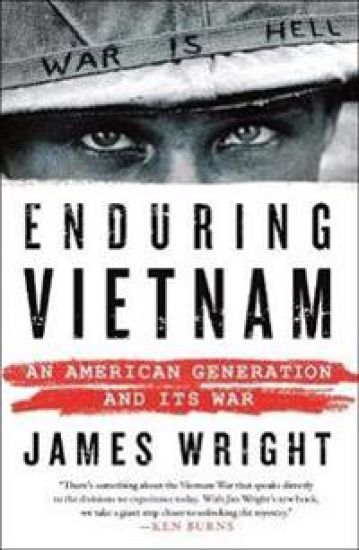
Enduring Vietnam

Enduring Vietnam

James Wright

St Martin's Press
2019
pokkari
A history of the American War in Vietnam that provides a rich overview of that war and an evocative reminder of the human faces of the generation who served. The Vietnam War is largely recalled as a mistake, either in the decision to engage there or in the nature of the engagement. Or both. Veterans of the war remain largely anonymous figures, accomplices in the mistake. Critically recounting the steps that led to the war, this book does not excuse the mistakes, but it brings those who served out of the shadows. Enduring Vietnam recounts the experiences of the young Americans who fought in Vietnam and of families who grieved those who did not return. By 1969 nearly half of the junior enlisted men who died in Vietnam were draftees. And their median age was 21--among the non-draftees it was only 20. The book describes the "baby boomers" growing up in the 1950s, why they went into the military, what they thought of the war, and what it was like to serve in "Nam." And to come home. With a rich narrative of the Battle for "Hamburger Hill," and through substantial interviews with those who served, the book depicts the cruelty of this war, and its quiet acts of courage. James Wright's Enduring Vietnam provides an important dimension to the profile of an American generation--and a rich account of an American War.
The Branch Will Not Break: 20th Century Nature Poems of North America (Hardcover)
The Branch Will Not Break is a reflective anthology of poems which evokes its author's upbringing in poverty-stricken Ohio during the 1930s and 1940s. Representing a radical and innovative departure from the more conventional and nature-orientated works of his earlier career, this collection sees James Wright embark on sudden narrative shifts while conjuring evocative imagery full of implication. Often, the poems begin with a description of a person or object - after these initial verses, we find a blossoming of imagery. This collection was the result of years of collaboration Wright enjoyed with fellow poet Robert Bly. Economical with words, Wright's poems are generally short but unfailing in evocation and implication. Some of the shortest, most rhythmic works in this collection carry shades of Eastern poetry such as Haiku. Others declare a raw scene, image and meaning in an appealing and deceptively simple manner.
The Branch Will Not Break: 20th Century Nature Poems of North America
The Branch Will Not Break is a reflective anthology of poems which evokes its author's upbringing in poverty-stricken Ohio during the 1930s and 1940s. Representing a radical and innovative departure from the more conventional and nature-orientated works of his earlier career, this collection sees James Wright embark on sudden narrative shifts while conjuring evocative imagery full of implication. Often, the poems begin with a description of a person or object - after these initial verses, we find a blossoming of imagery. This collection was the result of years of collaboration Wright enjoyed with fellow poet Robert Bly. Economical with words, Wright's poems are generally short but unfailing in evocation and implication. Some of the shortest, most rhythmic works in this collection carry shades of Eastern poetry such as Haiku. Others declare a raw scene, image and meaning in an appealing and deceptively simple manner.
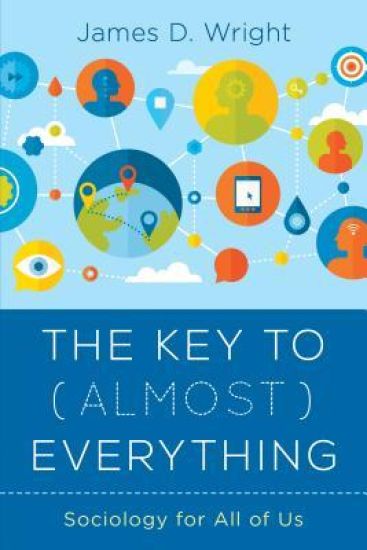
The Key to (Almost) Everything

The Key to (Almost) Everything

James Wright

Rowman Littlefield
2019
sidottu
The Key to (Almost) Everything is an engaging, contemporary and concise approach to sociology written for adults, students and just about anybody who could profit from knowing about the discipline of sociology. It is expertly written by an author drawing on 40 years of teaching on the fundamental social structures and processes characteristic of human societies. Each of the book’s chapters is modeled on the courses found in the sociology curriculum. These chapters are not course or lecture notes, rather they are engaging lessons on topics such as political sociology, urban sociology, religion in sociology, crime and guns, poverty, the American family, public opinion, wealth and power.
The Key to (Almost) Everything

The Key to (Almost) Everything

James Wright

Rowman Littlefield
2019
nidottu
The Key to (Almost) Everything is an engaging, contemporary and concise approach to sociology written for adults, students and just about anybody who could profit from knowing about the discipline of sociology. It is expertly written by an author drawing on 40 years of teaching on the fundamental social structures and processes characteristic of human societies. Each of the book’s chapters is modeled on the courses found in the sociology curriculum. These chapters are not course or lecture notes, rather they are engaging lessons on topics such as political sociology, urban sociology, religion in sociology, crime and guns, poverty, the American family, public opinion, wealth and power.
Lost Souls

Lost Souls

James Wright

Routledge
2018
nidottu
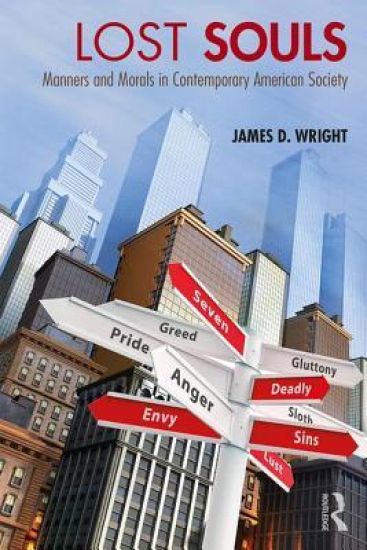
What is the state of contemporary American morality? From their original conception in Christian scripture to their assimilation into Western culture, the 'Seven Deadly Sins' – lust, greed, envy, pride, and all the rest – have guided human morality, steering human behavior and psychology away from evil and toward a full embrace of the good. But their hold on modern life is increasingly tenuous. Indeed, one may observe that these days, deadly sin is far more common and more commonly practiced than its virtuous counterparts – humility, charity, kindness, industriousness, and chastity. Without greed, there is no economy; without anger, no politics; and without pride and envy, surely less motivation and competition would exist. James D. Wright carefully examines the complexities and ambiguities in modern society in the context of the seven deadly sins and their corresponding virtues. Are we all lost souls, condemned by our immoral deeds, or are the trappings of older sin deteriorating? Is it time, finally, to reconsider the classifications of evil and good? Wright uses each chapter to consider how the social sciences have operationalized each 'sin', how they have been studied, and what lessons have been learned over time. He reviews recent trends and contemplates the societal costs and benefits of the behaviors in question. Lost Souls emerges, then, as a meditation on contemporary sin, concluding that the line between guilt and innocence, right and wrong, is often very thin.
Lost Souls

Lost Souls

James Wright

Routledge
2018
sidottu
What is the state of contemporary American morality? From their original conception in Christian scripture to their assimilation into Western culture, the 'Seven Deadly Sins' – lust, greed, envy, pride, and all the rest – have guided human morality, steering human behavior and psychology away from evil and toward a full embrace of the good. But their hold on modern life is increasingly tenuous. Indeed, one may observe that these days, deadly sin is far more common and more commonly practiced than its virtuous counterparts – humility, charity, kindness, industriousness, and chastity. Without greed, there is no economy; without anger, no politics; and without pride and envy, surely less motivation and competition would exist. James D. Wright carefully examines the complexities and ambiguities in modern society in the context of the seven deadly sins and their corresponding virtues. Are we all lost souls, condemned by our immoral deeds, or are the trappings of older sin deteriorating? Is it time, finally, to reconsider the classifications of evil and good? Wright uses each chapter to consider how the social sciences have operationalized each 'sin', how they have been studied, and what lessons have been learned over time. He reviews recent trends and contemplates the societal costs and benefits of the behaviors in question. Lost Souls emerges, then, as a meditation on contemporary sin, concluding that the line between guilt and innocence, right and wrong, is often very thin.
A Christian Reads the Qur'an: Honest Reading, Honest Reflection

A Christian Reads the Qur'an: Honest Reading, Honest Reflection

James Wright

Createspace Independent Publishing Platform
2018
nidottu
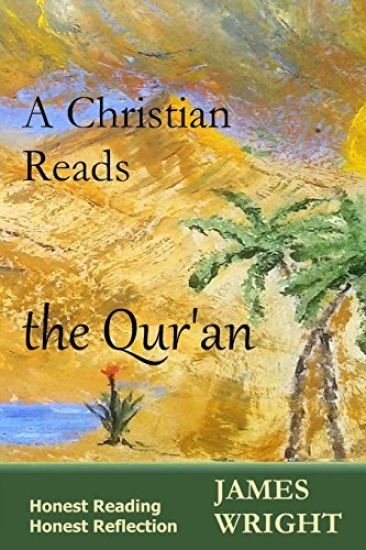
Why would a Christian read the Qur'an? To criticize it? To convert to Islam? Many of my Muslim friends want me to read it because they believe the Qur'an is the most important book in the world. I don't want to criticize the Qur'an. My purpose is to invite others on a quest for truth and respect. Far too often Muslims and Christians live in parallel universes. Reading the Qur'an can help build bridges of respect between one other. The Qur'an says "do not argue with the People of the Book except in the best way" (Surah 29:46 Al-Ankabut)." This can also be very readable to Muslims because it runs smoothly and seems to contain no dogmatic complexities... I like the conclusions especially the ultimate one in chapter 55. I would say, Yes it's perfect for the audience..." Mr. Nadir, Arab author." I'm sure that this book will touch the hearts of many people and stir their thinking..." Mr. L, Turkish author and scholar. "I congratulate you on having done a thorough evaluation of the Qur'an through the eyes of a Christian. It is a daunting task and your years of working in the Islamic world have given you some good insights and stories to share which do raise many valid questions. These questions should provide some good food for thought for people to think about." Dan Wickwire, author and scholar Middle East.
Poor and Homeless in the Sunshine State
A place like Orlando, Florida is not transformed from swampland to sprawling metropolis through Peter Pan-like flights of fancy, but through theme park expansions requiring developmental schemes that are tough minded and often worsen relationships between the wealthy and the poor. The homeless arrive with their own hopes and illusions, which are soon shattered. The rest of the local population makes its peace with the system. Meanwhile the homeless are reduced to advocacy models that neither middle- nor working-class folks much worry about. They are modern members of Ellison's "invisible men" but they comprise a racial and social mixture unlike any other in the American landscape. This book is primarily about the dark side of this portrait the poor, near-poor, homeless, and dispossessed who live in the midst of this verdant landscape. The phrase "down and out," has been used to describe people who are destitute or penniless since the late nineteenth century. Here the term is used in a more expansive sense, as synonymous with anyone who lives near, at, or over the edge of financial catastrophe.
State of the Masses

State of the Masses

James Wright

Routledge
2017
sidottu
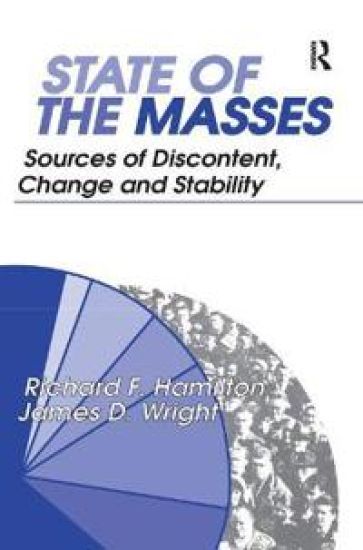
Is the consciousness of Americans in the midst of dramatic transformation? Or do people think and feel much the same as they have always thought and felt? Do most people enjoy their work, or hate it? Is the American family being replaced by new institutional forms, or is it much the same as it was in the 1950's? Have material values been replaced by a "postmaterial consciousness" in a postindustrial society? Are Americans becoming more conservative, less conservative, or staying about the same? State of the Masses asks the important questions. Originally published in 1986, this prescient study evaluate the views of social critics, neo-conservatives, neo-Marxists, post-industrialists, and the theorists of the little man, who puport to describe the nature, social conditions, outlooks, and motivations of the American populace. The claims of one group are often diametrically opposed to those of another. The authors make the case for which claims can be considered true and which false. Hamilton and Wright analyze the contradictory claims and compares their implications with the best social science research and data available at that time. They also explore the implications for theories in light of the conflicting portrait the evidence provides. The authors conclude with a new perspective for understanding continuities and changes in the United States. This is a prescient view of American society during turmoil, and a model for how social science research can be used predictively.
No More Gallant a Deed: A Civil War Memoir of the First Minnesota Volunteers
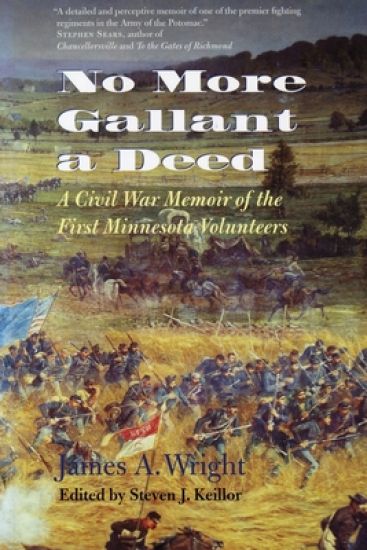
A perceptive and detailed Civil War memoir of the First Minnesota Regiment chronicling such famous battles as Bull Run, Antietam, Fredericksburg, and Gettysburg. James A. Wright was an orderly sergeant in Company F of the First Minnesota Volunteer Infantry Regiment in the Civil War. His memoir, based on his diaries and letters, is the fullest personal account of the battles, marches, and soldier life of one of the most renowned regiments in the Army of the Potomac. The First took part in every significant battle and action in the war in the East from 1861 to 1864. In remarkable detail, he describes the fighting at Bull Run, the Peninsula Campaign, Antietam, Fredericksburg, Gettysburg, and Bristoe Station. At Gettysburg, the First Minnesota halted the Confederate charge and suffered an 82 percent casualty rate. Wright's account of the battle is striking in its description of the horror the men felt at facing their foes, their determination to do their duty, and the shock of the loss of so many of their comrades. With an eloquence rare in war memoirs, Wright recalls the long marches, the poor food, the inadequate shelter, the dedicated officers, the debilitating illnesses, the longing for home, and the sense of pride in carrying out the struggle to preserve the Union. For conveying what the Civil War meant to one man, it is unmatched.
Social Problems, Social Issues, Social Science
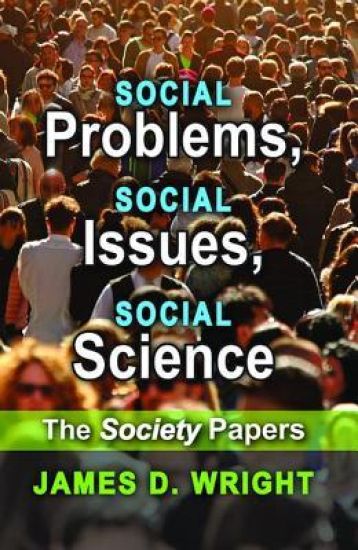
Sociology has tackled some of the most formidable problems that confront contemporary society: inequality, homelessness, violence, gender, and many more. Sociologists assert that hypotheses can be formulated and tested against empirical evidence, that faulty viewpoints can be uncovered and discarded, and that plausible theory can be distinguished from mere ideology. This collection was written over a span of forty-four years and is presented in the belief that sociology is a science. In Social Problems, Social Issues, Social Science, James D. Wright presents his research on some of the social issues that have most vexed America: homelessness, addiction, divorce, minimum wage, and gun control, among others. Starting with essays first published in the flagship journal Society, Wright offers readers a foundational look at specific social problems and the methods sociologists have used to study them. He then provides an up-to-date re-examination of each issue, analysing the changes that have occurred over time and how sociologists have responded to it. This book is both a retrospective on the field and on one scholar's life and work. Using his own experience in researching and writing about America's most trenchant social issues, Wright describes the evolution of the methods and theory used by social scientists to understand and, ultimately, to confront America's most troublesome social problems.
Social Problems, Social Issues, Social Science
Sociology has tackled some of the most formidable problems that confront contemporary society: inequality, homelessness, violence, gender, and many more. Sociologists assert that hypotheses can be formulated and tested against empirical evidence, that faulty viewpoints can be uncovered and discarded, and that plausible theory can be distinguished from mere ideology. This collection was written over a span of forty-four years and is presented in the belief that sociology is a science. In Social Problems, Social Issues, Social Science, James D. Wright presents his research on some of the social issues that have most vexed America: homelessness, addiction, divorce, minimum wage, and gun control, among others. Starting with essays first published in the flagship journal Society, Wright offers readers a foundational look at specific social problems and the methods sociologists have used to study them. He then provides an up-to-date re-examination of each issue, analysing the changes that have occurred over time and how sociologists have responded to it. This book is both a retrospective on the field and on one scholar's life and work. Using his own experience in researching and writing about America's most trenchant social issues, Wright describes the evolution of the methods and theory used by social scientists to understand and, ultimately, to confront America's most troublesome social problems.