

Kirjojen hintavertailu – 12 903 725 kirjaa ja 27 kauppaa

Kirjailija

Jan Egeland

Kirjat ja teokset yhdessä paikassa: 3 kirjaa, julkaisuja vuosilta 2010–2017, suosituimpiin kuuluu A Billion Lives. Vertaile teosten hintoja ja tarkista saatavuus suomalaisista kirjakaupoista.

3 kirjaa

Kirjojen julkaisuvuodet: 2010–2017.

Humanitarianism, War, and Politics

Humanitarianism, War, and Politics

Peter J. Hoffman; Thomas G. Weiss; Jan Egeland

Rowman Littlefield
2017
sidottu
What is humanitarianism? This authoritative book provides a comprehensive analysis of the original idea and its evolution, exploring its triangulation with war and politics. Peter J. Hoffman and Thomas G. Weiss trace the origins of humanitarianism, its social movement, and the institutions (international humanitarian law) and organizations (providers of assistance and protection) that comprise it. They consider the international humanitarian system’s ability to regulate the conduct of war, to improve the wellbeing of its victims, and to prosecute war criminals. Probing the profound changes in the culture and capacities that underpin the sector and alter the meaning of humanitarianism, they assess the reinventions that constitute “revolutions in humanitarian affairs.” The book begins with traditions and perspectives—ranging from classic international relations approaches to “Critical Humanitarian Studies” —and reviews seminal wartime emergencies and the creation and development of humanitarian agencies in the late nineteenth and twentieth centuries. The authors then examine the rise of “new humanitarianisms” after the Cold War’s end and contemporary cases after 9/11. The authors continue by unpacking the most recent “revolutions”—the International Criminal Court and the “Responsibility to Protect”—as well as such core challenges as displacement camps, infectious diseases, eco-refugees, and marketization. They conclude by evaluating the contemporary system and the prospects for further transformations, identifying scholarly puzzles and the acute operational problems faced by practitioners.

Humanitarianism, War, and Politics

Humanitarianism, War, and Politics

Peter J. Hoffman; Thomas G. Weiss; Jan Egeland

Rowman Littlefield
2017
nidottu
What is humanitarianism? This authoritative book provides a comprehensive analysis of the original idea and its evolution, exploring its triangulation with war and politics. Peter J. Hoffman and Thomas G. Weiss trace the origins of humanitarianism, its social movement, and the institutions (international humanitarian law) and organizations (providers of assistance and protection) that comprise it. They consider the international humanitarian system’s ability to regulate the conduct of war, to improve the wellbeing of its victims, and to prosecute war criminals. Probing the profound changes in the culture and capacities that underpin the sector and alter the meaning of humanitarianism, they assess the reinventions that constitute “revolutions in humanitarian affairs.” The book begins with traditions and perspectives—ranging from classic international relations approaches to “Critical Humanitarian Studies” —and reviews seminal wartime emergencies and the creation and development of humanitarian agencies in the late nineteenth and twentieth centuries. The authors then examine the rise of “new humanitarianisms” after the Cold War’s end and contemporary cases after 9/11. The authors continue by unpacking the most recent “revolutions”—the International Criminal Court and the “Responsibility to Protect”—as well as such core challenges as displacement camps, infectious diseases, eco-refugees, and marketization. They conclude by evaluating the contemporary system and the prospects for further transformations, identifying scholarly puzzles and the acute operational problems faced by practitioners.
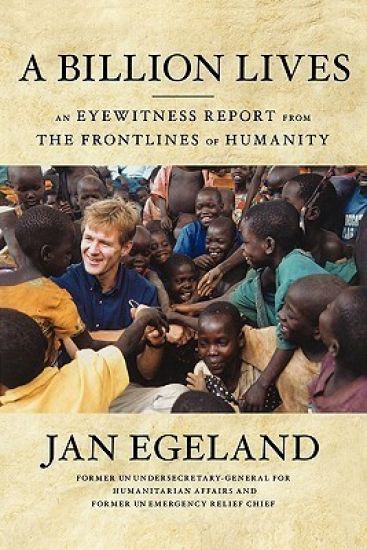
A Billion Lives

A Billion Lives

Jan Egeland

Simon Schuster
2010
pokkari
Called "the world's conscience" and one of the 100 most influential people of our time by Time magazine, Jan Egeland has been the public face of the United Nations. As Undersecretary-General for Humanitarian Affairs, he was in charge of the Office for the Coordination of Humanitarian Affairs (OCHA) for three and a half years. One of the bravest and most adventuresome figures on the international scene, Egeland takes us to the frontlines of war and chaos in Iraq, to scenes of ethnic cleansing in Darfur, to the ground zeroes of famine, earthquakes, and tsunamis. He challenges the first world to act. A Billion Lives is his on-the-ground account of his work in the most dangerous places in the world, where he has led relief efforts, negotiated truces with warlords, and intervened in what many had thought to be hopeless situations. As one of Secretary-General Kofi Annan's closest advisers, Jan Egeland was at the heart of crises during a difficult period in UN history, when the organization was plagued by the divisive aftermath of the Iraq war, the Oil-for-Food scandal, and terror attacks against UN workers. On the day Egeland came to New York to take up his job, the UN building in Baghdad was destroyed by a huge bomb, killing one of his predecessors, Sergio de Mello. Two months later Annan sent Egeland to Iraq to judge whether the UN could keep a presence there. Since that first mission to Baghdad, Egeland has been envoy to such places as Darfur, Eastern Congo, Lebanon, Gaza, Northern Israel, Northern Uganda, and Colombia. He coordinated the massive international relief efforts after the Indian Ocean tsunami and South Asian earthquake. As a negotiator and activist, Egeland is famous for direct language, whether he's addressing warlords, guerrilla leaders, generals, or heads of state. A Billion Lives is his passionate, adventure-filled eyewitness account of the catastrophes the world faces. And so Egeland writes that he has met the best and worst among us, has "confronted warlords, mass murderers, and tyrants, but [has] met many more peacemakers, relief workers, and human rights activists who risk their lives at humanity's first line of defense." In spite of the desperate need of so many, Egeland is convinced that, "For the vast majority of people, the world is getting better, that there is more peace, more people fed and educated, and fewer forced to become refugees than a generation ago. So there is reason for optimism," he concludes in this groundbreaking book that does not flinch but holds out reasons for hope.