
Kirjailija
Jan Grabowski
Kirjat ja teokset yhdessä paikassa: 6 kirjaa, julkaisuja vuosilta 2018–2026, suosituimpiin kuuluu Jasko Z Mirachowa. Vertaile teosten hintoja ja tarkista saatavuus suomalaisista kirjakaupoista.
6 kirjaa
Kirjojen julkaisuvuodet: 2018–2026.
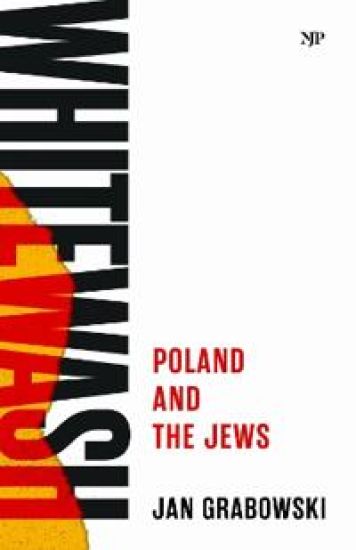
In Whitewash, Jan Grabowski brings to light the dangerous practice of Holocaust distortion through the lens of the Polish political landscape. Of the three million Polish Jews who found themselves under German occupation during World War Two, no more than 1 per cent survived the war. Poland was left with a singular burden: the responsibility to safeguard the memory of this immeasurable tragedy. Instead, Poland has emerged as a global leader in Holocaust denial and distortion, all in service of preserving the myth of an unblemished national identity. Deeply personal and brutally honest, this extended analysis intertwines Grabowski’s experiences and those of his family in Poland with a sharp critique of the state’s long-standing policy of Holocaust distortion. Carried out over decades by successive political parties, this campaign has become a powerful unifying force in Polish society. To protect the narrative of "political innocence" during the Holocaust, Poland has enacted criminal and civil laws designed to silence independent scholars, including Grabowski, who was sued for defamation in Polish court. In Whitewash, Grabowski examines Holocaust envy, distortion, denial, and de-Judaization in a searing call to protect the integrity of Holocaust memory. Whitewash effectively weaves together the history and politics of Holocaust distortion, grounding them in Grabowski’s own lived experience to underscore the immediate need for collective reckoning and action.
In Whitewash, Jan Grabowski brings to light the dangerous practice of Holocaust distortion through the lens of the Polish political landscape. Of the three million Polish Jews who found themselves under German occupation during World War Two, no more than 1 per cent survived the war. Poland was left with a singular burden: the responsibility to safeguard the memory of this immeasurable tragedy. Instead, Poland has emerged as a global leader in Holocaust denial and distortion, all in service of preserving the myth of an unblemished national identity. Deeply personal and brutally honest, this extended analysis intertwines Grabowski’s experiences and those of his family in Poland with a sharp critique of the state’s long-standing policy of Holocaust distortion. Carried out over decades by successive political parties, this campaign has become a powerful unifying force in Polish society. To protect the narrative of "political innocence" during the Holocaust, Poland has enacted criminal and civil laws designed to silence independent scholars, including Grabowski, who was sued for defamation in Polish court. In Whitewash, Grabowski examines Holocaust envy, distortion, denial, and de-Judaization in a searing call to protect the integrity of Holocaust memory. Whitewash effectively weaves together the history and politics of Holocaust distortion, grounding them in Grabowski’s own lived experience to underscore the immediate need for collective reckoning and action.

Poland, the epicentre of the Holocaust, began denying responsibility as soon as the Nazi atrocities ended. The nation's distortion of history continues today - with disturbing consequences." Holocaust denial has now been replaced by a much more dangerous and insidious foe."-Jan GrabowskiPoland is the place where the Holocaust was perpetrated - where close to 5 out of 6 million Jews were killed. Today, it is the place where a new threat is unfolding: the hijacking of history to transform the nation's past. Whitewash grapples with modern Poland's failure to acknowledge its role in the Holocaust. World-renowned Holocaust historian Jan Grabowski examines how the government, museums, schools and state institutions have been deployed to propagate a narrative of Polish national innocence. He recounts his own experience as the victim of smears and a notorious lawsuit for questioning the complicity of Poles in the destruction of the country's Jews, and explores the far-reaching consequences of Poland's historical distortions, which have been echoed and replicated worldwide to challenge the truth of the Holocaust.
Lessons and Legacies XIII
Alexandra Garbarini; Paul Jaskot; Brad Prager; Dana Smith; Marion Kaplan; Kaelber Lutz; Kubátová Hana; Martin Dean; Jan Grabowski; Simone Gigliotti; Pedro Correa Martín-Arroyo; Jonathan Druker; Gershon Greenberg; Lissa Skitolsky; Dorota Glowacka
Northwestern University Press
2018
sidottu
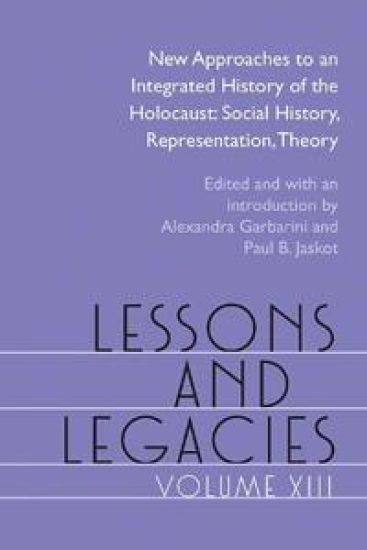
The social history of the genocide, its representation in postwar culture, and new theoretical approaches stand at the forefront of current research in a range of disciplines. Analyses at the most intimate scale—of the individual or of a particular locale— are juxtaposed with those that turn to broader studies of the war or postwar order. Complementing these different scales are theoretical investigations that address individual agency, moral judgment, and the construction of meaning and memory in the study of the victims of the Holocaust and in our understanding of society as a whole. Together they mark the contemporary scholarly landscape of Holocaust studies, which includes history as well as film and literary studies, philosophy, and religious studies (among other disciplines). Each of the volume's three sections contributes to understanding the Holocaust and postwar ramifications of the genocide by focusing on: 1) the history of specific communities of both victims and perpetrators; 2) postwar cultural representations; and 3) new theoretical understandings of each. The essays in this volume thus represent new interests in the field that contribute to building integrated histories of the Holocaust.
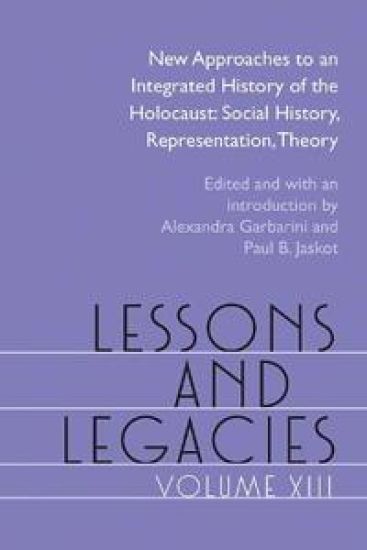
Lessons and Legacies XIII
Alexandra Garbarini; Paul Jaskot; Brad Prager; Dana Smith; Marion Kaplan; Kaelber Lutz; Kubátová Hana; Martin Dean; Jan Grabowski; Simone Gigliotti; Pedro Correa Martín-Arroyo; Jonathan Druker; Gershon Greenberg; Lissa Skitolsky; Dorota Glowacka
Northwestern University Press
2018
nidottu
The social history of the genocide, its representation in postwar culture, and new theoretical approaches stand at the forefront of current research in a range of disciplines. Analyses at the most intimate scale—of the individual or of a particular locale— are juxtaposed with those that turn to broader studies of the war or postwar order. Complementing these different scales are theoretical investigations that address individual agency, moral judgment, and the construction of meaning and memory in the study of the victims of the Holocaust and in our understanding of society as a whole. Together they mark the contemporary scholarly landscape of Holocaust studies, which includes history as well as film and literary studies, philosophy, and religious studies (among other disciplines). Each of the volume's three sections contributes to understanding the Holocaust and postwar ramifications of the genocide by focusing on: 1) the history of specific communities of both victims and perpetrators; 2) postwar cultural representations; and 3) new theoretical understandings of each. The essays in this volume thus represent new interests in the field that contribute to building integrated histories of the Holocaust.