Kirjojen hintavertailu – 12 880 490 kirjaa ja 26 kauppaa

Kirjailija

Jan Luiten van Zanden

Kirjat ja teokset yhdessä paikassa: 8 kirjaa, julkaisuja vuosilta 2004–2024, suosituimpiin kuuluu The Origins of Globalization. Vertaile teosten hintoja ja tarkista saatavuus suomalaisista kirjakaupoista.

8 kirjaa

Kirjojen julkaisuvuodet: 2004–2024.

The Origins of Globalization

The Origins of Globalization

Pim de Zwart; Jan Luiten van Zanden

Cambridge University Press
2018
pokkari
For better or for worse, in recent times the rapid growth of international economic exchange has changed our lives. But when did this process of globalization begin, and what effects did it have on economies and societies? Pim de Zwart and Jan Luiten van Zanden argue that the networks of trade established after the voyages of Columbus and Da Gama of the late fifteenth century had transformative effects inaugurating the first era of globalization. The global flows of ships, people, money and commodities between 1500 and 1800 were substantial, and the re-alignment of production and distribution resulting from these connections had important consequences for demography, well-being, state formation and the long-term economic growth prospects of the societies involved in the newly created global economy. Whether early globalization had benign or malignant effects differed by region, but the world economy as we now know it originated in these changes in the early modern period.
The Origins of Globalization

The Origins of Globalization

Pim de Zwart; Jan Luiten van Zanden

Cambridge University Press
2018
sidottu
For better or for worse, in recent times the rapid growth of international economic exchange has changed our lives. But when did this process of globalization begin, and what effects did it have on economies and societies? Pim de Zwart and Jan Luiten van Zanden argue that the networks of trade established after the voyages of Columbus and Da Gama of the late fifteenth century had transformative effects inaugurating the first era of globalization. The global flows of ships, people, money and commodities between 1500 and 1800 were substantial, and the re-alignment of production and distribution resulting from these connections had important consequences for demography, well-being, state formation and the long-term economic growth prospects of the societies involved in the newly created global economy. Whether early globalization had benign or malignant effects differed by region, but the world economy as we now know it originated in these changes in the early modern period.
Pioneers of Capitalism

Pioneers of Capitalism

Maarten Prak; Jan Luiten van Zanden

PRINCETON UNIVERSITY PRESS
2024
pokkari

Halvin toimitettuna 33,20 €

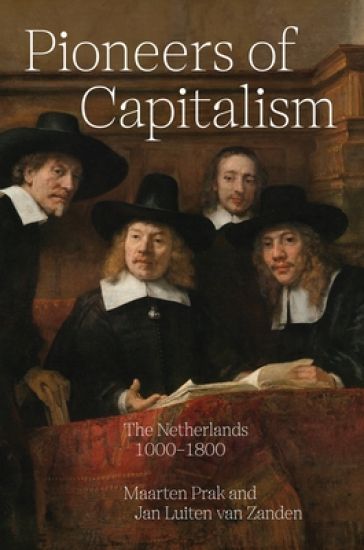
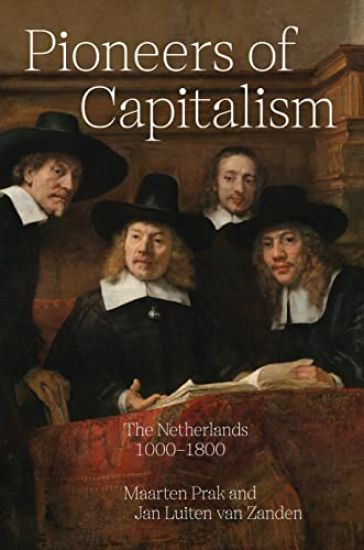
How medieval Dutch society laid the foundations for modern capitalismThe Netherlands was one of the pioneers of capitalism in the Middle Ages, giving rise to the spectacular Dutch Golden Age while ushering in an era of unprecedented, long-term economic growth. Pioneers of Capitalism examines the formal and informal institutions in the Netherlands that made this economic miracle possible, providing a groundbreaking new history of the emergence and early development of capitalism. Drawing on the latest quantitative theories in economic research, Maarten Prak and Jan Luiten van Zanden show how Dutch cities, corporations, guilds, commons, and other private and semipublic organizations provided safeguards for market transactions in the state’s absence. Informal institutions developed in the Netherlands long before the state created public safeguards for economic activity. Prak and van Zanden argue that, in the Netherlands itself, capitalism emerged within a robust civil society that constrained and counterbalanced its centrifugal forces, but that an unrestrained capitalism ruled in the overseas territories. Rather than collapsing under unrestricted greed, the Dutch economy flourished, but prosperity at home came at the price of slavery and other dire consequences for people outside Europe. Pioneers of Capitalism offers a panoramic account of the early history of capitalism, revealing how a small region of medieval Europe transformed itself into a powerhouse of sustained economic growth, and changed the world in the process.
Pioneers of Capitalism

Pioneers of Capitalism

Maarten Prak; Jan Luiten van Zanden

PRINCETON UNIVERSITY PRESS
2022
sidottu
How medieval Dutch society laid the foundations for modern capitalismThe Netherlands was one of the pioneers of capitalism in the Middle Ages, giving rise to the spectacular Dutch Golden Age while ushering in an era of unprecedented, long-term economic growth. Pioneers of Capitalism examines the formal and informal institutions in the Netherlands that made this economic miracle possible, providing a groundbreaking new history of the emergence and early development of capitalism. Drawing on the latest quantitative theories in economic research, Maarten Prak and Jan Luiten van Zanden show how Dutch cities, corporations, guilds, commons, and other private and semipublic organizations provided safeguards for market transactions in the state’s absence. Informal institutions developed in the Netherlands long before the state created public safeguards for economic activity. Prak and van Zanden argue that, in the Netherlands itself, capitalism emerged within a robust civil society that constrained and counterbalanced its centrifugal forces, but that an unrestrained capitalism ruled in the overseas territories. Rather than collapsing under unrestricted greed, the Dutch economy flourished, but prosperity at home came at the price of slavery and other dire consequences for people outside Europe. Pioneers of Capitalism offers a panoramic account of the early history of capitalism, revealing how a small region of medieval Europe transformed itself into a powerhouse of sustained economic growth, and changed the world in the process.
Capital Women

Capital Women

Jan Luiten van Zanden; Sarah Carmichael; Tine De Moor

Oxford University Press Inc
2019
sidottu
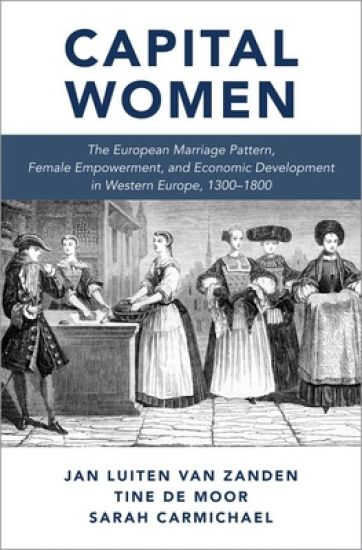
How women increasingly became economic agents in early modern Europe is the focus of this stimulating book, which highlights how female agency was crucial for understanding the development of the Western European economy and sheds light on economic development today. Jan Luiten van Zanden, Tine De Moor and Sarah Carmichael argue that over centuries a "European Marriage Pattern" developed, characterized by high numbers of singles among men and women, high marriage ages among men and women, and neolocality, where the couple forms a new nuclear household and did not co-reside with the parents of either bride or groom. This was due to the influence of the Catholic Church's teachings of marriage based on consensus, the rise of labor markets, and institutions concerning property transfers between generations that enhanced wage labor by women. Over time an unprecedented demographic regime was created and embedded in a highly commercial environment in which households interacted frequently with labor, capital and commodity markets. This was one of the main causes of the gradual move away from a Malthusian state towards an economy able to generate long-term economic growth. The authors explore how the pattern was influenced by and influenced female human capital formation, access to the capital market, and participation in the labor market. They use numerous measures of economic activity, including the unique "Girlpower-Index" that measures the average age at first marriage of women minus the spousal age gap, with higher absolute age at marriage and lower spousal age gap both indicating greater female agency and autonomy. The book also examines how this measure can increase understanding of contemporary dynamics of women and the economy. The authors thus shed light on the degree to which women are allowed to play an influential role in and on the economy and society, which varies greatly from one society to another.
An Economic History of Indonesia

An Economic History of Indonesia

Jan Luiten van Zanden; Daan Marks

Routledge
2014
nidottu
Based on new datasets, this book presents an economic history of Indonesia. It analyses the causes of stagnation of growth during the colonial and independence period, making use of new theoretical insights from institutional economics and new growth theory. The book looks at the major themes of Indonesian history: colonial exploitation and the successes and limitations of the post 1900 welfare policies, the price of instability after 1945, and the economic miracle after 1967. The book not only discusses economic change and development – or the lack thereof – but also the institutional and socio-political structures that were behind these changes. It also presents a lot of new data on the changing welfare of the Indonesian population, on income distribution, and on the functioning of markets for rice, credit and labour. Concluding with a discussion on whether the poor profited from the economic changes, this book is a useful contribution to Southeast Asian Studies and International Economics.
An Economic History of Indonesia

An Economic History of Indonesia

Jan Luiten van Zanden; Daan Marks

Routledge
2012
sidottu
Based on new datasets, this book presents an economic history of Indonesia. It analyses the causes of stagnation of growth during the colonial and independence period, making use of new theoretical insights from institutional economics and new growth theory. The book looks at the major themes of Indonesian history: colonial exploitation and the successes and limitations of the post 1900 welfare policies, the price of instability after 1945, and the economic miracle after 1967. The book not only discusses economic change and development – or the lack thereof – but also the institutional and socio-political structures that were behind these changes. It also presents a lot of new data on the changing welfare of the Indonesian population, on income distribution, and on the functioning of markets for rice, credit and labour. Concluding with a discussion on whether the poor profited from the economic changes, this book is a useful contribution to Southeast Asian Studies and International Economics.
The Strictures of Inheritance

The Strictures of Inheritance

Jan Luiten Van Zanden; Arthur van Riel

Princeton University Press
2004
sidottu
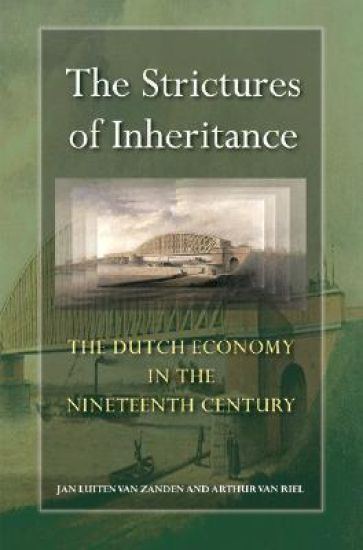
A major feat of research and synthesis, this book presents the first comprehensive history of the Dutch economy in the nineteenth century--an important but poorly understood piece of European economic history. Based on a detailed reconstruction of extensive economic data, the authors account for demise of the Dutch economy's golden age. After showing how institutional factors combined to make the Dutch economy a victim of its own success, the book traces its subsequent emergence as a modern industrial economy. Between 1780 and 1914, the Netherlands went through a double transition. Its economy--which, in the words of Adam Smith, was approaching a "stationary state" in the eighteenth century--entered a process of modern economic growth during the middle decades of the nineteenth. At the same time, the country's sociopolitical structure was undergoing radical transformation as the decentralized polity of the republic gave way to a unitary state. As the authors show, the dramatic transformation of the Dutch political structure was intertwined with equally radical changes in the institutional structure of the economy. The outcome of this dual transition was a rapidly industrializing economy on one side and, on the other, the neocorporatist sociopolitical structure that would characterize the Netherlands in the twentieth century. Analyzing both processes with a focus on institutional change, this book argues that the economic and political development of the Netherlands can be understood only in tandem.