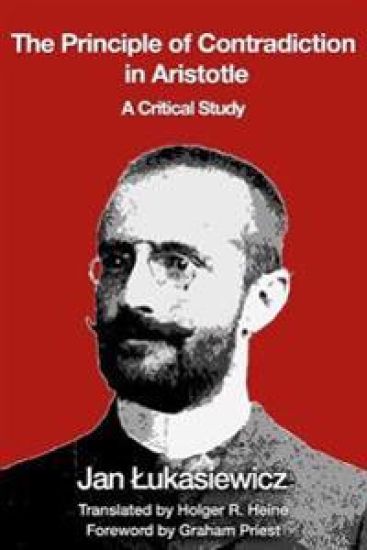
The Principle of Contradiction in Aristotle
Graham Priest; Jan Lukasiewicz
Topos Productions
2021
pokkari
For more than two thousand years, Aristotle's Principle of Non-Contradiction was almost universally accepted as the most certain and best known of all logical and metaphysical principles in Western philosophical thought. Hegel was the first modern philosopher to challenge its validity, but it was not until the emergence of modern analytic philosophy in the late nineteenth and early twentieth century that the truth of the principle became the object of critical analysis and debate. Jan Lukasiewicz' work on Aristotle and the principle of contradiction, first published in 1910, presents one of the first and truly pioneering investigation into the logical and metaphysical foundations of this principle. Lukasiewicz applies the newly developed analytic tools of mathematical logic to Aristotle's seminal defense of the principle in Book IV of the Metaphysics and aims to show that the principle is not nearly as secure as the generally accepted, mostly uncritical, and often dogmatic belief in its universal truth would have it. Lukasiewicz' goal, however, is far more ambitious than a critical analysis of the principle. He wants to develop a revolutionary new logic, a non-Aristotelian logic, a formally constructed logic that does not include or endorse the principle of contradiction in its Aristotelian conception As such, his work on Aristotle and the principle of contradiction marks the first step in his search for a new logic that does not entail the consequence of an all-encompassing logical determinism, a search that saw its first success some ten years later with his development of a three-valued propositional calculus in 1920. Lukasiewicz' approach to the issues surrounding the Aristotelian conception of the principle of contradiction and its modern descendants is both historical and analytical-it is a sustained and methodical effort to think critically and historically about logic and the foundations of logical inference. The arguments and results that Lukasiewicz develops in his metalogical analysis touch on many topics that are still part of a lively and often inconclusive debate that continues to this day.