

Kirjailija
Jan Reed
Kirjat ja teokset yhdessä paikassa: 6 kirjaa, julkaisuja vuosilta 2004–2014, suosituimpiin kuuluu Appreciative Inquiry. Vertaile teosten hintoja ja tarkista saatavuus suomalaisista kirjakaupoista.
6 kirjaa
Kirjojen julkaisuvuodet: 2004–2014.
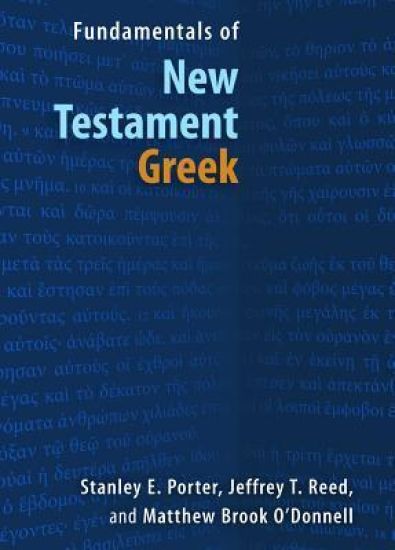
Fundamentals of New Testament Greek
S. Porter; Jan Reed; M. O'Donnell
William B Eerdmans Publishing Co
2010
sidottu
This extremely useful volume is a comprehensive introduction to the grammar and vocabulary of the Greek of the New Testament, with extensive paradigms, examples, and explanations. / Porter, Reed, and O'Donnell's Fundamentals of New Testament Greek makes use of pedagogically sound and linguistically informed language-instruction techniques to provide the most effective textbook possible. The book introduces the individual elements of the Greek language according to their frequency of use in the New Testament so as to reinforce in students the elements that they will most often encounter. Every grammatical element is explained in sufficient detail -- including illustrative examples -- and is accompanied by useful information to describe its composition and analysis. The authors also include complete paradigms with plenty of examples, and significant vocabulary is introduced throughout the course of the volume. / Students who complete this text can engage in serious reading, translation, and understanding of the Greek New Testament, moving directly into Greek exegesis courses and more advanced Greek-language courses. Fundamentals of New Testament Greek: First Year will prove invaluable for gaining a thorough foundational understanding of New Testament Greek. It is bound to be a standard text for years to come.
Appreciative Inquiry: Research for Change is the first book dedicated to exploring appreciative inquiry (AI) as an approach to change-focused research. More than ever, students and researchers seek to do more than report on what they see following a research study or project, but rather engage the research environment (participants, stakeholders) to promote change. In other words, their studies are as much research-based as they are meant to initiate or sustain social or organizational change. Very often, the nature of this dual purpose - research and change - requires the researcher to use nontraditional approaches that bridge the theory-practice gap. In this book, author Jan Reed draws on the work of David Cooperrider and other pioneers in the area of AI to bridge the current gap between consulting activity and academic research in AI. The book begins with real-world, international insights and experiences of AI as a research methodology and offers the history and principles of AI. Next, it provides ways of linking and differentiating these activities and exploring the range of ways to engage AI in change-focused research and practice - from research question and research design through data collection, data analysis, interpretation, and dissemination of findings. And perhaps most importantly, the book places AI in the context of other research paradigms and approaches, addressing positivist versus naturalistic stances, social constructionist concepts, and related methods and methodologies such as action research, PAR, ethnography, case studies, and narrative inquiry. This book is appropriate for use in graduate-level methods courses devoted to appreciative inquiry, change- or community-based research, organizational development and change, and related topics across the social sciences, education, and management. It will also prove invaluable to researchers and professionals who are interested in using AI but need to know how to frame this approach within the greater context of traditional research. Key Features:Comprehensive introduction to Appreciative Inquiry (AI) and the range of debates that it can generate for a researcher or professional used to employing otherwise traditional research modelsInternational examples from recent published and unpublished projects in which AI was used, with an emphasis on those that shaped policy, planning, and future practicesDiscussion and guidance on how to make the connections between AI and various research paradigms and approaches to research, including positivist versus naturalistic research, social constructionist concepts, action research PAR, ethnography, narrative inquiry, and case studiesAn assessment of the strengths and limitations of AI in research environmentsPractical guidance and ideas for generating different research questions, managing, organizing, and analyzing data, and communicating and disseminating the final results Individual and group exercises that draw on organizational development techniques as a way to bring AI concepts to life through practice.
Appreciative Inquiry: Research for Change is the first book dedicated to exploring appreciative inquiry (AI) as an approach to change-focused research. More than ever, students and researchers seek to do more than report on what they see following a research study or project, but rather engage the research environment (participants, stakeholders) to promote change. In other words, their studies are as much research-based as they are meant to initiate or sustain social or organizational change. Very often, the nature of this dual purpose - research and change - requires the researcher to use nontraditional approaches that bridge the theory-practice gap. In this book, author Jan Reed draws on the work of David Cooperrider and other pioneers in the area of AI to bridge the current gap between consulting activity and academic research in AI. The book begins with real-world, international insights and experiences of AI as a research methodology and offers the history and principles of AI. Next, it provides ways of linking and differentiating these activities and exploring the range of ways to engage AI in change-focused research and practice - from research question and research design through data collection, data analysis, interpretation, and dissemination of findings. And perhaps most importantly, the book places AI in the context of other research paradigms and approaches, addressing positivist versus naturalistic stances, social constructionist concepts, and related methods and methodologies such as action research, PAR, ethnography, case studies, and narrative inquiry. This book is appropriate for use in graduate-level methods courses devoted to appreciative inquiry, change- or community-based research, organizational development and change, and related topics across the social sciences, education, and management. It will also prove invaluable to researchers and professionals who are interested in using AI but need to know how to frame this approach within the greater context of traditional research. Key Features:Comprehensive introduction to Appreciative Inquiry (AI) and the range of debates that it can generate for a researcher or professional used to employing otherwise traditional research modelsInternational examples from recent published and unpublished projects in which AI was used, with an emphasis on those that shaped policy, planning, and future practicesDiscussion and guidance on how to make the connections between AI and various research paradigms and approaches to research, including positivist versus naturalistic research, social constructionist concepts, action research PAR, ethnography, narrative inquiry, and case studiesAn assessment of the strengths and limitations of AI in research environmentsPractical guidance and ideas for generating different research questions, managing, organizing, and analyzing data, and communicating and disseminating the final results Individual and group exercises that draw on organizational development techniques as a way to bring AI concepts to life through practice.

Health, well-being and older people
Jan Reed; David Stanley; Charlotte Clarke
Policy Press
2004
nidottu
In an ageing society, the health and well-being of older people has become a primary focus of concern for government, policy makers and practitioners. With moves towards greater integration of health and social care services, there is a need for improved understanding of the importance and benefits of a person-centred, holistic approach to work in these fields. This accessible text, the produce of a collaborative venture between older people's groups and academics, provides students, academics and practitioners across a wide range of health and social care professions, including, nursing, social work, social care and gerontology, with a guide to understanding the value of this approach.
Health, well-being and older people
Jan Reed; David Stanley; Clarke Charlotte
Policy Press
2004
sidottu
In an ageing society, the health and well-being of older people has become a primary focus of concern for government, policy makers and practitioners. With moves towards greater integration of health and social care services, there is a need for improved understanding of the importance and benefits of a person-centred, holistic approach to work in these fields. This accessible text, the produce of a collaborative venture between older people's groups and academics, provides students, academics and practitioners across a wide range of health and social care professions, including, nursing, social work, social care and gerontology, with a guide to understanding the value of this approach.