Kirjojen hintavertailu – 12 859 829 kirjaa ja 27 kauppaa

Kirjailija

Jan Tomasz Gross

Kirjat ja teokset yhdessä paikassa: 3 kirjaa, julkaisuja vuosilta 2014–2025, suosituimpiin kuuluu Collected Essays on War, Holocaust and the Crisis of Communism. Vertaile teosten hintoja ja tarkista saatavuus suomalaisista kirjakaupoista.

3 kirjaa

Kirjojen julkaisuvuodet: 2014–2025.

Sosedi

Sosedi

Jan Tomasz Gross

ISIA Media Verlag
2025
pokkari
V nachale ijulja 1941 goda, v pervye nedeli nemeckoj okkupacii Vostochnoj Pol'shi, pered jetim anneksirovannoj SSSR, prokatilis' strashnye evrejskie pogromy, uchinennye ne nemcami, a poljakami. Samyj zverskij pogrom sluchilsja 10 ijuljav gorodke Edvabno: ego pol'skie zhiteli sognali v saraj i sozhgli zhiv'em sotni svoih sosedej-evreev. Dolgie gody jeto sobytie ostavalos' prikrytym plotnoj dvojnoj zavesoj - iz molchanija i umolchanija. Jetu zavesu polnost'ju snjala kniga Jana Tomasha Grossa Sosedi. Istorija unichtozhenija evrejskogo mestechka, vyshedshaja v mae 2000 goda na pol'skom jazyke. Avtor - pol'sko-amerikanskij istorik i sociolog, specialist ne stol'ko po Holokostu, skol'ko po vostochno-evropejskoj istorii. Knigu prochla vsja Pol'sha, ona srazu zhe i raskolola pol'skoe obshhestvo, privykshee k vozvyshennomu obrazu svoej strany kak Hrista narodov. Poljaki ispytali ot Sosedej takoj ozhog i takoj bolevoj shok, kakogo oni do jetogo ne ispytyvali nikogda. Knigu soprovozhdajut tri posleslovija, napisannyh istorikom Pavlom Poljanom. Pervoe posvjashheno istorii tak nazyvaemyh vostochnyh kresov - geograficheskogo areala, k kotoromu prinadlezhit i Edvabno. Vtoroe - sobstvenno knige Jana Grossa - jetojknige-ozhogu - i tomu gigantskomu rezonansu, kotoryj ona vyzvala. I tret'e - drugim proizvedenijam v jetom svoeobraznom zhanre proizvedenija-ozhoga. Kniga prednaznachena dlja shirokogo kruga chitatelej, interesujushhihsja istoriej Vtoroj mirovoj vojny, istoriej Holokosta i istoriej Pol'shi. Jan Tomash Gross (Jan Tomasz Gross) - amerikanskij istorik, sociolog i politolog pol'skogo proishozhdenija Poljan Pavel Markovich - professor, doktor geograficheskih nauk, vedushhij nauchnyj sotrudnik Instituta geografii Rossijskoj akademii nauk, vedushhij jekspert Mandel'shtamovskogo centra Nauchno-issledovatel'skogo universiteta Vysshaja shkola jekonomiki
Golden Harvest

Golden Harvest

Jan Tomasz Gross; Irena Grudzinska Gross

Oxford University Press Inc
2016
nidottu
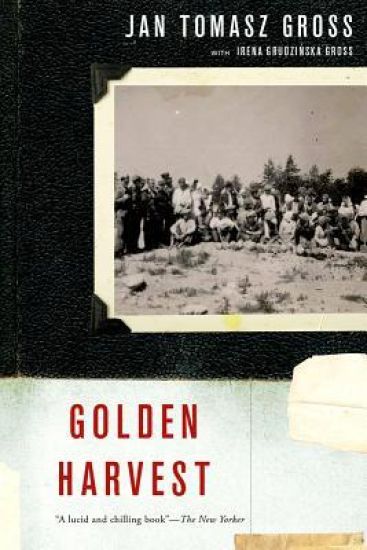
It seems at first commonplace: a group photograph of peasants at harvest time, after hard work well done, resting contentedly with their tools behind the fruits of their labor. But when one finally notices the "crops" scattered in front of the group, what seemed innocent on first view become horrific skulls and bones. Where are we? Who are the people in the photograph, and what are they doing? The starting point of Jan Tomasz and Irena Grudzinska Gross's Golden Harvest, this haunting photograph in fact depicts a group of peasants--"diggers"--atop a mountain of ashes at Treblinka, where some 800,000 Jews were gassed and cremated. The diggers are searching for gold and precious stones that Nazi executioners may have overlooked. The story captured in this grainy black-and-white photograph symbolizes the vast, continent-wide plunder of Jewish wealth that went hand-in-hand with the Holocaust. The seizure of Jewish assets during World War II occasionally generates widespread attention when Swiss banks are challenged to produce lists of dormant accounts, or national museums are forced to return stolen paintings. But the theft of Europe's Jewish population was not limited to conquering armies, leading banks, or museums. It was perpetrated also by local people, such as those pictured in the photograph. Lyrical and often heartbreaking, A Golden Harvest takes readers across Europe as it exposes the economic ravaging of an entire society. Beginning with a simple group shot, the authors have written a moving book that evokes the depth and range, as well as the intimacy, of the Final Solution.
Collected Essays on War, Holocaust and the Crisis of Communism
The author undertakes an intellectual journey into the hidden past of the Polish history after 1939. He deals with Holocaust, collaboration, totalitarian rule, crisis of communism in Eastern Europe as well as Polish-Jewish relations during the war. The author is a founding father of a new approach in Holocaust research in Poland in which he has taken it from out of its intellectual ghetto as a strictly Jewish subject and repositioned it at the center of Poland’s wartime history. Among other topics, the collection of essays deals with Jewish community in the Soviet annexed territories on the eve of the Holocaust, opportunistic killings and plunder of Jews by their neighbors and Poland’s development from a civil society to a political nation.